


As the Voyager spacecraft continue their journey through interstellar space, Australians are being offered a unique opportunity to send their own messages into the cosmos. This initiative marks the 50th anniversary of the Voyager project, which first launched in 1977. The spacecraft, now over 20 billion kilometers from Earth, carry the iconic Golden Record, a gold-plated copper phonograph disk designed to introduce the human race to potential extraterrestrial beings.
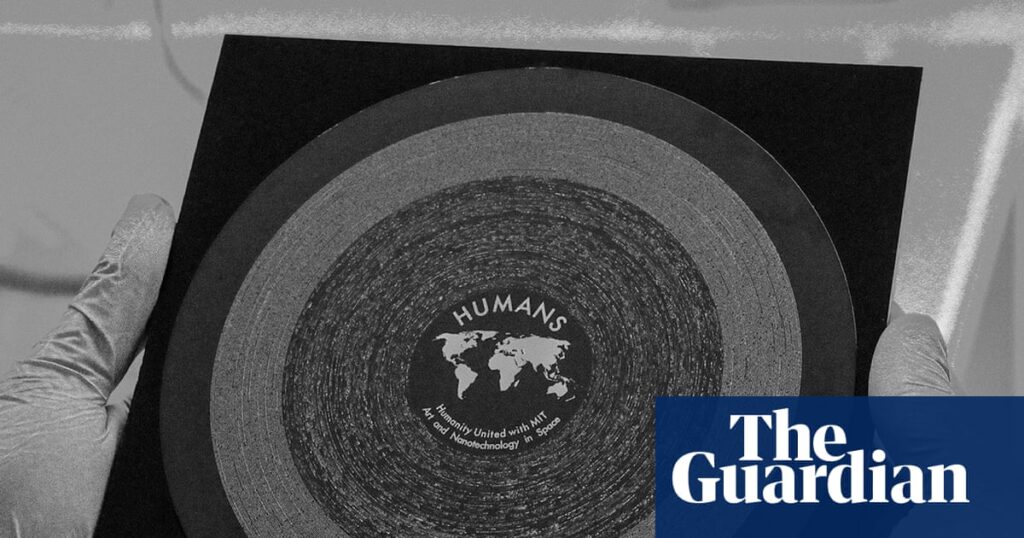
The Golden Record includes spoken greetings in 55 languages and music from various cultures, including two songs from the Yolngu people, traditional owners of Arnhem Land. The record’s cover provides instructions on how to play it, a pulsar star map to locate our solar system, and a guide to the time of the craft’s launch. Almost five decades later, Australians have the chance to contribute their own messages through the Humanity United with MIT Art and Nanotechnology in Space (HUMANS) Deep Space Message project, in collaboration with Sydney’s Powerhouse Museum.
Contributing to the Cosmic Dialogue
More than 1,700 individuals have already participated in the project, which invites people to answer the question: “What would you like the universe to remember about our story on Earth?” Participants have until February 27 to record their messages, which will be sent into deep space. The project has previously launched messages to the International Space Station and the moon, but this endeavor will coincide with the Voyagers’ 50th anniversary.
Messages vary from simple greetings to philosophical reflections. One participant, a nine-year-old, shared, “Hello friends in space, I’m nine years old and I live on Earth. I love looking at the stars at night and imagining who might be out there.” Another message humorously notes, “Humans are mostly harmless, however people eat pineapple on pizza. Don’t judge.”
A Democratic Approach to Space Messaging
The original Golden Record was curated by a committee chaired by renowned scientist Carl Sagan. In contrast, the HUMANS project takes a more democratic approach, allowing a broader spectrum of voices to be heard. Lisa Havilah, the CEO of the Powerhouse Museum, emphasizes the project’s focus on human connection. “It makes you focus on what it is about me, my world, and my place in the world that you want to tell about humans and human life,” she explains.
Dr. Maya Nasr, a Harvard University science engineer and the project lead, collaborated with MIT researchers to develop the silicone nano wafer that will carry the audio. She describes the messages as “really, deeply human,” covering themes such as love, identity, culture, and the essence of everyday life on Earth.
“The Golden Record was always an outward gesture of who we were in the 1970s to extraterrestrials, if they existed,” Nasr says. “And HUMANS was really inspired by that legacy, but what we really want is to be an inward reflection of who we are, and to connect people through that.”
Reflecting on Humanity’s Place in the Universe
Dr. Nasr believes the project serves as a reminder of humanity’s shared story, especially in a world that often feels fragmented. She notes that the act of contemplating our message to the universe can enhance our awareness of Earth’s fragility and rarity. “The silence of the universe kind of asks us more about who we are, when no one answers back,” she reflects.
Despite the vastness of space, Nasr holds hope for extraterrestrial life. “It would be really extraordinary if life only existed once,” she says. “I think it’s really hard to believe that we’re the only experiment that life ever tried.”
In her own message, recorded in Arabic, Nasr captures the essence of human contradiction and resilience. She states, “I would like the universe to remember that we carried contradictions within us while searching for meaning. That we were human beings who dreamed, made mistakes, loved, and created memories.”
As the deadline for submissions approaches, the project invites Australians to consider what they wish to communicate to the universe. Whether playful or profound, each message contributes to a collective narrative that may one day reach distant worlds, echoing the hopes and dreams of a small planet in the vast cosmos.