



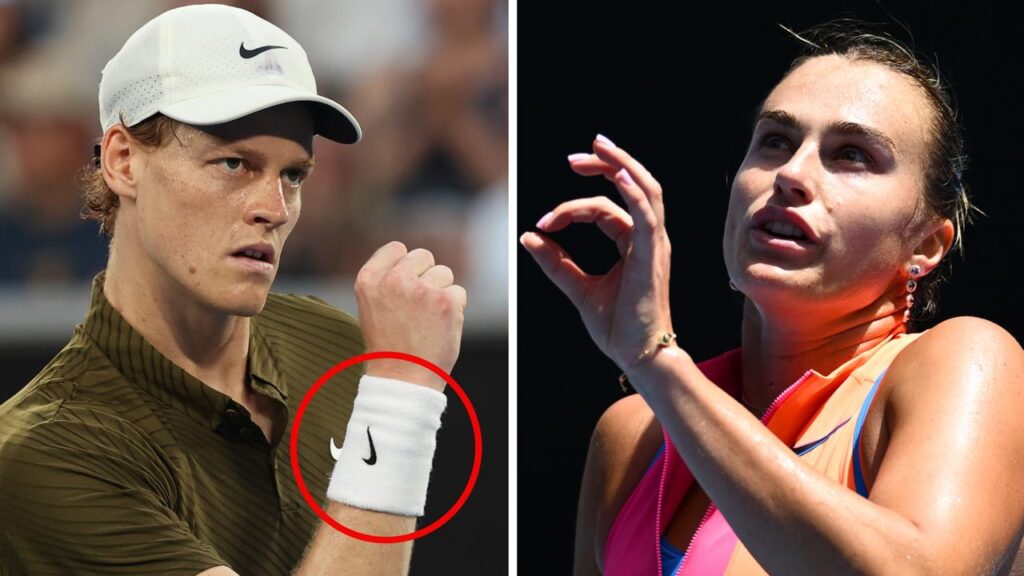
The Australian Open’s ongoing tussle with athlete technology has intensified in the second week of the Grand Slam, following a discreet maneuver by World No. 2 Jannik Sinner. Just before his fourth-round match against fellow Italian Luciano Darderi on Monday evening, Sinner was instructed by the chair umpire to remove a WHOOP device concealed beneath his sweatband.
The 24-year-old complied without protest, mere hours after tennis superstar Carlos Alcaraz faced a similar directive. Earlier in the tournament, Women’s World No. 1 Aryna Sabalenka was also asked to discard the technology, which tracks continuous health metrics such as sleep, strain, and recovery, aiming to optimize athletic performance.
Technology in Tennis: A Divisive Issue
The ATP, which oversees the men’s tennis tour but not Grand Slam events, has permitted the use of such technology in matches since 2024. Meanwhile, the WTA has allowed female players to wear them since 2021. However, the Grand Slam tournaments, governed by the International Tennis Federation (ITF), have not embraced this change.
In a statement to foxsports.com.au, WHOOP criticized the prohibition of their device in Grand Slam events, arguing that it impedes athletes’ rights to access their health data.
“WHOOP believes athletes have a fundamental right to understand their own performance and health — including during competition at events like the Australian Open,” the statement read. “WHOOP is approved by the International Tennis Federation for in-match wear and poses no safety, fairness, or competitive risk. Blocking access to personal health data does not protect sport. WHOOP will continue to stand with athletes and our members to defend their right to their data.”
WHOOP’s Global Influence
Valued at $3.6 billion as of August 2021, WHOOP is a staple among high-profile athletes worldwide across various sports. Despite the ban, Sinner’s performance remained unaffected as he triumphed 6-1, 6-3, 7-6 (7-2) in a two-hour and nine-minute match at Margaret Court Arena.
In a post-match press conference, Sinner discussed his interaction with the chair umpire and explained his preference against alternative tracking devices.
“The umpire asked me straight away if this was a tracker. I said: ‘Yes’, he said: ‘Remove’. It’s fine,” Sinner stated. “There are other things we could use … (like) the vest, but it’s a bit uncomfortable for me. You feel like you have something on your shoulders and it’s a bit different.”
Voices from the Tennis Community
Former Australian tennis player John Millman, along with other former players, expressed frustration over tennis’s slow adaptation to technological advancements in major tournaments.
“I think it’s ridiculous,” Millman told Nine on Tuesday. “The ITF have been caught sleeping, on their back foot. They haven’t got up to date with it all. It’s ATP and WTA approved as long as the haptic feedback (vibrations) are turned off. I think the ITF have been falling asleep.”
This development follows a broader conversation in sports about the integration of technology and the balance between tradition and innovation. As players increasingly seek data-driven insights to enhance their performance, the debate over devices like WHOOP is likely to continue.
Looking Ahead
The controversy at the Australian Open highlights a growing tension between athletes’ desire for technological tools and the governing bodies’ cautious approach to change. As the tennis world grapples with these issues, the outcome could set a precedent for other sports grappling with similar technological integrations.
Meanwhile, as the tournament progresses, the focus remains on the athletes and their performances, with technology playing a silent yet significant role in the background. The conversation around WHOOP and similar devices will undoubtedly persist, potentially influencing future policy decisions in tennis and beyond.