




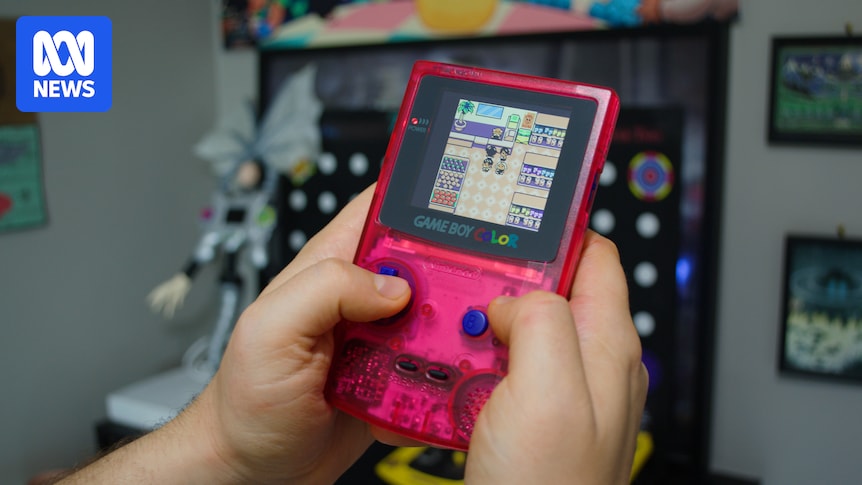
Orlando Mee, a multimedia artist based on South Australia’s Yorke Peninsula, has found a unique niche in game development by creating new games for the classic Game Boy console. Initially, Mee did not set out to become a game developer. His journey began as part of his art practice, where he experimented with interactivity using cheap electronics from discount stores for an exhibition called “Draining The Ocean.”
“I work with lots of different weird technology and I was looking for a way to program interactive objects that I made using pieces of kind of plastic junk that you might buy at a two-dollar shop,” Mee explains. By replacing the existing electronics with a small computer equipped with a screen and buttons, he discovered that the easiest way to program lights, sounds, and interactivity was to incorporate a small game. The Game Boy became the medium of choice.
Using GB Studio, a free software designed for creating Game Boy games, Mee began building tiny games to embed within his artworks. Now, he is developing a new strategy game for the 28-year-old Game Boy Color console, integrating elements of board games and his Anglo-Indian heritage. “Before it was even a video game, I thought of it as part of my arts practice where I was trying to explore my Indian heritage, and paying tribute to the often forgotten contribution of India to the world of tabletop games,” Mee says.
Reviving Retro Gaming
The Game Boy, originally released in 1989, featured a simple monochromatic screen with a resolution of just 160 by 140 pixels and 16 kilobytes of memory. Despite its limited specifications, the console became a favorite worldwide due to its affordability and portability. Nintendo sold approximately 118 million units globally, solidifying the Game Boy’s place in the thriving retro gaming scene.
During the COVID-19 lockdowns, the resale of retro games and consoles surged, leading many to rediscover these vintage devices. Melbourne’s Tom Lockwood, known by his pseudonym Gumpy Function, is another Australian developer creating new games for the Game Boy. Lockwood, who began making games during the pandemic, appreciates the creative constraints imposed by the console’s limitations.
“The first console I had was the Nintendo and the original Game Boy, and I’ve always been drawn to the more pick-up-and-play; retro games have always been very arcadey or gameplay-dense,” Lockwood says. He started developing games after becoming a stay-at-home dad, leveraging the simpler designs of Game Boy games for quicker iterations.
“I was just kind of drawn to this process, I can only fit so much information in this scene, given that it’s Game Boy RAM,” Lockwood notes.
Creative Constraints and New Opportunities
Lockwood, who has ADHD, finds the short design and development cycles of Game Boy games ideal. “I think the reason why, specifically, Game Boy development has been so good for me is because it’s quick turnover, you can make games kind of quickly,” he explains. Lockwood has become one of the most prolific Game Boy developers, releasing multiple titles, including the viral “Grimace’s Birthday,” part of a marketing campaign for McDonald’s.
New games are often released as downloadable ROM files, playable on specialized cartridges on the original Game Boy hardware or through software emulators. This approach allows developers to reach both nostalgic gamers and new audiences.
Nostalgia Meets Innovation
Mee’s game, “Yakshini Lokam,” uses the nostalgic designs of Game Boy games, asking the hypothetical question, “What if the cultural hub of a generation of games was set somewhere else?” By incorporating Indian cultural elements, Mee experiments with established Game Boy game rules from Japan, Europe, and the USA.
“A lot of the color choice in the game feels quite unusual to a Western audience that’s maybe more familiar with knights and dragons type fantasy,” Mee says.
The game features color schemes inspired by Indian art, history, and architecture, using bright colors like bold pinks and turquoises. These design choices offer a fresh perspective on a beloved gaming platform, highlighting the enduring appeal and versatility of the Game Boy console.
As developers like Mee and Lockwood continue to innovate within the constraints of retro gaming technology, they breathe new life into classic consoles, proving that creativity knows no bounds—even in a world dominated by cutting-edge graphics and complex gameplay mechanics.