




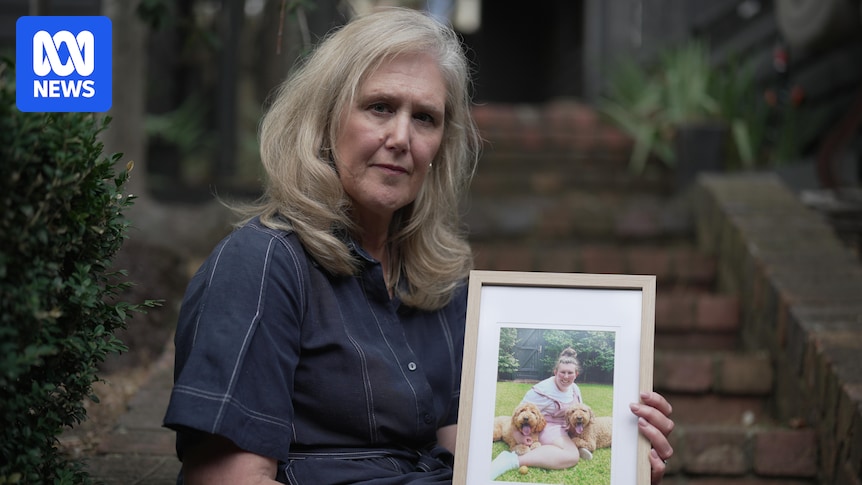
Reminders of Alison Collins’s late daughter Erin fill the Melbourne home they once shared. From the family’s loyal groodle Harper, who brought Erin much comfort, to the Lego masterpieces carefully constructed and proudly displayed, Alison is careful not to let any memories fade, even the most painful ones that are much harder to confront. Less than six months ago, 24-year-old Erin died from an overdose.
On medication for mental health issues, Erin had begun “doctor shopping,” convincing multiple telehealth providers she needed large quantities of her medication and stockpiling it over time. Those telehealth doctors were unaware of the complexities of Erin’s condition or that her regular treating team had arranged for her to pick up a controlled dose of the medication from the local pharmacy each day.
They also had no idea Erin had been in hospital several times last year, requiring critical care for medication misuse, and were not checking or updating her My Health Record — the digital system that stores patient information, including scripts.
“Her hospital team was putting warning messages in My Health Record in the hope that the telehealth services and local pharmacies would be able to see those records and stop dispensing … [but] they weren’t being seen,” Ms. Collins said.
Government Response to a Tragic Loss
Although the grief is still raw, Alison has turned an unthinkable loss into a rallying cry for action. For months, she has been campaigning for a national alert system so health professionals can detect potential medication abuse. Her cause has now caught the attention of the highest level of government, with federal Health Minister Mark Butler vowing to introduce sweeping changes.
“I was really impacted by Alison’s story and her willingness really to channel what is extraordinary grief into advocacy for a system that’s better for people into the future,” he said.
The federal government will move to force prescribers to record all medicines-related information under a new National Medicines Record that is accessible for patients and their doctors. It plans to use existing legislation to establish the new rules, which would focus particularly on private online prescribers.
Balancing Patient Safety and Privacy
The plan is still in its early stages, with the federal government promising $4.4 million to get the system off the ground. A consultation period is underway, with the health department working with providers and medical and IT experts to discuss how to set up a system that accurately and promptly records all medicines.
The government anticipates the National Medicines Record would become an overarching prescription monitoring system, which would be linked to a patient’s My Health Record. Currently, healthcare providers can access prescription history and medications through My Health Record, but patients can hide or remove specific documents or opt out of the program entirely.
There were also serious security and privacy concerns during the beleaguered My Health Record rollout, with its default mode of presuming consent to record sensitive medical information criticized by multiple experts. Like that rollout, one of the challenges with creating an overarching national medicines database will be striking the delicate balance between patient safety and privacy, and Mr. Butler says the consultation period will consider that and other complexities over the course of this year.
“Ultimately this is all about patient consent and we want obviously patients consenting to their information being recorded on the record and then the record being available to health professionals that they allow to access the record,” he said. “We’re confident that will work in the vast, vast majority of cases. But we’ve got to make sure that technology is available, first to the patient, but also to the medical professional.”
Expert Opinions and Future Implications
The government says the 1800Medicare App — where patients can currently access their prescription history through My Health Record — will also be enhanced in the process. Royal Australian College of General Practitioners (RACGP) president Michael Wright said a national medicines record was “a really sensible move” that was “overdue” and would prevent the fragmentation of care.
“If people are seeing multiple providers, there’s a risk that information either isn’t shared or gets lost, and we can see tragic circumstances happen,” Dr. Wright said.
Dr. Wright noted that many GP practices had software that automatically uploaded electronic scripts, but some online providers were not following the same process. “There’s [also] information that’s gathered by hospitals and other medical specialists that doesn’t get routinely added,” he said.
Australia has a digital Real Time Prescription Monitoring system, which records high-risk medications like opioids, but Dr. Wright said a broader system was needed to record all medications.
“It doesn’t have to be a high-risk medication for there to be a serious consequence … there are so many medications and so many side effects.”
Alison Collins believes a National Medicines Record could have saved her daughter.
“If these measures were in place with Erin and for us to support her, I believe that our situation would have been very different,” she said. While it is too late for her, she has taken comfort that her own tragedy could potentially prevent others. “That will save other families going through this same heartbreak.”