




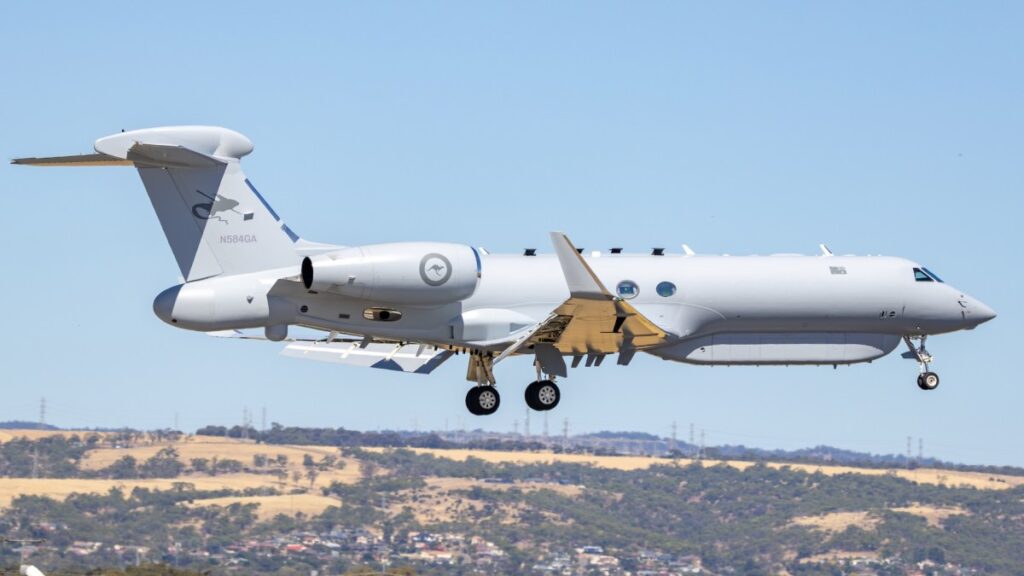
Australia has reached a significant milestone in its ambitious plan to modernize its air force with the arrival of the first MC-55A Peregrine. This advanced platform, designed for “airborne intelligence, surveillance, reconnaissance, and electronic warfare” (AISREW), landed at RAAF Base Edinburgh in South Australia, marking a new era in the Royal Australian Air Force’s (RAAF) operational capabilities.
The aircraft, a highly modified version of the Gulfstream G550 business jet, is the first of four on order. It touched down today at 3:53 p.m. local time after a complex delivery journey from the L3Harris facility in Greenville, Texas, with stops at several U.S. military bases and Pacific islands.
Strategic Acquisition and Capabilities
The acquisition of the MC-55A Peregrine is part of Australia’s broader strategy to enhance its defense capabilities. In 2017, the U.S. State Department approved the sale of up to five of these modified jets to Australia, and by 2019, the AISREW program was officially announced with a $1.6 billion investment under Project AIR 555.
The MC-55A boasts a comprehensive suite of sensors, including numerous antennas and a distinctive belly ‘canoe’ and tail cone, which house additional sensors. These features enable the aircraft to perform a variety of missions, from electronic warfare (EW) to signals intelligence (SIGINT) and intelligence, surveillance, and reconnaissance (ISR).
“The MC-55A is intended to serve as a multirole aircraft, encompassing functions traditionally spread across multiple platforms,” said a defense analyst familiar with the program.
Integration into Australia’s Defense Network
One of the key roles of the MC-55A is to act as a networking relay and data-fusion platform within Australia’s joint warfighting network. This capability allows it to link various assets, including the F-35A, E-7A Wedgetail, and EA-18G Growler aircraft, as well as naval and ground forces.
The aircraft’s ability to create an ‘active net’ across the battlespace is akin to the U.S. Air Force’s E-11A Battlefield Airborne Communications Node (BACN). This function is crucial for maintaining connectivity and information flow in complex operational environments.
Technological Advancements and Collaborations
The MC-55A’s design reflects significant advancements in miniaturization and sensor technology. L3Harris Technologies, responsible for integrating the mission systems, has equipped the aircraft with powerful sensors and high-bandwidth satellite datalinks, enabling near real-time data transmission.
While specific sensor details remain classified, the aircraft’s design suggests capabilities for both passive intelligence collection and active electronic warfare. This flexibility makes the MC-55A a valuable asset in modern warfare, where electronic and cyber capabilities are increasingly critical.
Regional Implications and Future Prospects
With growing tensions in the Indo-Pacific region, particularly involving China’s military activities, the MC-55A is expected to play a crucial role in surveillance and intelligence-gathering operations. Its deployment to strategic locations, including the Cocos (Keeling) Islands, enhances Australia’s ability to monitor regional developments.
As Australia continues to pioneer in electronic warfare and ISR capabilities, the MC-55A’s introduction is a testament to the country’s commitment to maintaining a cutting-edge defense posture. The RAAF’s integration of Collaborative Combat Aircraft (CCA) and the potential for future acquisitions of additional MC-55As underscore this strategic focus.
“The MC-55A Peregrine represents a significant leap forward in our air force’s operational capabilities,” stated a senior RAAF official. “It will enhance our ability to operate effectively in the modern battlespace.”
As the RAAF prepares to integrate the MC-55A into its fleet, the aircraft is poised to become a cornerstone of Australia’s defense strategy, ensuring the nation remains at the forefront of military technology and operational readiness.