

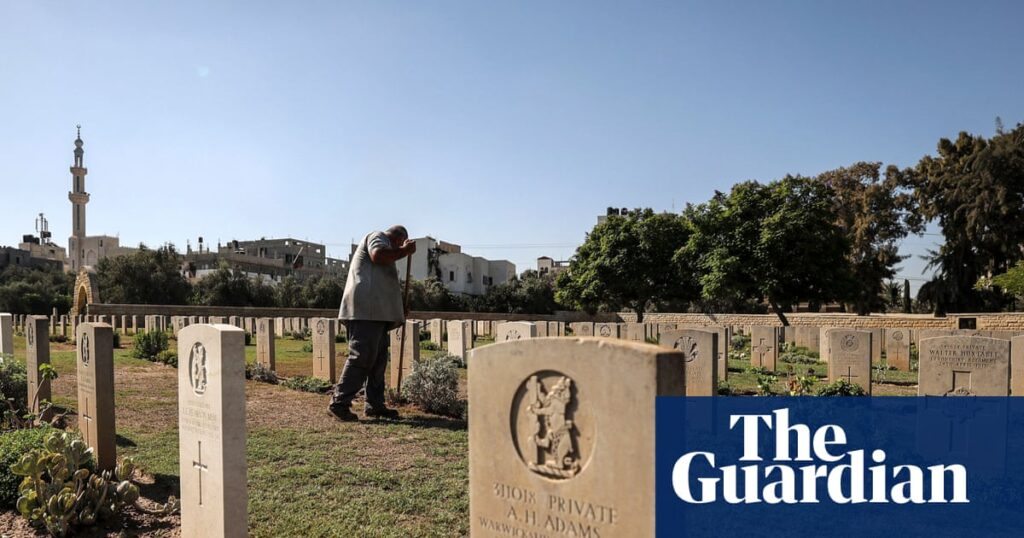
The Australian government has committed to restoring the graves of Australian soldiers in Gaza after recent satellite imagery and eyewitness accounts revealed that the Israel Defense Forces (IDF) had bulldozed parts of the Commonwealth war cemetery. However, access to the site may be delayed for months or even years due to the ongoing conflict in the region.
More than 250 Australian soldiers, primarily light horsemen from World War I, are buried at the Gaza War Cemetery. While the majority of graves in the cemetery are British, the most severe damage has occurred in a section housing Australian graves from World War II. The Tuffah area of Gaza City, where the cemetery is located, has been heavily shelled during the current conflict. Systematic and extensive damage from military earthmoving activities has been observed in the southern corner of the cemetery over the past year.
Extent of Damage and Immediate Concerns
Satellite images reveal that rows of gravestones have been removed, and the soil has been significantly disturbed in sections A and B of the cemetery, which contain the graves of Australian soldiers from World War II. A substantial earth berm is visible, bisecting the disturbed area. A spokesperson for Australia’s Department of Veterans’ Affairs confirmed the “significant damage” to the cemetery, including Australian graves.
“The Office of Australian War Graves is very concerned by the damage to the cemetery and Australian war graves. We remain committed to ensuring the restoration of all affected graves as soon as feasible,” the spokesperson stated.
The Commonwealth War Graves Commission has expressed its intention to secure and repair the cemetery once it is safe, although full reconstruction may take some time due to immediate post-conflict humanitarian priorities.
Reactions and Historical Context
Peter Tinley, national president of the Returned & Services League of Australia, emphasized the importance of maintaining the graves. “Commonwealth War Graves represent a solemn covenant between the nation and those who served,” he said, adding that the organization would work with authorities to ensure the restoration of Australian graves in Gaza.
Essam Jarada, the former caretaker of the Gaza cemetery, recounted two bulldozing operations in April and May 2025. “The first bulldozing occurred outside the cemetery walls, extending approximately 12 meters around all sides,” he explained, noting that later operations affected the graves of Australian soldiers within the cemetery walls.
“I witnessed this bulldozing after the Israeli army withdrew from the area, around late April or early May,” Jarada said.
The IDF stated that the area was an active combat zone at the time, necessitating defensive measures. “During IDF operations, terrorists attempted to attack IDF troops and took cover in structures close to the cemetery,” an army spokesperson noted, emphasizing that operational measures were taken to neutralize threats.
Expert Opinions and Broader Implications
Military historian Prof. Peter Stanley from the University of NSW Canberra highlighted the emotional significance of the Gaza cemetery for Australians. “The Gaza cemetery is as valued and as cared for as any cemetery in the world,” he remarked, stressing the importance of maintaining these sacred sites despite the ongoing conflict.
“For Australians, a serious consequence of this conflict is the desecration of the graves of Australian soldiers. That might not be major in the global scheme of things, but it is definitely something Australians should be concerned about,” Stanley said.
Stanley also drew parallels with other historical conflicts where Commonwealth war graves have been damaged, such as in Iraq during the Iran-Iraq War and the US-led invasion in 2003. He noted that while graves can be repaired, the respect and equitable treatment of those who died in war remain paramount.
Future Steps and Ongoing Challenges
The Commonwealth War Graves Commission has expressed deep concern over the extensive damage to the Gaza cemetery, which includes headstones, memorials, and boundary walls. The ongoing conflict poses a continued risk of further destruction, and access to Gaza remains restricted.
“It is unlikely we will be able to enter Gaza for some time and are not able to protect the sites from further damage,” the commission stated.
As Australia and international bodies navigate the complexities of the conflict, the restoration of the Gaza War Cemetery remains a poignant symbol of the broader humanitarian and historical challenges faced in the region. The commitment to repair these graves underscores the enduring respect for those who served and the importance of preserving historical memory amidst ongoing turmoil.