



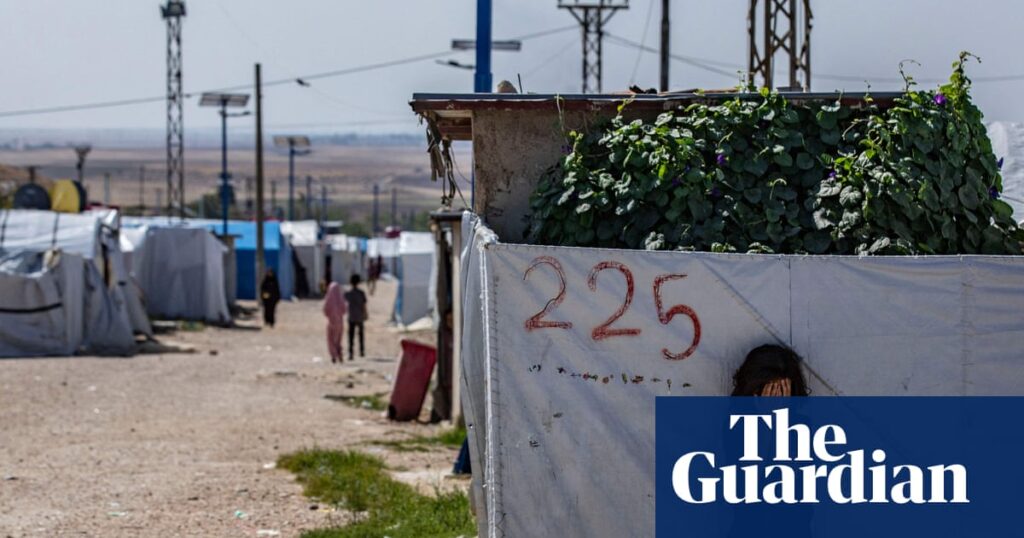
Australian children held in increasingly “militarised” displacement camps in north-east Syria have been warned they will be shot if they attempt to breach the fence line. This alarming situation arises as Australia continues to refuse issuing its citizens passports necessary for repatriation, despite warnings from the United States that leaving them there “compounds risk to all of us.”
The U.S. has offered assistance to bring Australians out of the camps, contingent upon the issuance of travel documents or passports—a condition Australia has yet to meet. The U.S. government has consistently advocated for the closure of these camps, urging all countries to repatriate their citizens. They argue that leaving women and children in Syrian camps increases their vulnerability to radicalization and heightens the risk of an Islamic State resurgence.
Conditions in the Camps
There are fewer than 40 Australians, primarily young children, held in two detention camps in north-east Syria. These individuals are the wives, widows, and children of deceased or incarcerated Islamic State fighters. Most have been detained in the Roj camp near the Turkish border since 2019. Reports indicate that there are 12 Australian women and between 22 and 25 Australian children in Roj, with some children born in the camp.
The Australians in these camps have not been charged with crimes and do not face arrest warrants, though they could potentially face charges upon returning to Australia. In June, Home Affairs Minister Tony Burke met with Save the Children CEO Mat Tinkler and advocate Kamalle Dabboussy, discussing the deteriorating conditions within the camps.
“The camps are becoming more militarised, intrusive, and securitised. The kids are being weaponised against their mothers ie if they go beyond the fence lines they will be shot.” – Notes from a meeting with government officials
Sources within the camps confirm that women and children have been warned that unauthorized breaches of the camp perimeter will be met with force. A Syrian source described the directive as “shoot first and ask questions later.”
Government Stance and International Pressure
The official notes from the June meeting reveal that Kurdish forces controlling the camps would allow people to leave if the Australian government assured them that passports would be issued. However, Minister Burke responded that this was not under consideration at the time, suggesting alternative outcomes without direct government commitments.
In a subsequent letter in August, Dabboussy and Tinkler reiterated the U.S.’s willingness to facilitate the repatriation of foreign nationals safely and securely. Despite two successful repatriation missions in 2019 and 2022, the Australian government maintains it “doesn’t have a plan” to repatriate the remaining individuals in the camps.
“Repatriating vulnerable populations before they are radicalised is not just compassion – it is a decisive blow against Isis’s ability to regenerate.” – Adm Brad Cooper, U.S. Central Command
Challenges and Humanitarian Concerns
In October, two women and four children managed to escape the al-Hawl detention camp, eventually reaching Lebanon where they received passports at the Australian embassy and returned home. However, it’s unclear if more Australians remain in al-Hawl camp.
As of 2024, Home Affairs Minister Clare O’Neil was preparing a plan to repatriate the remaining Australians, but concerns over potential backlash from community groups in electorally sensitive areas delayed the plan. The government ultimately abandoned the repatriation effort before the May election.
Handwritten notes from a late 2024 meeting, provided to the Senate, reflect the political sensitivities surrounding the issue. The notes highlighted challenges such as “drone attacks, less guards,” and concerns about surviving the harsh winter conditions in the camps.
Human Rights Watch has condemned the “inhuman, degrading, and life-threatening conditions” in the camps, criticizing the indefinite detention of women and children without charge or trial as unlawful. Common issues include dysentery outbreaks, inadequate sanitation, and insufficient heating fuel, which have severe consequences during the frigid winters.
International and Domestic Implications
The U.S., which funds a significant portion of security operations in north-east Syria through the Kurdish-led Syrian Democratic Forces, aims to reduce its involvement. The Trump administration’s $117 million cut in U.S. humanitarian assistance to the region has already led to the closure of crucial projects providing medical and psychological support.
According to the U.S. inspector general for Operation Inherent Resolve, IS continues efforts to indoctrinate camp residents and infiltrate detention facilities, with one incursion resulting in the deaths of a woman and a child. Adm Brad Cooper emphasized the urgency of repatriation at a UN conference, warning that these camps are “incubators for radicalisation.”
As the international community continues to pressure Australia to act, the situation remains a complex intersection of humanitarian concern, political sensitivity, and security risk. The future of the Australians still detained in Syria hangs in the balance as the government weighs its options in the face of mounting criticism.