



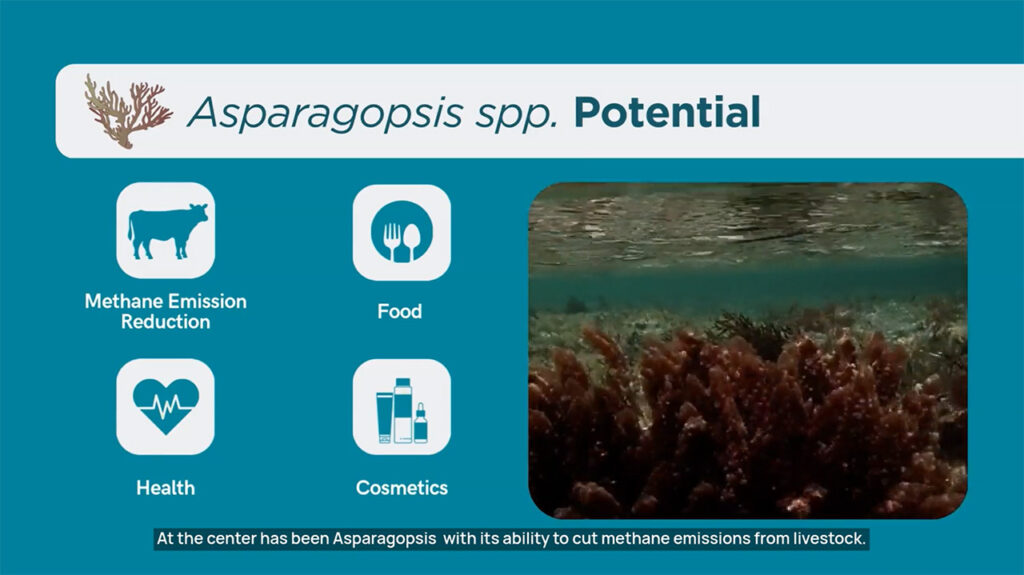
The Department of Agriculture, Fisheries and Forestry has announced an $8 million grant program aimed at scaling up the production of Asparagopsis, a red seaweed known for its methane-reducing properties when used as livestock feed. This initiative, delivered by the Australian Sustainable Seaweed Alliance (ASSA) and the Fisheries Research and Development Corporation (FRDC), is a significant step in Australia’s efforts to curb greenhouse gas emissions.
As global and national pressures mount to reduce emissions, the role of enteric emissions—methane produced by livestock—has come under scrutiny. According to the National Inventory Report, these emissions account for 71% of Australia’s agricultural emissions and 13% of the country’s total emissions. Making Asparagopsis feed supplements both widely available and affordable for Australian farmers is seen as a crucial national interest.
Industry Insights and Developments
Australian Rural & Regional News reached out to Professor Catriona Macleod, Chair of ASSA, for an update on the industry’s progress in Australia. Professor Macleod highlighted the significant achievements made possible through the grant program.
“ASSA deeply appreciates the R&D support received from DAFF and FRDC, whose investment has made it possible to complete 15 key projects within the past two years. The achievements accomplished by our team in such a brief period are a source of great pride,” said Professor Macleod.
A key focus of these projects was to support scalable seaweed cultivation, particularly of Asparagopsis. The development of a hatchery manual has not only advanced Asparagopsis production but also serves as a template for general seaweed cultivation, offering transferable skills across the industry. Furthermore, research into seaweed’s environmental benefits, such as blue carbon potential and bioremediation, has broader applications.
Innovations and Resources
One of the standout outcomes from the funding is the creation of the prototype online portal, Seaweed Central. This platform is designed to be a comprehensive resource for seaweed farmers and investors, featuring a Permit Portal for easy access to licensing and regulatory information.
“Seaweed Central offers sections on why seaweed matters, a knowledge bank for farmers, and a Seaweed Learning section filled with educational materials on seaweed and aquaculture for teachers,” Professor Macleod explained. “We hope these resources will inspire the next generation of seaweed farmers and promote resilience in natural systems.”
The portal has already attracted global attention and is poised to become a key networking and knowledge-sharing platform both locally and internationally.
Economic and Environmental Impacts
Another significant development is the creation of a model to assess the product potential and economic viability of Asparagopsis in a biorefinery setting. This adaptable framework can be applied to various feedstock materials, providing new investors with a roadmap for product development and production processes.
“The decision to focus the initial phase of research on Asparagopsis was especially significant, given its strong connections to terrestrial farming,” noted Professor Macleod. “We are eager to present additional findings in early 2026, which will demonstrate the benefits of biostimulants made from seaweed and ways that seaweed growers and land-based farmers can collaborate more closely.”
As the seaweed industry in Australia continues to evolve, the implications for both environmental sustainability and economic growth are substantial. The grant program not only supports current industry players but also invites new investors to explore the potential of seaweed as a sustainable resource.
Looking ahead, the continued collaboration between seaweed growers and land-based farmers could play a pivotal role in enhancing food security and delivering greater sustainability across the agricultural sector.