




Mining and bank shares exerted significant downward pressure on the Australian sharemarket today, following a slump in European equities. This downturn was triggered by escalating trade tensions between the United States and Europe, sparked by US President Donald Trump’s controversial push to take control of Greenland.
By early afternoon, the S&P/ASX200 had dropped 49.8 points, representing a 0.6 percent decline, settling at 8824.70. Similarly, the broader All Ordinaries index fell by 55.2 points, or 0.6 percent, to 9139.7. Five of the market’s eleven sectors experienced losses, with real estate, mining, banking, and energy companies leading the decline.
Mining Sector Takes a Hit
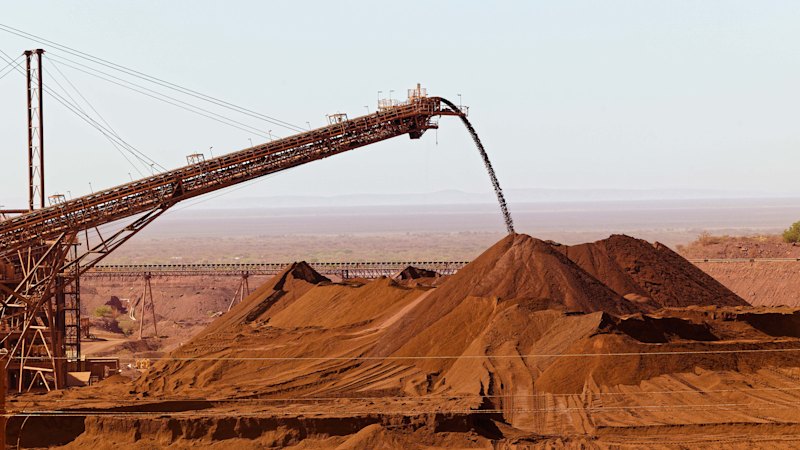
The iron ore giants were notably affected, with BHP Billiton shedding 2 percent, Rio Tinto dropping 1.6 percent, and Fortescue Metals Group losing 0.9 percent. Despite BHP releasing a production report indicating a 5 percent increase in iron ore production to 69.7 million tonnes in the second quarter compared to the same period last year, the market response was tepid. The company reaffirmed its annual production guidance, yet investor sentiment remained cautious.
Banking Shares in the Red
Bank shares also faced a challenging day. Commonwealth Bank saw a 1.5 percent decline, Westpac fell by 0.8 percent, National Australia Bank decreased by 1.1 percent, and ANZ Bank was down 1.2 percent. The investment giant Macquarie Group also recorded a 1.2 percent loss.
Meanwhile, financial services company AMP experienced a 1.3 percent drop after announcing that its chief executive, Alexis George, would retire. AMP’s finance chief, Blair Vernon, is set to take over. George has been at the helm since 2021, steering the company through significant changes following the 2018 royal commission into financial misconduct.
Energy Sector Sees Mixed Results
In contrast, Origin Energy bucked the trend, gaining 2 percent after announcing it would extend the operation of Australia’s largest coal-fired power plant, Eraring, until 2029. This decision follows fresh warnings about the electricity grid’s readiness to handle the plant’s retirement, which was initially planned for 2027, without exacerbating blackout risks.
Global Market Repercussions
Overnight, European shares mostly fell, and US stock futures indicated potential declines in the next Wall Street session. This followed President Trump’s weekend threat to impose a 10 percent tariff on imports from eight European countries opposing his Greenland ambitions. Germany’s DAX lost 1.3 percent, the CAC 40 in Paris fell 1.9 percent, and Britain’s FTSE 100 declined 0.4 percent. US markets were closed for Martin Luther King Jr. Day, but futures suggested a 1 percent drop in the S&P 500.
On the ASX, futures pointed to a 0.4 percent or 34-point decline at market open, following a 0.3 percent drop on Monday.
Transatlantic Tensions Escalate
The European nations targeted by Trump’s tariff threats issued a strong joint statement, condemning the move as undermining transatlantic relations and risking a “dangerous downward spiral.” This marked the most forceful rebuke from European allies since Trump’s return to the White House nearly a year ago.
According to Stephen Innes of SPI Asset Management, Trump’s actions are testing the strategic alignment and institutional trust that underpin European support for the US, its largest trading partner and financier.
“In a world where geopolitical cohesion within the Western alliance is no longer taken for granted, the willingness to recycle capital indefinitely into US assets becomes less automatic. This is not a short-term liquidation story. It is a slow rebalancing story, and those are far more consequential,” Innes said.
Trump’s threat to levy tariffs on nations opposing his Greenland bid risks reigniting market volatility, reminiscent of the early months of his second term. European officials have indicated they are unlikely to back down and are contemplating retaliatory measures.
“The nervousness is palpable,” remarked Alexandre Baradez, chief market analyst at IG in Paris. “All in all, you have so many issues piling up—from credit cards to the independence of the Fed and tariffs—that I really don’t see the case for stock markets to keep on breaching new records.”
Future Implications and Strategic Responses
This standoff occurs amid a backdrop of resilient earnings and sustained investment in artificial intelligence, which have supported risk appetite. The European Union’s response will be pivotal, with discussions underway about imposing tariffs on €93 billion ($161.3 billion) of US goods.
French President Emmanuel Macron is reportedly seeking to activate the EU’s anti-coercion instrument, while German leader Friedrich Merz has expressed reluctance due to Germany’s export dependency.
“The key element to watch in the coming days is whether the message translates into formal measures or remains purely rhetorical, which would make a clear difference in the market reaction,” said Francisco Simón, European head of strategy at Santander Asset Management.
As the situation unfolds, market participants will closely monitor any developments that could further influence the global economic landscape.