




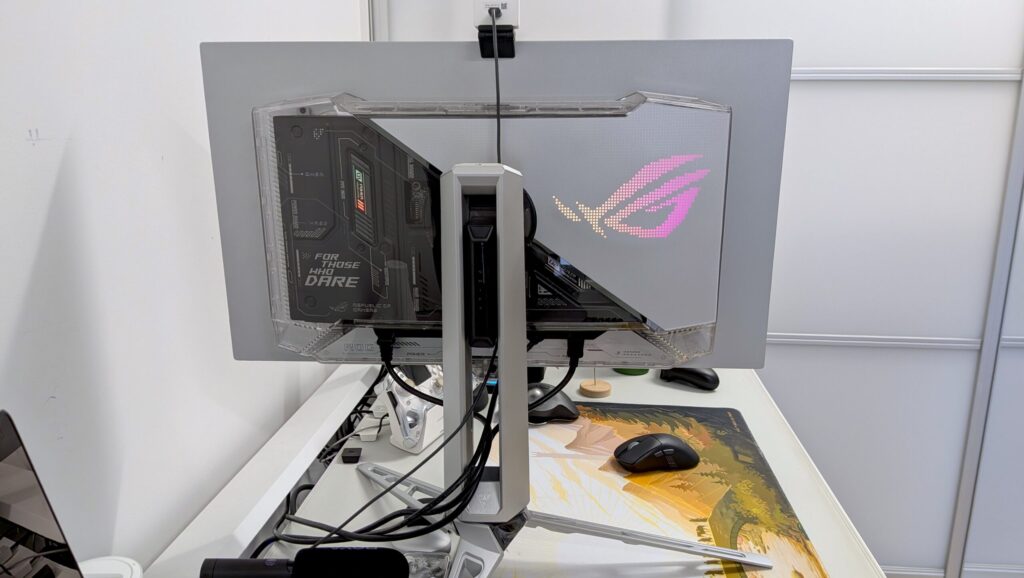
When you unbox the Asus ROG Swift PG27AQWP-W, you’re not just setting up a monitor; you’re making a statement. With its translucent rear panel glowing in RGB and a chassis that screams premium design, ASUS’s claim of being the “No.1 OLED for Gaming” sets a high bar. This is more than just a piece of gaming hardware; it’s a work of art that demands attention on your desk.
The specifications are nothing short of extraordinary: a dual-mode OLED that can switch between QHD at 540Hz or 720p at an astonishing 720Hz. We’ve reached a point where this monitor surpasses the capabilities of most gaming rigs. Testing reveals an input latency that feels almost predictive, making motion not just smooth but seemingly anticipatory.
Performance and Practicality
However, the reality of 720p in 2026 is that it appears noticeably soft, and achieving over 400 FPS at this resolution requires top-tier hardware like the RTX 5080, along with every optimization trick available. While this setup serves as an impressive tech demonstration, the practical sweet spot lies in QHD at 540Hz. It remains outrageously fast and smooth while respecting modern gaming visuals and text clarity.
The true performance hero is the Tandem OLED technology. Unlike traditional WOLED panels, this uses two OLED stacks working in tandem, allowing for higher peak brightness, a wider color gamut, and a longer lifespan. Highlights remain unclipped, colors stay vibrant even in HDR mode, and the panel shows remarkable resistance to static burn-in.
Innovative Features and Design
ASUS complements this with its OLED Care Pro system, which includes automated pixel cleaning, subtle screen movement to prevent burn-in, and a proximity sensor that turns off the display when you step away. These features provide peace of mind, allowing users to focus on gaming without worrying about panel degradation.
The PG27AQWP-W stands out in terms of image clarity. Its TrueBlack Glossy surface offers genuinely black blacks, akin to looking into space. Text is crisp, supported by a new RGWB sub-pixel layout that reduces the red/green fringing common in high-resolution gaming monitors.
For productivity tasks such as reading documents, editing video timelines, or writing scripts, this monitor feels native and uncompromised. Motion handling is nearly flawless, with a 0.02ms gray-to-gray response, ELMB ghosting elimination, and G-Sync compatibility. At 540Hz, the display feels locked to your inputs, with blur virtually eliminated.
The Cost of Cutting-Edge Technology
The question remains: is 720Hz amazing? Absolutely. Is it practical for most gamers? Not quite. Even with top-tier silicon, consistently hitting those numbers at 720p is challenging, and the visual trade-off becomes apparent after experiencing QHD. The beauty of this display is that its “normal” mode—QHD at up to 540Hz—is already exceptional and manageable. Dropping to 240–360Hz for GPU sanity while keeping HDR on allows users to enjoy the Tandem OLED’s brightness and color volume without compromising workflow.
Daily use of this monitor is a pleasure. Its industrial design is the most aesthetically confident ASUS has released, featuring clean lines, a transparent back, and tasteful ROG flair without the typical “gamer grille” plastic drama. Connectivity options are modern and generous, including HDMI and crucially, DisplayPort 2.1a UHBR20 with full 80Gbps bandwidth, ensuring no limitations in achieving high refresh rates at QHD.
The monitor is priced at $1,999, making it more expensive than the 4K PG32UCDM, which might be a better option for some gamers and professionals.
Future of Gaming Monitors
The broader question is whether the pursuit of higher refresh rates is the right direction for innovation. Many argue that improvements in panel reliability, sustained brightness, burn-in mitigation, and text rendering are more impactful. ASUS seems to understand this with the PG27AQWP-W, as its Tandem OLED and care systems push OLED technology toward a “set and forget” experience. The clarity and zero-haze finish make it a superior choice for daily use compared to most IPS “fast panels.”
As a piece of hardware, the PG27AQWP-W is near-perfect for those who appreciate technology that looks incredible and performs exceptionally. While it’s not cheap, it delivers on its promises. The refresh rates are impressive, but the OLED fundamentals are the true reason to invest.
In conclusion, the Asus ROG Swift PG27AQWP-W is the best-looking and best-performing OLED gaming monitor available. Tandem OLED technology is the standout feature, 720Hz is the spectacle, and 540Hz QHD is the practical sweet spot. For those who value beauty, clarity, and low-latency performance, this monitor is a must-have.
Asus Australia kindly loaned the Asus ROG Swift PG27AQWP-W to PowerUp for the purpose of this review.