




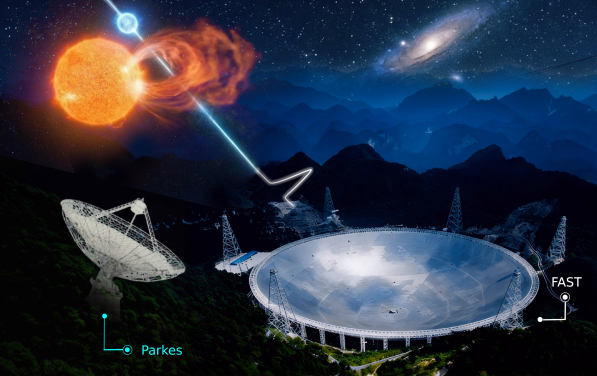
An international team of astronomers, including a researcher from the Department of Physics at The University of Hong Kong (HKU), has unveiled groundbreaking evidence that some fast radio burst (FRB) sources are located within binary stellar systems. This discovery challenges previous assumptions that these intense radio waves originated from isolated stars.
Utilizing the Five-hundred-meter Aperture Spherical Telescope (FAST) in Guizhou, China, also known as the “China Sky Eye,” the team identified a unique signal indicating the presence of a companion star orbiting the FRB source. The findings, published in the journal Science, stem from nearly 20 months of monitoring an active repeating FRB approximately 2.5 billion light-years away.
A Rare Signal: The RM Flare
Changes in the polarization properties of radio waves can provide insights into the environment surrounding an FRB source. The team observed a rare phenomenon known as an ‘RM flare’—a sudden and dramatic shift in the polarization properties of the radio signal. This flare is likely caused by a coronal mass ejection (CME) from a companion star, affecting the FRB source’s environment.
‘This finding provides a definitive clue to the origin of at least some repeating FRBs,’ said Professor Bing ZHANG, Chair Professor of Astrophysics at HKU and a corresponding author of the study. ‘The evidence strongly supports a binary system containing a magnetar—a neutron star with an extremely strong magnetic field, and a star like our Sun.’
Monitoring Repeating FRBs with FAST
Fast radio bursts are millisecond-long yet extraordinarily bright radio flashes from beyond our Milky Way galaxy. While most FRBs are observed only once, a minority repeat, offering rare opportunities for long-term study. These repeating sources have been closely monitored by FAST since 2020 through a dedicated FRB Key Science Programme co-led by Professor Bing Zhang.
FRB 220529A was one of the active repeating FRBs continuously monitored with FAST. ‘FRB 220529A was monitored for months and initially appeared unremarkable,’ noted Professor Bing Zhang. ‘Then, after long-term observation for 17 months, something truly exciting happened.’
Tracing the Signal Through Space
FRBs are known for their near 100% linear polarization. As radio waves traverse a magnetized plasma, their polarization angle rotates with frequency—an effect known as Faraday rotation, measured by the rotation measure (RM).
‘Near the end of 2023, we detected an abrupt RM increase by more than a factor of a hundred,’ said Dr. Ye LI of Purple Mountain Observatory and the University of Science and Technology of China, the paper’s first author. ‘The RM then rapidly declined over two weeks, returning to its previous level. We call this an “RM flare”.’
This short-lived RM change aligns with the hypothesis of a dense magnetized plasma briefly crossing the line of sight. ‘One natural explanation is that a nearby companion star ejected this plasma,’ explained Professor Bing Zhang.
‘Such a model works well to interpret the observations,’ added Professor Yuanpei YANG from Yunnan University, a co-first author of the paper. ‘The required plasma clump is consistent with CMEs launched by the Sun and other stars in the Milky Way.’
Despite the companion star’s invisibility at this distance, its presence was revealed through continuous radio observations with FAST and Australia’s Parkes telescope.
‘This discovery was made possible by the persevering observations using the world’s best telescopes and the tireless work of our dedicated research team,’ said Professor Xuefeng WU of Purple Mountain Observatory and the University of Science and Technology of China, the lead corresponding author.
Implications and Future Research
The discovery supports a recent unified physical model proposed by Professor Bing Zhang and his collaborator, suggesting that all FRBs originate from magnetars, with interactions in binary systems allowing for a preferred geometry that facilitates more frequent, repeating bursts. Continued long-term monitoring of repeating FRBs could reveal how common binary systems are among these enigmatic sources.
Collaboration and Support
The research was conducted in collaboration with HKU, Purple Mountain Observatory, Yunnan University, the National Astronomical Observatories of the Chinese Academy of Sciences, and other institutions. Professors Xuefeng Wu, Peng Jiang, Weiwei Zhu, and Bing Zhang served as co-corresponding authors.
The project was supported by the National Natural Science Foundation of China and other national and international grants. Observing time was provided by the FAST FRB Key Science Project, a FAST DDT program, as well as FAST and Parkes PI projects.
This development marks a significant leap in understanding the origins of fast radio bursts, opening new avenues for exploring the universe’s most mysterious phenomena.