




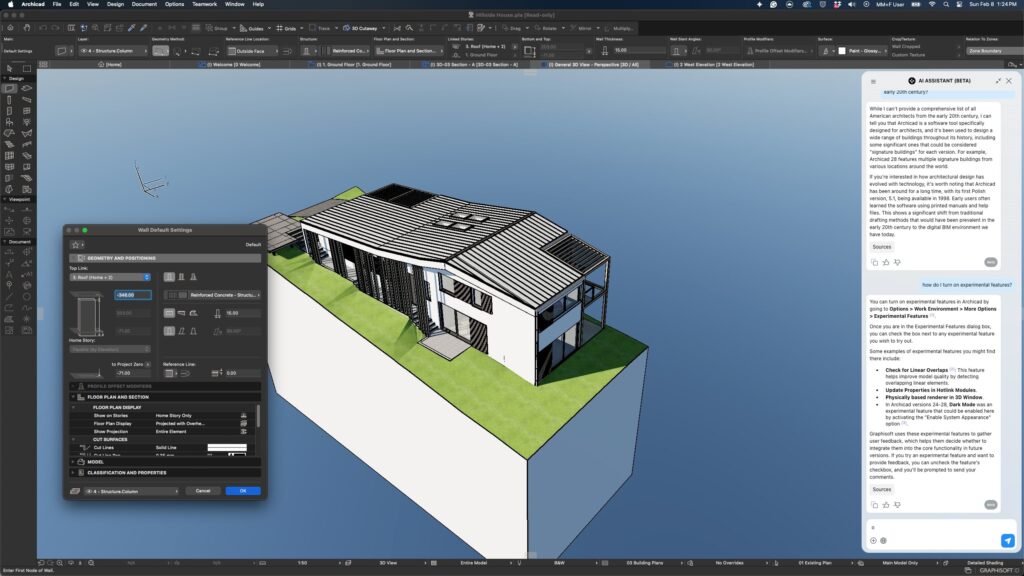
Last fall, Graphisoft unveiled Archicad 29, the latest iteration of its renowned BIM authoring tool, further solidifying its position as a leader in the AEC industry. This release introduces the AI Assistant (Beta), a groundbreaking feature that integrates artificial intelligence into the design process, offering a glimpse into the future of architectural workflows.
Graphisoft has been steadily expanding its ecosystem, notably with its award-winning BIMx and BIMcloud technologies. These innovations have been pivotal, especially during the global pandemic, enabling architects to transition smoothly to remote work. The introduction of the MEP Designer further enhances this ecosystem, catering specifically to the MEP sector.
The Role of AI in Archicad 29
The AI Assistant in Archicad 29 represents a significant step in Graphisoft’s “Design Intelligence Strategy.” Positioned as the backbone for next-generation AI-enabled workflows, this feature aims to revolutionize how architects interact with their BIM models. The AI Assistant provides expert guidance, answers queries, and enhances model interactions, making it an essential tool for both novice and experienced users.
Upon launching the AI Assistant, users must agree to specific terms, as Graphisoft acts as the Data Processor, adhering to GDPR regulations. Once activated, the assistant offers functionalities such as learning about Archicad, understanding best practices, filtering BIM model elements, and creating AI visualizations.
Exploring AI Capabilities
Testing the AI Assistant’s ability to answer questions about Archicad revealed its potential. For instance, when asked about the Navigator, the assistant accurately distinguished between Viewpoints and Views, showcasing its understanding of the software’s intricacies.
However, when queried about best practices, the AI Assistant showed limitations. While it successfully referenced ADA regulations for toilet placement, it struggled with US-specific regulations, as its current knowledge base is UK-centric. Graphisoft plans to expand this database, ensuring a broader range of applicable codes in future updates.
Filtering and Visualization
The AI Assistant’s ability to filter BIM model elements is particularly noteworthy. It accurately identified load-bearing columns and doors under specific dimensions, though it currently lacks numerical analysis capabilities. Graphisoft acknowledges this gap and aims to enhance the assistant’s functionality with future updates, leveraging the Model Context Protocol (MCP) for more advanced queries.
Archicad 29 also introduces AI Visualizer 2.0, a tool that provides architects with greater control over AI-generated visualizations. Users can upload images and adjust settings to refine the AI’s output, streamlining the design process and saving valuable time.
Productivity Enhancements
Archicad 29 brings several productivity improvements that, while seemingly minor, offer significant benefits to users. New rotation tools simplify the process of changing building section directions, and the ability to input openings directly in section and elevation views enhances design flexibility.
Filtering for unused views within the Navigator is another valuable addition, allowing users to streamline their projects by identifying and removing unnecessary elements. This feature, coupled with the ability to update library content more frequently, ensures that users have access to the latest tools and resources.
Documentation and Collaboration
Updates to documentation processes in Archicad 29 include improved schedule formatting and new arrowhead styles, offering architects greater customization options. The ability to assign renovation status to markers further aids in managing project changes without losing critical data.
Collaboration features have also been enhanced, with support for IFC 4.3 and updated connections to platforms like BIMPLUS and Bluebeam. These integrations facilitate seamless communication and coordination among project stakeholders, reinforcing Archicad’s role as a collaborative tool.
Looking Ahead
While Archicad 29 may appear to be a lighter update compared to previous releases, it lays the groundwork for future innovations. The introduction of the AI Assistant is just the beginning, with Graphisoft committed to expanding its capabilities and integrating more advanced AI functionalities.
For firms considering an upgrade, Archicad 29 offers substantial benefits, particularly for those new to the software. The AI Assistant provides valuable support for learning and mastering the program, while experienced users will appreciate the productivity enhancements and improved collaboration features.
Overall, Archicad 29 is a strategic release that positions Graphisoft for continued success in the evolving landscape of BIM technology. As the company continues to refine its AI capabilities and expand its ecosystem, users can expect even more powerful tools to enhance their design processes.