




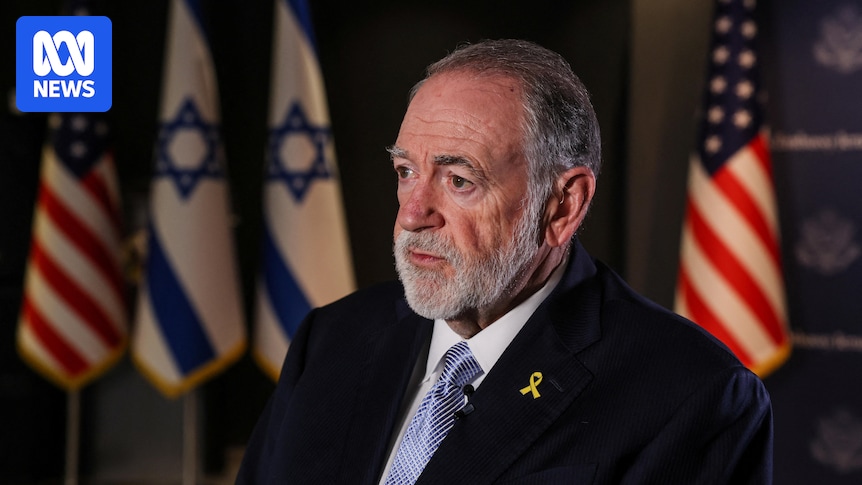
Arab and Muslim nations have voiced strong condemnation and profound concern over recent comments made by the United States ambassador to Israel, Mike Huckabee. The ambassador suggested that Israel could claim a biblical right to territories extending far beyond its current borders in the Middle East. The remarks, made during an interview with right-wing commentator Tucker Carlson, have sparked significant backlash from several countries in the region.
The interview took place after Carlson, a former Fox News host, was invited to Israel by Huckabee. Carlson had previously criticized Israel’s treatment of Christians in Jerusalem and the occupied West Bank. During their discussion, Carlson questioned Huckabee about his interpretation of a biblical passage from Genesis, which he suggested could be used to justify expansive territorial claims.
Controversial Biblical Interpretation
In the interview, Carlson referenced Genesis chapter 15, verse 18, stating, “Abram, it’s pre-Abraham, it’s Abram, receives from God the news that his descendants will inherit the land — and you tell me as the theologian if I’m getting this wrong — but from the Euphrates to the Nile, I think that’s right.” He further elaborated that this interpretation would encompass the entire Middle East, including Israel, Jordan, Syria, Lebanon, and parts of Saudi Arabia and Iraq.
Huckabee responded by acknowledging the large scope of the land described but noted, “This particular area that we’re talking about now, Israel is a land that God gave through Abraham to a people that he chose.” He added, “It was a people, a place, and a purpose — we can look at it that way.”
When pressed by Carlson to specify the land in question, Huckabee suggested that while it “would be fine if they took it all,” Israel was not seeking to claim such extensive territory. Instead, he emphasized Israel’s right to the land it currently occupies.
International Backlash
The comments have drawn sharp criticism from a coalition of Arab and Muslim nations. In a joint statement, the foreign ministries of Saudi Arabia, Egypt, Jordan, the United Arab Emirates, Indonesia, Pakistan, Türkiye, Qatar, Kuwait, Oman, Bahrain, Lebanon, Syria, and the Palestinian Authority labeled Huckabee’s rhetoric as “dangerous and inflammatory.”
“The ministries reaffirmed that Israel has no sovereignty whatsoever over the Occupied Palestinian Territory or any other occupied Arab lands,” the statement read. “They reiterated their firm rejection of any attempts to annex the West Bank or separate it from the Gaza Strip, their strong opposition to the expansion of settlement activities in the Occupied Palestinian Territory, and their categorical rejection of any threat to the sovereignty of Arab states.”
The statement further warned that Israel’s expansionist policies could inflame violence and conflict in the region, undermining prospects for peace. The countries called for an end to incendiary statements that could exacerbate tensions.
Political Reactions and Historical Context
Israel’s far-right Finance Minister Bezalel Smotrich, known for advocating the annexation of Palestinian territories, expressed support for Huckabee’s comments on social media, adding Israeli and US flag emojis to his post. Meanwhile, Carlson has been a vocal critic of Israel, describing it as “probably the most violent country on Earth” in the same episode as the Huckabee interview.
Historically, the interpretation of biblical texts to justify territorial claims has been a contentious issue. The modern state of Israel was established in 1948, and its borders have been a subject of international debate and conflict ever since. The occupation of Palestinian territories in East Jerusalem, the West Bank, and Gaza is considered illegal under international law, a stance that is widely supported by the international community.
Regional Survey Highlights Concerns
Amidst these developments, a recent survey conducted by the Arab Center Washington DC, a US-based think tank, revealed regional perceptions of security threats. The survey, which included over 40,000 participants from across the Arab world, found that 28% viewed Israel as the greatest threat to regional security, followed by the United States at 10%, and Iran at 8%.
“Twenty-eight per cent of those surveyed said Israel presented the greatest threat to the security of the region,” the survey reported, highlighting the deep-seated concerns about Israel’s policies and actions in the Middle East.
As tensions continue to simmer, the international community remains watchful of developments in the region. The potential for increased conflict underscores the importance of diplomatic efforts to address longstanding grievances and foster peace.