


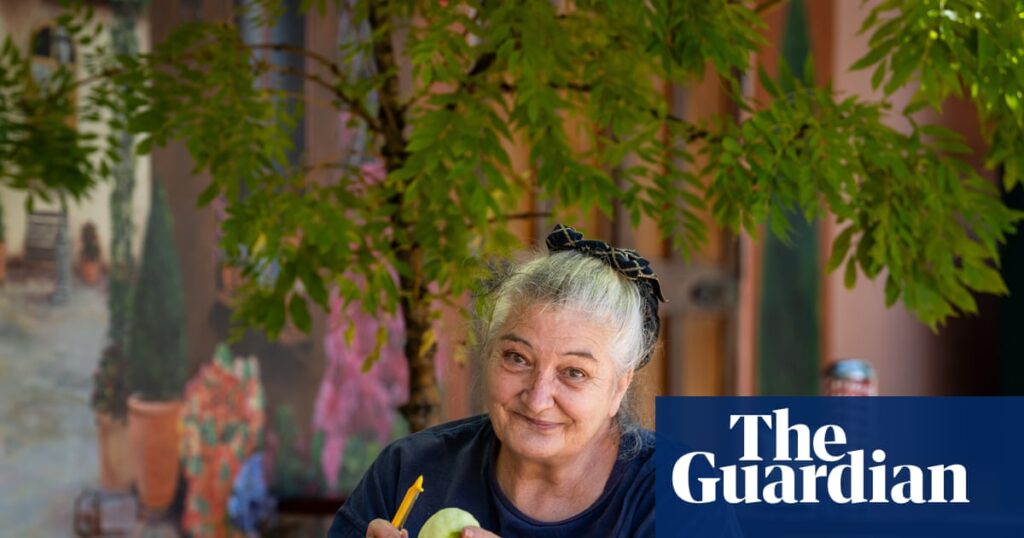
Outside a marquee, across from the clock tower, a crowd gathers at the Stanthorpe Apple and Grape Harvest Festival for the much-anticipated apple peeling contest. While the term “contest” might be an exaggeration, Kerrie Stratford, 65, remains the undisputed champion. With 21 titles under her belt at this Queensland town’s biannual festival, her collection of trophies includes a particularly unique prize: a rock adorned with a peeler.
Despite Stratford’s dominance, a table of 10 hopeful competitors is ready to challenge her reign. However, none admit to practicing secretly at home, as nonchalance seems to be the only acceptable attitude towards competitive apple peeling. Stratford herself maintains a relaxed demeanor. “No, no, no,” she insists. “I’m just relaxed,” she adds, though her focus tells a different story.
The Pressure of Breaking Records
This morning, Stratford aims to break her own record. The pressure is palpable as the peelers are set, apples ready, and fingers flexed. The first contest is for the fastest peel, a record Stratford once held. “I held the fastest and longest, both titles, for quite a while,” she reflects. “But as I’ve gotten older, my speed isn’t there anymore. Arthritis is coming in.”
Russell Wantling, the festival’s president, stands to employ the full force of his peeler. The victory goes to cookery writer Kim McCosker, who is also judging the apple pie competition later that morning. As the second contest for the longest peel begins, Stratford’s hands tremble slightly as she clutches the peeler. The countdown begins, and the art of peeling unfolds. Stratford meticulously removes not just the skin but part of the flesh to ensure the peel doesn’t break.
“My fingers are cramping bad,” Stratford admits through gritted teeth, as she reaches the bottom of the apple with mere seconds to spare.
Health Challenges and Personal Resilience
Despite her efforts, Stratford does not break her 2018 record of 6.1 meters, producing a peel of 3.9 meters (nearly 13 feet) instead. John Bruschi from Toowoomba gives her a run for her money, having studied her technique over the years. The tremors in Stratford’s hands, it turns out, are not from nerves but from serious health issues. She battles Dercum’s disease, described as “one of the 10 most horrible diseases you could ever get,” alongside polyclonal B-cell lymphocytosis. “I’m a ticking time bomb,” she confides, noting that a genetic mutation renders pain medication ineffective.
Living on acreage outside town with eight chickens, a red heeler, and a short-billed corella with a foul mouth, Stratford leads a life marked by resilience. Since her husband’s passing a decade ago, she hasn’t changed a thing in their home, allowing dust to settle as a testament to her enduring grief.
The Festival’s Rich History and Economic Impact
The Stanthorpe Apple and Grape Harvest Festival, now in its 60th year, is a cornerstone event in Queensland’s granite belt. Situated on a fertile plateau high on the Great Dividing Range, it ranks among the country’s largest harvest festivals, drawing in $20 million and an estimated 70,000 visitors over 10 vibrant days. This year’s festivities commenced with an Italian long lunch for 600 attendees.
The festival’s roots trace back to the 1870s when Italian Catholic priest Father Jerome Davadi initiated winemaking in Stanthorpe, cultivating grapes for altar wine as tin mining declined. During World War II, the town housed Italian prisoners who worked on local orchards and farms, embedding their heritage deeply in the region’s vineyards.
“We all have apple and grape stories. We live and breathe it,” says Samantha Wantling, the festival’s vice-president, emphasizing the community’s deep connection to the event.
As Stratford reflects on her achievements, she acknowledges that there are more pressing concerns than another trophy. “You don’t take it too seriously; there are more serious things to think about,” she muses, embodying the spirit of resilience and community that defines the Stanthorpe festival.