



In a remarkable achievement for climate science, the MYIC team, led by Dr. Joel Pedro, has successfully advanced their multi-year mission to retrieve ancient ice cores from Antarctica. These cores, containing climate archives up to 1-2 million years old, offer invaluable insights into Earth’s historical climate shifts. The project, conducted at the Australian Antarctic Division, aims to deepen our understanding of changes in ice age cycles, temperature fluctuations, and greenhouse gas levels.
Dr. Pedro expressed his satisfaction with the progress made this year, stating, “We ticked off our big things this season, which were to set up our new deep drill system that we designed and built at the Australian Antarctic Division, and drill to 400.68 metres.” The team also conducted a comprehensive geophysical survey, reaching down to the bedrock 3000 meters below, to refine age estimates of the ice layers as they delve deeper into the climate record.
Breaking New Ground
The historic drilling commenced on Boxing Day after a month of setting up the sophisticated deep drilling system. This included an eight-meter drill ‘sonde,’ a four-tonne winch, and intricate electrical, control, and communication systems. “It was the first time we’d drilled ice cores with the new system, after seven years of preparation, and we managed to drill quite a nice core, so it was a very happy moment,” Dr. Pedro remarked.
Two dedicated teams, each comprising two drillers and two core processors, worked in eight-hour shifts to meticulously extract, clean, cut, and package the cores into one-meter lengths for transport back to Australia. The operation was a testament to careful planning and execution, with Dr. Pedro noting, “We drilled from 7am through to 11pm, but we chose not to drill through the night because people get tired and little mistakes can make big problems.”
Setting Up for Success
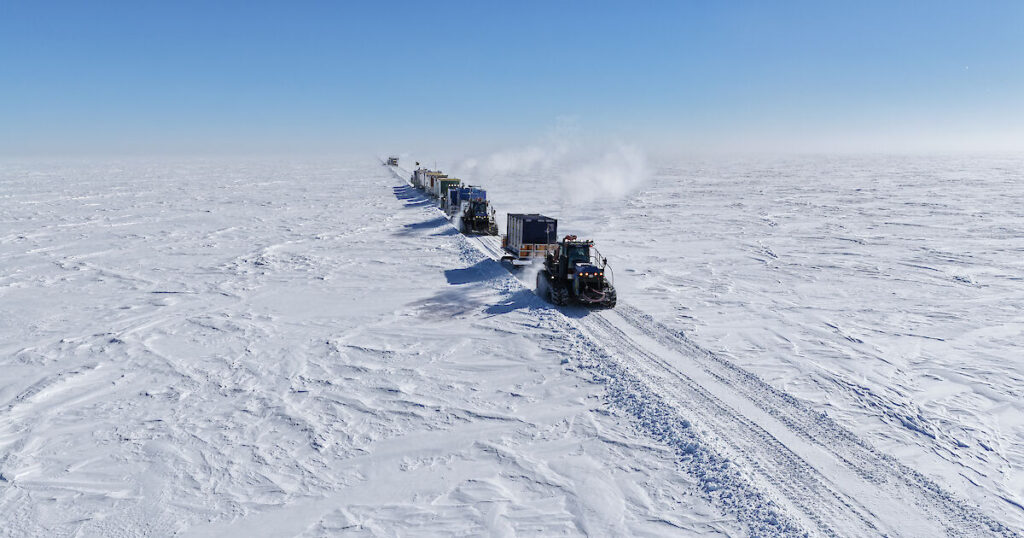
The success of this season was partly due to an early start made possible by the pre-positioning of equipment via a C-17 airdrop and the deployment of a 10-person traverse team to Casey on RSV Nuyina in October. This strategic planning allowed the team to maximize their drilling window before adverse weather conditions set in.
Traverse Leader Damien Beloin highlighted the logistical achievements, stating, “The total weight of the traverse was 640 tonnes, which is the heaviest to date.” The team endured challenging conditions, including four days of blizzard and poor visibility, yet managed to maintain high morale through group activities and camaraderie.
Life in the Antarctic
Despite the harsh environment, the team fostered a strong sense of community, enhanced by weekly volleyball games and interactions with nearby stations. “Some of us did not know each other before we got there, but within a few weeks we’d formed a very solid and experienced group in the middle of Antarctica,” Beloin shared.
Looking Ahead
The ice cores are set to be flown back to Hobart for further analysis, while Dr. Pedro and his team prepare for another ambitious drilling season later this year. “Our target next year is to drill down to over 1000 metres, which will take us deep into the Pleistocene epoch and the last ice age,” Dr. Pedro explained.
The MYIC team’s work is crucial for understanding the ancient climate patterns preserved in the Antarctic ice sheet. By studying the internal layers of ice, researchers can model the flow of ice and estimate its age at various depths. Ice between 1-2 million years old is anticipated near the bedrock, providing a window into Earth’s distant past.
Drilling Through Time
As the team continues their groundbreaking work, they are not only uncovering the secrets of Earth’s climate history but also paving the way for future scientific endeavors. The data collected will contribute significantly to climate models, helping scientists predict future climate scenarios with greater accuracy.
The upcoming drilling season promises to yield even deeper insights, as the team aims to penetrate further into the ice sheet, unlocking more chapters of our planet’s climatic story. With each core extracted, the MYIC team brings us closer to understanding the complex interplay of factors that have shaped Earth’s climate over millions of years.