




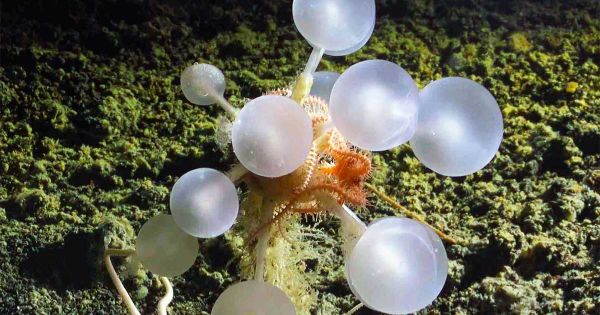
A groundbreaking discovery beneath the Antarctic waters has revealed a carnivorous sea sponge among other unique species, thanks to a collaborative effort between The Nippon Foundation’s Nekton Ocean Census and the Schmidt Ocean Institute. Utilizing the research vessel Falkor, the team ventured into the depths of the Bellingshausen Sea, uncovering a hidden world previously shrouded by ice.
In early 2025, the iceberg A-84’s detachment from the George VI Ice Shelf exposed a seafloor long concealed beneath the ice. This new access point allowed researchers to explore a polar habitat untouched by sunlight, providing an unprecedented opportunity to study the ecosystem’s response to environmental changes.
Revealing the Deep: The Expedition’s Findings
Led by Michelle Taylor, head of science at the Nippon Foundation-Nekton Ocean Census and a lecturer at the University of Essex, the team deployed a remotely operated vehicle (ROV) to safely navigate the newly exposed seabed. The ROV, equipped with lights and cameras, meticulously collected samples and recorded high-definition video footage of the seafloor.
Among the fascinating discoveries were hydrothermal vents, vibrant coral gardens, and the first confirmed footage of a juvenile colossal squid. However, the most intriguing find was a carnivorous sea sponge, a member of the Cladorhizidae family, which traps and digests small crustaceans with its tiny hooked structures.
The carnivorous sponge’s unique feeding strategy allows it to thrive in nutrient-scarce environments, where traditional filter feeding would be insufficient.
Osedax: The Bone-Eating Worm
Another remarkable inhabitant of this seafloor is the Osedax, or “zombie worm,” known for its ability to consume bones. These worms, which lack a mouth and gut, rely on symbiotic bacteria to extract nutrients from the bones of whales and other large animals that sink to the ocean floor.
Since their discovery in 2004 off the coast of California, Osedax species have been found on various bones, showcasing their adaptability and significant role in recycling vertebrate remains. In the Southern Ocean, these worms were observed on seal bones near volcanic islands, demonstrating the diverse feeding strategies coexisting on the seafloor.
Life in Extreme Environments
Around the hydrothermal vents near the South Sandwich Islands, life thrives in a chemical-rich environment rather than a sunlit food web. Communities here depend on chemosynthetic microbes, which derive energy from chemical reactions. Previous expeditions have shown that these vent fields host unique communities, distinct from those at lower latitudes.
At these sites, diverse species such as crabs, barnacles, and snails congregate around vent openings, supported by bacteria utilizing chemicals in the hot fluids. The surveys also documented armored iridescent scale worms, unfamiliar sea stars, and crustaceans adapted to volcanic slopes.
Despite the harsh conditions of the hadal zone, life persists, forming communities on rocky outcrops and patchy sediments at depths exceeding 20,000 feet.
Challenges of Southern Ocean Exploration
Despite decades of research, much of the Southern Ocean remains unexplored. Harsh weather, long transit times, and limited research opportunities mean that only a small fraction of the seafloor has been surveyed. This lack of data poses challenges for conservation efforts, as many polar habitats remain invisible in conservation plans.
According to Michelle Taylor, “To date, we have only assessed fewer than 30% of the samples collected from this expedition.” This under-sampling highlights the need for continued exploration and data collection to inform conservation strategies.
From Discovery to Conservation
In the past, deep-sea samples often languished in storage for years before being analyzed. However, the current expedition prioritized rapid processing, with experts conducting a species discovery workshop aboard the ship. DNA barcoding was employed to identify new species, accelerating the pace of discovery.
“Accelerating species discovery is not a scientific luxury, it is essential for public good,” stated Mitsuyuki Unno, Executive Director of The Nippon Foundation.
Each newly identified species contributes to a growing database, aiding conservation efforts and providing crucial insights into the resilience of polar ecosystems facing climate change. As interest in mining, fishing, and bioprospecting grows, comprehensive data from expeditions like this are vital for assessing potential environmental impacts.
The Nippon Foundation-Nekton Ocean Census aims to bridge the knowledge gap by combining advanced technology and collaborative research to enhance our understanding of these remote ecosystems. As the expedition continues to yield new discoveries, the importance of preserving these fragile habitats becomes increasingly clear.