

At first glance, the small African island of Anjouan might seem like the quintessential offshore secrecy haven. With no corporate taxes, minimal bureaucracy, and limited oversight, it provides an ideal environment for businesses aiming to evade scrutiny. However, the island’s allure is marred by a significant issue: the legitimacy of its licences.
Anjouan hosts a variety of financial entities, including banks, insurance brokers, and cryptocurrency exchanges, alongside a booming industry of black-market gambling websites. These operations, some of which target Australian customers illegally, rely on licences that local authorities deem worthless. According to officials, the island’s regulators are “fictitious entities” operating “illegally,” yet this hasn’t deterred a network of companies from profiting from the sale of hundreds of these licences.
The Troubled History of Anjouan’s Regulation
Anjouan is part of the Comoros Union, a sovereign nation off Africa’s east coast, consisting of three semi-autonomous islands. In the late 1990s, Anjouan declared independence, leading to the establishment of its own corporate regulator, the Anjouan Offshore Finance Authority (AOFA). However, the AOFA’s legitimacy was quickly questioned. In 2007, the Comoros’s vice-president accused it of facilitating “money laundering operations.” A subsequent World Bank mission reported that the creation of offshore banks in Anjouan was illegal under Comoros law.
Despite being officially dissolved following the Comoros’s reunification and subsequent banking laws in 2013 and 2015, the AOFA continues to maintain a public register of licensed companies. Over 50 banks, insurance companies, brokers, and gambling sites have been registered since its dissolution, with the network selling these fraudulent licences likely generating tens of millions annually.
Warnings and Continued Operations
The Comoros Central Bank has issued multiple warnings about the fictitious nature of Anjouan’s regulators and the firms selling their licences. In a 2023 statement, the central bank described these entities as “fictitious structures” with no physical or legal presence in the Comoros.
“They … have in reality no physical or legal existence in the territory of the Union of the Comoros,” said Ait-Ahmed Djalim, a Comoros Central Bank official, in 2020.
Black Market Casinos and Australian Customers
Despite warnings, online casinos continue to operate under Anjouan licences. Leon Casino, for instance, proudly displays its Anjouan licence, even after being identified as illegal by Australian authorities in early 2025. Without an Australian gambling licence, Leon offers banned products such as virtual slot machines and in-play sports betting. The casino has engaged in high-profile sponsorships and events in Australia, although there is no suggestion that those involved were aware of its illegal status.
Testing by the ABC revealed that Leon Casino offered various local payment options, including credit card and cryptocurrency. However, scrutiny led to the disappearance of some payment vendors from the casino’s website, indicating a lack of oversight associated with Anjouan licences.
The Mystery of Anjouan’s Regulatory Bodies
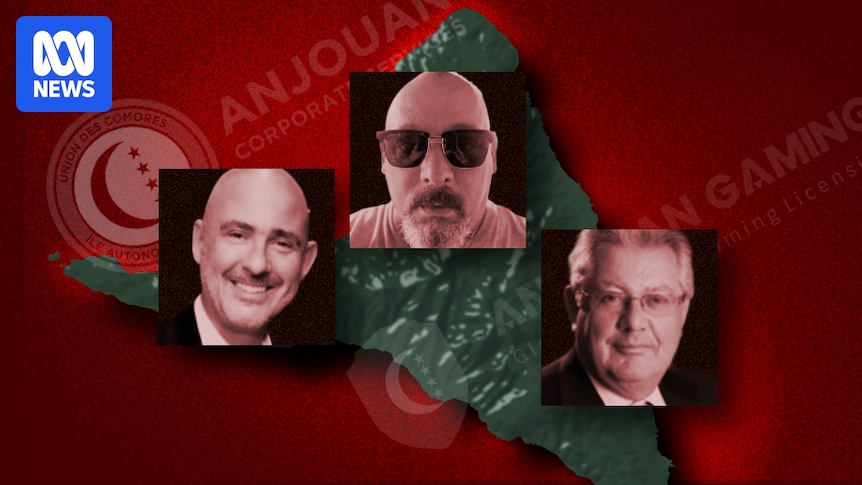
The AOFA, the supposed regulatory body, lacks credibility and accountability. Its website lists a misspelled email address and no government officials. Licences are sold through Anjouan Corporate Services, which lists no directors or board members. Ait-Ahmed Djalim confirmed the company’s illegal operation status.
The history of Anjouan Corporate Services is intertwined with a British man, Ronnie Dvorkin, identified in a 2007 speech by the Comoros’s vice-president. Dvorkin was linked to another “fictitious entity” and has since been succeeded by a younger family member, Adam Dvorkin, who continues the business alongside the Sorsky family.
The Costa Rican Connection
Records reveal a sister company, Anjouan Licensing Services, established in 2023. This entity claims to issue gambling licences, potentially generating up to 22 million euros annually. Like its counterpart, it cites oversight from the AOFA, despite being labeled “illegal” by former Comoros attorney-general Azad Mzé.
Anjouan Licensing Services claims to have issued more than 1,300 gambling licences. At around 17,000 euros ($30,000) per licence per year, the company could be making up to 22 million euros a year.
Domain registration records link Anjouan Licensing Services to a Costa Rican company, Fast Offshore, run by Canadian Ron Mendelson. Mendelson, who promotes Anjouan’s benefits for online casinos, appears well-connected within the industry, but did not respond to inquiries.
Implications and Future Outlook
The ongoing sale of dubious licences by Anjouan’s regulatory bodies raises significant concerns about regulatory oversight and international business practices. As the Comoros Central Bank continues to issue warnings, the global financial community must grapple with the implications of such operations on international commerce and regulatory frameworks.
Moving forward, increased scrutiny and potential international cooperation may be necessary to address the challenges posed by Anjouan’s offshore industry. The island’s situation underscores the complexities of global financial regulation and the need for vigilant oversight to prevent the exploitation of legal loopholes.