




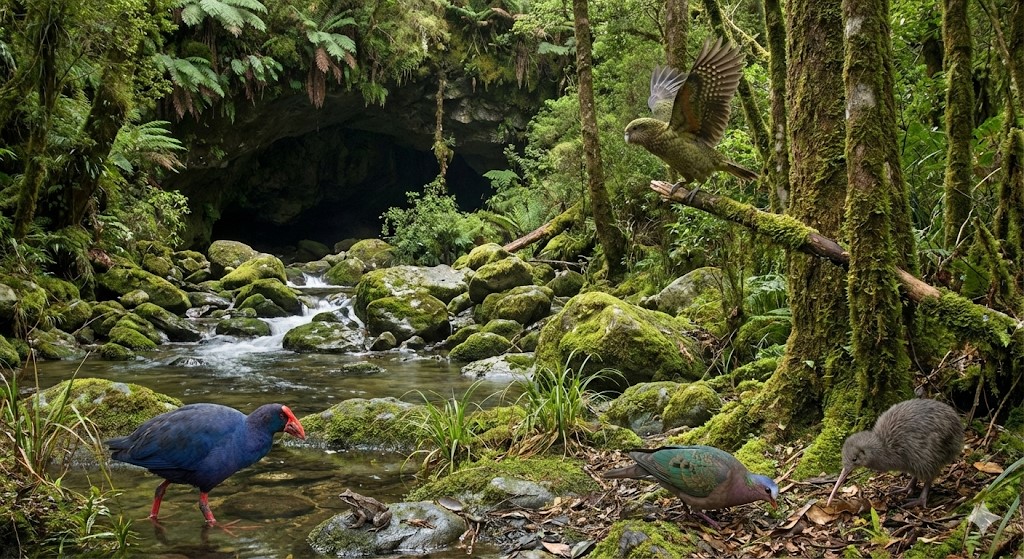
In a groundbreaking discovery, scientists from Australia and New Zealand have unearthed a treasure trove of ancient wildlife remains in a cave near Waitomo on Aotearoa’s North Island. This marks the first time a significant number of million-year-old fossils, including an ancestor of the large flightless Kākāpō parrot, have been found in the region.
The fossils, which include remains from 12 ancient bird species and four frog species, provide a rare glimpse into New Zealand’s ecosystem approximately one million years ago. The findings suggest that New Zealand’s ancient wildlife was heavily influenced by catastrophic climate changes and volcanic eruptions, leading to frequent extinctions and species replacements long before human arrival. These insights were published in the journal Alcheringa: An Australasian Journal of Palaeontology.
New Insights into New Zealand’s Prehistoric Ecosystem
According to the study’s lead author, Associate Professor Trevor Worthy from Flinders University, this research breaks new ground in understanding New Zealand’s ancient avifauna. “This is a newly recognised avifauna for New Zealand, one that was replaced by the one humans encountered a million years later,” Worthy explained. “This remarkable find suggests our ancient forests were once home to a diverse group of birds that did not survive the next million years.”
The research team, comprising palaeontologists from Flinders University and Canterbury Museum, alongside volcanologists Joel Baker from the University of Auckland and Simon Barker of Victoria University of Wellington, analyzed the fossils. Their findings indicate that approximately 33-50% of species went extinct during the million years preceding human settlement in Aotearoa New Zealand.
Impact of Climate and Volcanic Activity
Dr. Paul Scofield, co-author and Senior Curator of Natural History at Canterbury Museum, highlighted the role of rapid climate shifts and cataclysmic volcanic eruptions in driving these extinctions. “From our excavations at St Bathans in Central Otago over many years, we have a snapshot of life in Aotearoa between 20 and 16 million years ago. These new findings cast light on the 15 million year period from then to 1 million years ago, which is largely absent from New Zealand’s fossil record,” Scofield noted.
“This wasn’t a missing chapter in New Zealand’s ancient history, it was a missing volume,” Dr. Scofield emphasized.
Among the most significant discoveries is a new species of parrot, Strigops insulaborealis, an ancient relative of the Kākāpō. Unlike its modern counterpart, which is known for being a heavy, flightless bird, this ancestor may have been capable of flight. The analysis suggests it had weaker legs than its modern descendant, indicating it was less adept at climbing.
Evolutionary Implications and Future Research
The cave also revealed an extinct ancestor of the modern Takahē, providing researchers with valuable insights into the evolution of this iconic New Zealand bird. Additionally, an extinct species of pigeon closely related to Australian bronzewing pigeons was discovered.
“The shifting forest and shrubland habitats forced a reset of the bird populations,” Dr. Scofield added. “We believe this was a major driver for the evolutionary diversification of birds and other fauna in the North Island.”
The fossils were accurately dated between two layers of volcanic ash preserved in the cave, one from an eruption 1.55 million years ago and the other from a massive eruption 1 million years ago. The more recent eruption likely covered much of the North Island in ash, with some preserved in caves, marking the site as the oldest known cave in the North Island.
Revisiting New Zealand’s Natural History
Associate Professor Worthy emphasized the significance of these fossils in providing a critical, missing baseline for New Zealand’s natural history. “For decades, the extinction of New Zealand’s birds was viewed primarily through the lens of human arrival 750 years ago. This study proves that natural forces like super-volcanoes and dramatic climate shifts were already sculpting the unique identity of our wildlife over a million years ago.”
The research, titled ‘The first Early Pleistocene (ca 1 Ma) fossil terrestrial vertebrate fauna from a cave in New Zealand reveals substantial avifaunal turnover in the last million years,’ was published in Alcheringa: An Australasian Journal of Palaeontology.
This discovery not only enriches our understanding of New Zealand’s prehistoric biodiversity but also underscores the profound impact of natural events on the evolution and extinction of species. As researchers continue to explore these findings, they hope to uncover more about the dynamic history of the region’s wildlife.