




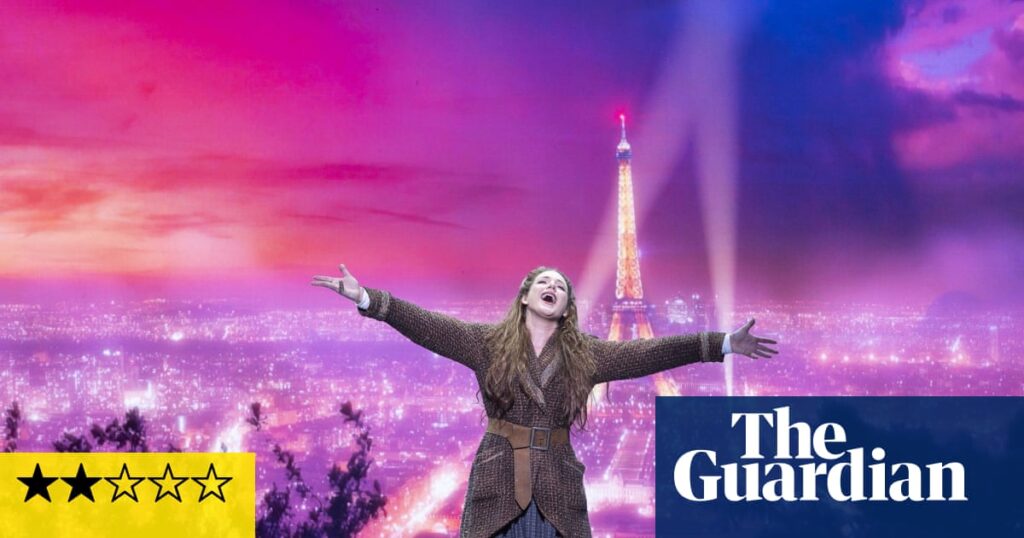
The real Grand Duchess Anastasia Romanov was murdered alongside her father Tsar Nicholas II and the rest of her family during Russia’s Bolshevik revolution in 1918. Despite irrefutable evidence to the contrary, rumors of her survival persist, fueled by the myth of the lost princess—a narrative that has proven irresistible to creators of historical fiction and animated films alike. The 2017 Broadway musical adaptation of “Anastasia,” which recently premiered in Melbourne, Australia, before embarking on a national tour, is the latest to capitalize on this enduring legend. Although not a Disney production, it closely mimics Disney’s formula: heavy on sentiment, rich in spectacle, and notably lacking in substance.
Based on the 1997 animated film, the musical features music by Stephen Flaherty and lyrics by Lynn Ahrens. It portrays Anastasia (played by Georgina Hopson) as surviving a fictionalized storming of her family’s palace, which in reality occurred years after their deaths. She emerges with amnesia, believing herself to be “Anya,” a plot device borrowed from the movie that book writer Terrence McNally leaves unaddressed. In the newly renamed Leningrad, Anya encounters two “lovable rogues”: Dmitry (Robert Tripolino) and Vlad (Rodney Dobson), who plan to pass her off as the lost princess. Their journey to Paris to meet Anastasia’s grandmother, the Empress Dowager (Nancye Hayes), is pursued by a zealous Bolshevik general, Gleb Vaganov (Joshua Robson).
A Missed Opportunity for Historical Depth
The production aspires to be thrilling and evocative, aiming for the grand historical sweep seen in musicals like “Les Misérables.” However, it falls short, offering a shallow adaptation of both the animated source material and the historical record. The Romanovs’ downfall was due to complex, multifaceted reasons, yet they are depicted here as fragile innocents, mere victims of Bolshevik aggression. The narrative glosses over the Romanovs’ immense wealth amid widespread starvation and ignores the implications of their exile in Paris. Instead, it opts for superficial comparisons of tiaras.
While an animated film for young families might overlook such complexities, a stage adaptation with aspirations of grandeur should engage with historical events more thoughtfully. McNally captures the shifting loyalties of revolutionary times but fails to explore the dynamics of power and wealth. By replacing the film’s character of Rasputin with the boorish Gleb, the narrative stakes are diminished, leaving unresolved the central dilemma: how to root for an heir to an unearned fortune seeking validation of her royal rights.
Production and Performance: A Mixed Bag
The musical’s production boasts a veneer of luxury, with costumes by Linda Cho and lighting by Donald Holder evoking the splendor of imperial Russia and the vibrancy of jazz-era Paris. However, the visual experience is marred by projections designed by Aaron Rhone, which are filled with clichés and lack depth. Historical images pass by without impact, and props appear oddly cheap, such as a Fabergé music box that resembles a discarded carburetor.
Tripolino and Dobson form a likable comedic duo, while Robson injects some malice into his portrayal of the committed Bolshevik. Hayes brings gravitas to the role of the Empress Dowager, and Rhonda Burchmore shines as the Countess Lily, a vivid White Russian who enlivens the stage whenever she appears. However, Hopson is miscast as the young ingenue, lacking the charm and vulnerability the role demands. Her voice often sounds strained, and her costumes do little to enhance her portrayal.
Cultural and Historical Disconnects
The creative team behind “Anastasia” previously delivered the stately and resonant “Ragtime,” a musical that skillfully interwove historical figures into a narrative of great depth. Unfortunately, they fail to replicate that magic here. While “Anastasia” touches on the end of Russian imperialism, it is overshadowed by American cultural imperialism. The choice to have Australian performers adopt American accents for Russian characters is perplexing, and the music, intended to reflect Russian and Parisian influences, feels contrived and repetitive.
The producers may hope audiences will be swept away by the romanticism, but this tone-deaf celebration of privilege feels uncomfortably contemporary in all the wrong ways. Like a renovated ballroom during a cost-of-living crisis, it is royally off-putting.
Ultimately, “Anastasia” offers a story of identity and belonging, but it does so by sacrificing historical accuracy and depth. As audiences seek more nuanced narratives, this adaptation serves as a reminder of the importance of engaging with history in a meaningful way.