


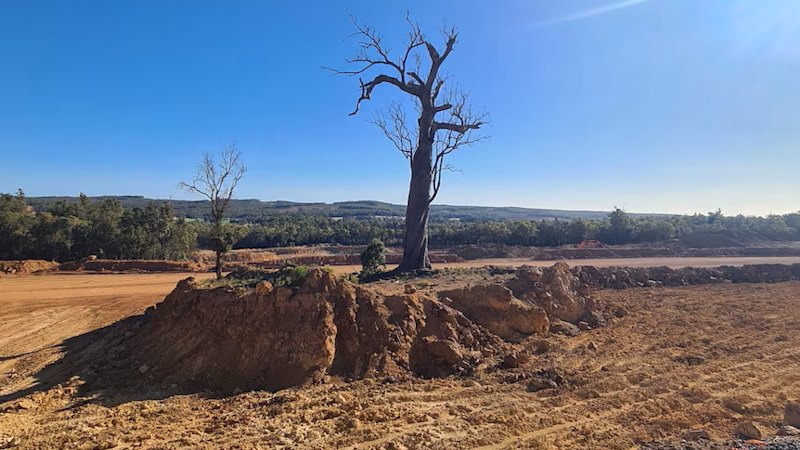
The Department of Water and Environmental Regulation (DWER) has launched an investigation into Alcoa’s mining operations in Western Australia over a suspected breach of environmental regulations. The inquiry centers on a solitary jarrah tree at the company’s Huntly mine site, which is subject to a 10-meter buffer zone as part of Alcoa’s exemption order for bauxite mining in the Jarrahdale region.
The alleged breach involves the proximity of mining activities to the jarrah tree, which is considered significant due to its potential to provide nesting for endangered black cockatoos. This investigation was confirmed by the independent news site Boiling Cold, which cited a DWER spokesperson stating,
“It would not be appropriate to make further comment while the investigation is ongoing.”
Political and Environmental Reactions
The WA Greens have played a pivotal role in bringing this issue to light. MLC Jess Beckerling claims to have provided documentation that prompted the DWER investigation. She expressed strong criticism of the Cook government’s decision to grant Alcoa the exemption, arguing that the conditions were insufficient to protect the environment.
Beckerling stated,
“If the breach is confirmed, which I am confident it must be, then Alcoa must be immediately notified that its special exemption from WA’s environment laws is no longer valid and any clearing or mining activities must cease at least until the EPA’s assessment is complete.”
She further emphasized,
“A clear commitment was made to cancel Alcoa’s exemption if any breaches occurred. If this breach is confirmed, the government must immediately cancel the exemption order, Alcoa’s clearing must stop and no fresh order should be issued.”
Alcoa’s Response and Historical Context
In response to the investigation, an Alcoa spokesperson acknowledged the inquiry and reiterated the company’s commitment to adhering to the conditions of its operations. The spokesperson emphasized that Alcoa has been cooperating with DWER and maintained that the company operates within the guidelines of the section 6 exemption order.
The spokesperson explained,
“We have been assisting DWER with inquiries regarding a significant tree at our Huntly mine. A tree is classified as significant based on its size. The tree was identified in 2014 pre-mining surveys and a 10-meter buffer was applied in line with relevant management plans at the time. The tree was not identified as a black cockatoo nesting tree.”
Alcoa clarified that the clearing around the tree occurred in 2020, before the implementation of the section 6 conditions, and that subsequent mining activities up to March 2024 did not violate the buffer zone requirements.
Future Implications and Environmental Considerations
Alcoa has highlighted its ongoing efforts to enhance environmental protections, proposing a more extensive 30-meter buffer around known and suitable black cockatoo nesting trees as part of its current environmental assessment. The company asserts its dedication to balancing environmental and social considerations while producing aluminium, a material crucial for decarbonization efforts.
The spokesperson added,
“We continue to work with regulators, third-party consultants, and researchers to maintain our commitment to continuously improving our approaches to environmental protection, mining operations, and rehabilitation.”
Alcoa’s rehabilitation work, supported by peer-reviewed research, aims to establish self-sustaining, resilient forests meeting post-mining completion criteria. This investigation into Alcoa’s practices underscores the ongoing tension between industrial development and environmental stewardship, a balancing act that remains a focal point in the region’s regulatory landscape.