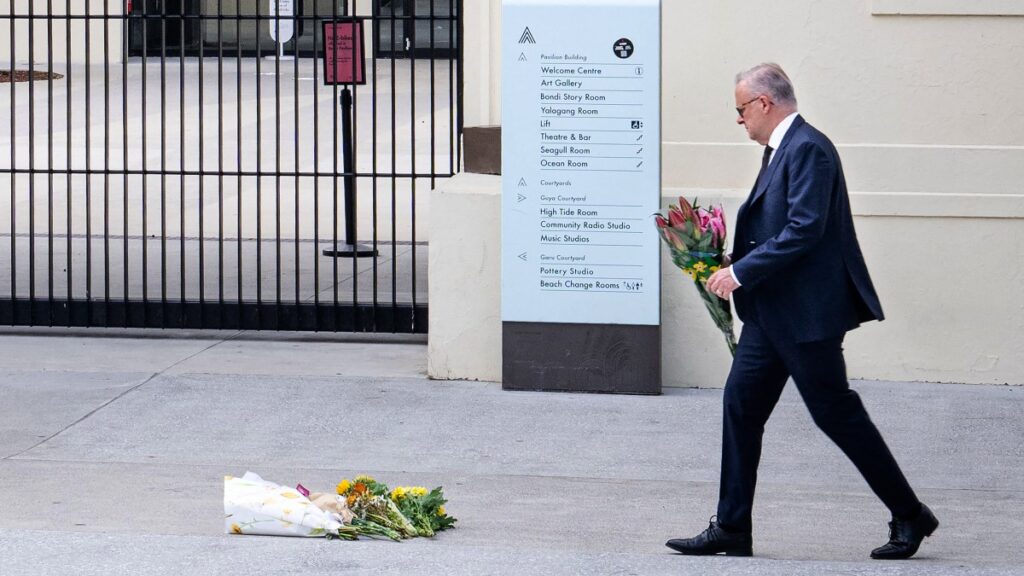
Amid mounting pressure and public outcry, Australian Prime Minister Anthony Albanese has announced a royal commission to investigate antisemitism and social cohesion following the devastating terror attack at Bondi Beach. The decision marks a significant reversal for Albanese, who had previously resisted calls for such an inquiry, opting instead for a state-based investigation and a closed-door review of federal intelligence and law enforcement agencies.
At a press conference in Canberra, Albanese portrayed his change of heart as a demonstration of responsive leadership. “I’ve taken the time to reflect, to meet with leaders in the Jewish community and, most importantly, I’ve met with many of the families of victims and survivors of that horrific attack,” he stated. “In family homes, in synagogues … at community events, I’ve listened, and in a democracy, that’s a good thing to listen to what people are saying.”
Political Turbulence and Public Pressure
The announcement comes as Albanese faces the most significant challenge of his premiership. Karen Middleton, author of the biography “Albanese: Telling It Straight,” noted that the massacre and its aftermath have severely tested his leadership. “He was in an unassailable position after he won the 2025 federal election, and politically everything changed on December 14,” she said.
Albanese’s Labor Party had secured a historic victory in May, winning 94 of the 150 seats in the House of Representatives. However, the preferential voting system masked a more fragile support base, with only 35 percent of the population casting their first-preference vote for Albanese, the second lowest since 1910.
Immediate Responses and Criticisms
Following the Bondi attack, the government swiftly implemented a national gun buy-back scheme, reformed anti-hate speech laws, and launched a narrowly focused review of federal intelligence services. Meanwhile, Chris Minns, the Labor premier of New South Wales, initiated a state-wide investigation and called for a federal royal commission, emphasizing that extremism and antisemitism transcend state borders.
Critics, including former Labor defence industry minister Mike Kelly, argued that Albanese’s initial reluctance to mobilize national resources was a misstep. “It’s a national issue, not a state or city issue … and it needed national leadership,” Kelly asserted.
“A royal commission is the most credible and unifying pathway to understanding what went wrong,” wrote the signatories of an open letter urging Albanese to act. This letter was signed by families of 11 Bondi victims and 100 Labor members, including former MPs, party officials, trade union leaders, and councillors.
Community Reactions and Future Implications
The decision to launch a royal commission has been met with mixed reactions. Kellie Sloane, leader of the conservative Liberal Party in New South Wales, criticized Albanese for misreading the national mood. “Only reluctantly, it appears, he relented after we had sports stars and business leaders also step up and say enough is enough,” she commented.
Families of the victims have expressed feelings of betrayal, citing failures in national security and rising antisemitism. Sheina Gutnick, whose father Reuven Morrison died in the attack, voiced her frustration: “Now we have to live with the repercussions of that for the rest of our lives. If the corrective action was taken sooner rather than later, this wouldn’t have happened.”
Despite Albanese’s claims of engaging with the Jewish community, Gutnick stated that he had not approached her or other families she knew. She emphasized the need for proactive leadership and accountability.
Political and Social Ramifications
Since the attack, Albanese’s popularity has plummeted by 15 percentage points, while Minns has seen an increase. Middleton highlighted the immense pressure on the prime minister, noting his tendency to rely on personal judgment over political advisers. “His strongest political adviser is himself,” she remarked.
Albanese has set a deadline for the royal commission to report back by the first anniversary of the attack. This timeline could help him be perceived as responsive and allow the government to act on recommendations before the next election.
“In a way that’s very similar to the UK, our electorate has become very balkanised,” said Kos Samaras, a former Labor strategist. “Within a month, most Australians will view it as a government that’s taken fairly considerate steps to respond to Bondi.”
Shaun Ratcliff of Accent Research acknowledged the political challenges but suggested the public’s focus would be on the government’s future actions. “Will they be willing to accept that maybe the government’s taking its time to make sure it gets it right?” he asked.
As the royal commission begins its work, the ability of federal agencies to communicate effectively with state police forces and the infrastructure for information sharing will be scrutinized. These elements will be crucial in evaluating Albanese’s leadership and the government’s response to the crisis.
In the wake of the attack, the focus now shifts to ensuring comprehensive answers and preventing future tragedies. Gutnick emphasized the need for decisive leadership: “We need hands-on leadership … as he backflips on his decision, hopefully he will continuously move forward and make the right decisions.”