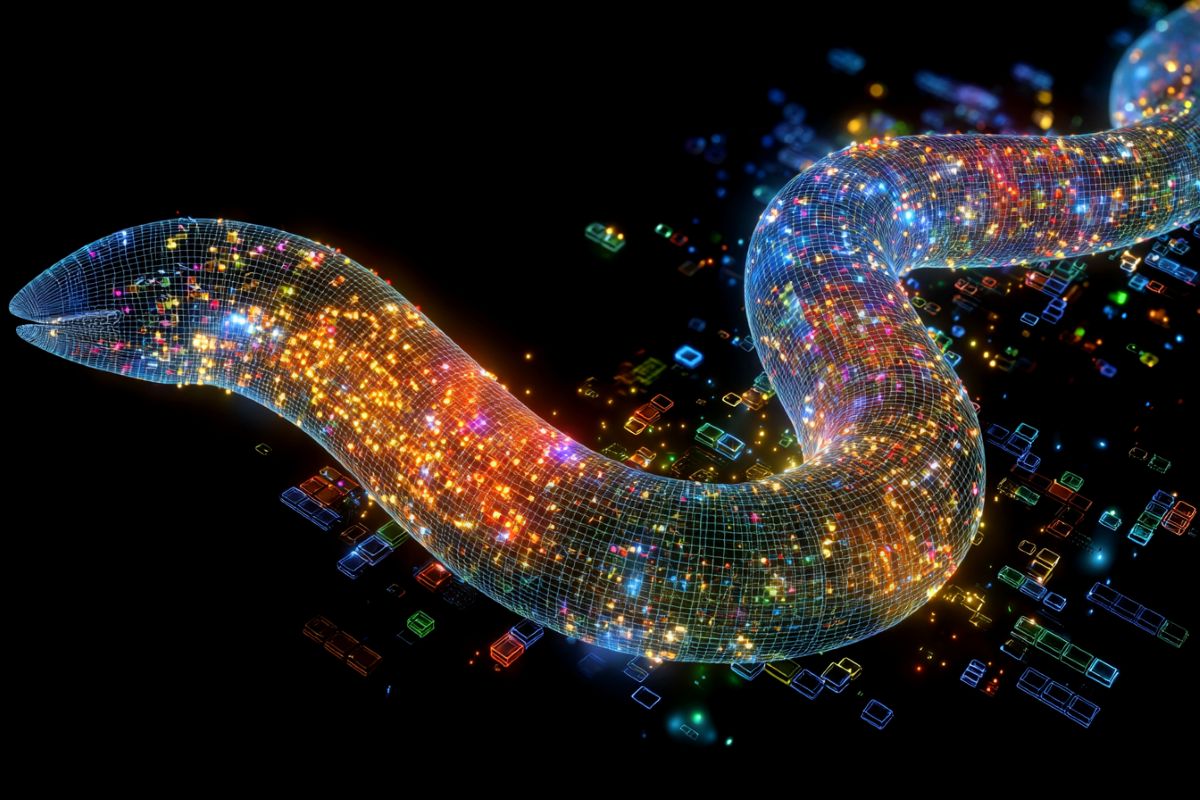




Understanding how brain activity translates to behavior has long been a challenge for neuroscientists, especially when it involves tracking individual neurons in real-time within complex, moving organisms. This challenge, often referred to as the “wiggle” problem, arises because the relative position of brain cells constantly shifts as animals move. However, researchers at the Picower Institute at MIT have developed three AI-infused tools—BrainAlignNet, AutoCellLabeler, and CellDiscoveryNet—that promise to solve this “alignment and annotation” bottleneck with remarkable accuracy.
These innovative tools can automatically identify and track cells with up to 99.6% accuracy, even as animals warp and move. This breakthrough replaces months of manual labor with near-instant, automated analysis, offering a new model for decoding the nervous systems of living, behaving organisms.
Solving the “Wiggle” Problem
The task of tracking neurons in live animals is notoriously difficult due to the constant movement of the organism, which shifts the position of brain cells. The newly developed tools address this by employing advanced AI techniques to maintain high accuracy and speed. BrainAlignNet, for instance, tracks cells through long video series with 99.6% accuracy and operates 600 times faster than previous methods. Meanwhile, AutoCellLabeler can identify specific cell types with 98% accuracy using a color-coding system, and CellDiscoveryNet uniquely identifies and clusters cell types across different animals without human training.
While these tools were initially developed for the roundworm C. elegans, they have already been successfully applied to the more complex, deforming nervous system of the C. hemisphaerica jellyfish. This broad application underscores the potential of these tools to revolutionize neuroscience research.
Expert Insights and Applications
According to Steven Flavell, senior author of the study and associate professor at the Picower Institute, “In a live behaving animal, we can now keep track of neurons over time and even determine the exact identities of most neurons. This is essential for our goal of relating brain activity to behavior.” The tools have largely eliminated the need to choose between speed and accuracy in labeling cells, providing a potential model for other labs working with large series of images in human tissues or samples from other organisms.
Brady Weissbourd, a study co-author and assistant professor of Biology and Brain and Cognitive Sciences, highlighted the impact of these tools on his research with jellyfish. “They call it a jellyfish for a reason,” he said. “Any part of it can move relative to any other part of it. The tool helped us to register our videos to be able to extract neural activity from them.”
From Manual Labor to Automated Precision
The development of these tools marks a significant shift from the labor-intensive process of manual annotation. In Flavell’s lab, individuals with months of training previously spent up to five hours annotating each cell’s identity from video recordings of worms. This daunting task, even with the aid of a comprehensive four-color-channel barcoding system, was both time-consuming and costly.
However, the introduction of AutoCellLabeler, developed by lead author Adam Atanas, transformed this process. Each tool leverages existing neural network architectures, optimized to specifically address alignment and annotation challenges. Importantly, the neural networks can independently learn which features in the image lead to task success, such as aligning cells over time or annotating a cell’s identity.
BrainAlignNet works 600 times faster than previous methods with 99.6% accuracy, while AutoCellLabeler achieves 98% accuracy even with limited color labeling.
Future Directions and Implications
While these tools have already demonstrated significant promise, there is further to go. Weissbourd is working on labeling all the cells in the jellyfish and developing a microscope capable of imaging the jellies as they swim freely. The potential applications of these tools extend beyond neuroscience, offering a framework for tackling similar challenges in other fields requiring the alignment and annotation of dense heterogeneous cell types in complex tissues.
The research, funded by organizations such as the National Institutes of Health and the Howard Hughes Medical Institute, represents a major advancement in the field of neuroscience. As labs continue to grapple with vast amounts of microscopy data, these AI tools provide a much-needed solution, paving the way for more efficient and accurate research.
In conclusion, the development of BrainAlignNet, AutoCellLabeler, and CellDiscoveryNet marks a pivotal moment in neuroscience research. By automating the process of neuron tracking and identification, these tools not only enhance our understanding of brain activity and behavior but also set the stage for future innovations in the field.