
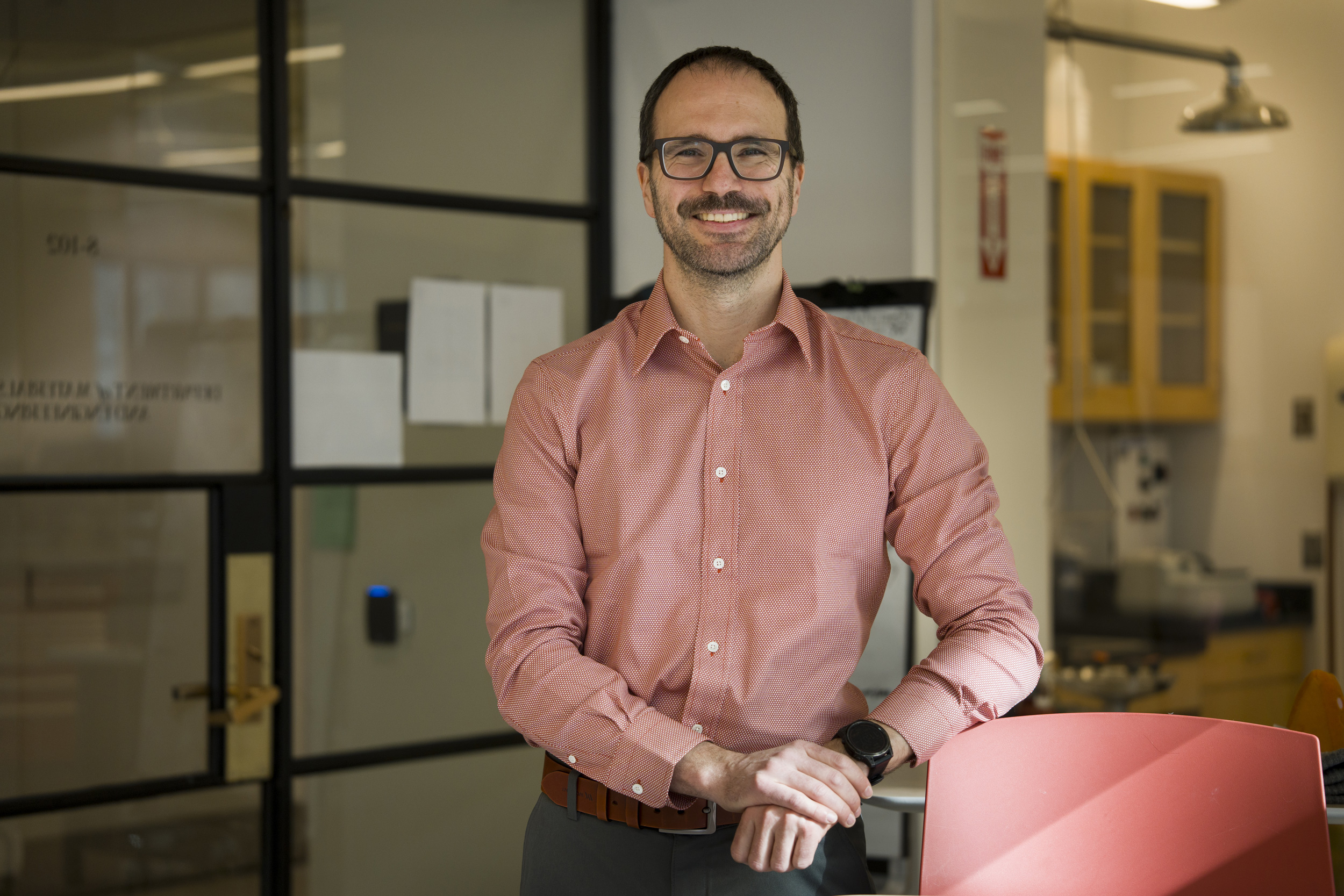

For more than a decade, MIT Associate Professor Rafael Gómez-Bombarelli has harnessed the power of artificial intelligence to create groundbreaking new materials. As AI technology has advanced, so too have his ambitions. Now, as a newly tenured professor in materials science and engineering, Gómez-Bombarelli believes AI is on the brink of transforming science in unprecedented ways. His work at MIT and beyond is dedicated to accelerating this future.
“We’re at a second inflection point,” Gómez-Bombarelli explains. “The first one was around 2015 with the initial wave of representation learning, generative AI, and high-throughput data in some scientific areas. Those techniques were among the first I integrated into my lab at MIT. Now, I believe we’re at a new juncture, blending language and merging multiple modalities into general scientific intelligence.”
AI and Material Discovery
Gómez-Bombarelli’s research marries physics-based simulations with machine learning and generative AI to discover new materials with promising real-world applications. His work has led to innovations in materials for batteries, catalysts, plastics, and organic light-emitting diodes (OLEDs). Additionally, he has co-founded multiple companies and served on scientific advisory boards for startups applying AI to drug discovery, robotics, and more. His latest venture, Lila Sciences, aims to build a scientific superintelligence platform for the life sciences, chemical, and materials science industries.
“AI for science is one of the most exciting and aspirational uses of AI,” Gómez-Bombarelli states. “Other applications for AI have more downsides and ambiguities. AI for science is about bringing a better future forward in time.”
From Experiments to Simulations
Gómez-Bombarelli’s journey into the world of science began in Spain, where he developed a passion for the physical sciences at an early age. In 2001, he won a Chemistry Olympics competition, setting him on an academic path in chemistry at the University of Salamanca, where he also completed his PhD, investigating DNA-damaging chemicals.
“My PhD started out experimental, and then I got bitten by the bug of simulation and computer science about halfway through,” he recalls. “Programming felt like a natural way to organize one’s thinking, and it was less limited by physical constraints.”
His postdoctoral work in Scotland and later at Harvard University with Professor Alán Aspuru-Guzik further solidified his interest in computational approaches. “I was one of the first to use generative AI for chemistry in 2016, and part of the first team to use neural networks to understand molecules in 2015,” Gómez-Bombarelli notes.
Building a Computational Future
In 2018, Gómez-Bombarelli was encouraged by Aspuru-Guzik to apply for a position at MIT’s Department of Materials Science and Engineering. Initially hesitant, he was convinced to apply and ultimately joined MIT, where he found a collaborative and energetic research environment.
Today, his lab focuses on how the composition, structure, and reactivity of atoms impact material performance. They utilize high-throughput simulations to create new materials and develop tools for merging deep learning with physics-based modeling. “Physics-based simulations enhance AI algorithms as they receive more data, creating virtuous cycles between AI and simulations,” Gómez-Bombarelli explains.
His research group, which is entirely computational, collaborates closely with experimentalists to ensure the practical application of their discoveries. “We love working with experimentalists and aim to be good partners,” he says. “Our computational tools help experimentalists triage ideas from AI.”
The Future of AI in Science
As artificial intelligence continues to evolve, Gómez-Bombarelli has witnessed the field mature significantly. Major companies like Meta, Microsoft, and Google’s DeepMind now conduct physics-based simulations similar to those he pioneered. In November, the U.S. Department of Energy launched the Genesis Mission to accelerate scientific discovery using AI.
“AI for simulations has transitioned from a possibility to a consensus scientific view,” Gómez-Bombarelli observes. “We’ve seen that scaling works for simulations and language. Now we’re poised to see how scaling works for science.”
Reflecting on his experiences at MIT, Gómez-Bombarelli appreciates the non-competitive, positive-sum environment among researchers. His research group, comprising about 25 graduate students and postdocs, embodies this spirit. “We’ve naturally grown into a diverse group, each with unique career aspirations,” he says. “Helping people be the best versions of themselves is rewarding. Now, I’ve become the one encouraging others to apply for faculty positions.”