




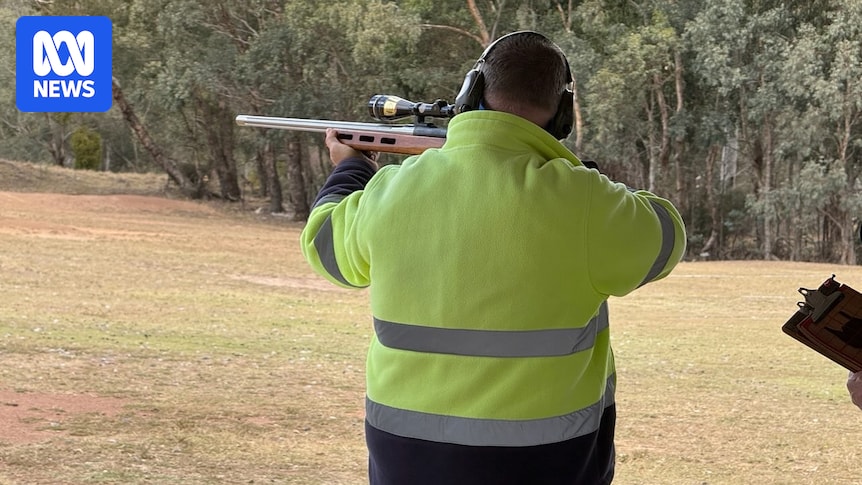
Professional and recreational shooters in the Australian Capital Territory (ACT) have expressed concerns over potential changes to gun laws, following the government’s announcement that current legislation is “outdated.” This comes as state and territory governments review their firearms legislation in response to last month’s Bondi terror attack, with the federal government working towards a national gun buyback scheme.
The ACT government is contemplating reforms that may include a cap on the number of firearms an individual can own. Currently, there are over 22,000 firearms registered to approximately 7,000 licensees in the territory. The proposed changes have stirred anxiety among gun owners, who fear restrictions similar to those recently enacted in New South Wales, where ownership is limited to four firearms per person.
Concerns from the Shooting Community
Shane Stroud, president of the Sporting Shooters Association of Australia ACT, voiced the community’s apprehensions, noting that many members rely on firearms for competitive shooting, hunting, and professional purposes. “A lot of our people are not only competitive shooters, but they’re also hunters, they’re also professional or commercial shooters, so they need to use firearms to put food on their table and provide a livelihood for their family,” he explained.
Stroud emphasized that the ACT already has stringent regulations, with an average of three firearms per registered owner. Although there is no absolute limit on ownership, each firearm must be justified by a legitimate need, assessed under the Firearms Act. “The principle is, you’re vetting the user and the purpose for which the firearm will be used,” he added. “You have to satisfy a genuine reason.”
Government’s Perspective on Reform
ACT Police Minister Marisa Paterson highlighted the necessity for reform, citing advancements in firearms technology and the need for nationally consistent laws. “Our gun laws in the ACT are quite dated, and technology has moved on a lot,” she stated on ABC Radio Canberra. Paterson noted that the government is considering caps on gun ownership and reviewing firearm categorization and licensing requirements.
Other jurisdictions, such as Western Australia and New South Wales, have already implemented significant reforms, with caps of five and four firearms respectively. Paterson also mentioned the development of a digital National Firearms Register, set to replace the current paper-based system by July 2028.
“This is due to be up and running by July 2028,” she said.
National Gun Buyback Scheme and Anti-Vilification Law Updates
While support for Labor’s proposed national gun buyback scheme is waning, Labor-led governments in the ACT, Western Australia, Victoria, and New South Wales have shown support. ACT Chief Minister Andrew Barr expressed hope for federal negotiations on cost-sharing for the scheme. “There’s always a case for the smaller jurisdictions that the cost sometimes of national consistency can be quite high,” he said on ABC Radio Canberra.
In addition to gun law reforms, Barr announced plans to strengthen the ACT’s anti-vilification laws, potentially introducing criminal penalties for hate speech. Currently, such offenses fall under the Discrimination Act (1991), which does not typically involve criminal penalties. Barr emphasized the importance of community feedback in the review process, aiming to propose new legislation later in the year.
“We need to talk to people. We need to understand what will or will not happen in the federal parliament in coming parliamentary sittings,” Barr said.
Opposition and Community Consultation
ACT Opposition Leader Mark Parton acknowledged the robustness of the territory’s existing anti-vilification laws but cautioned against changes that might infringe on free speech. “I think that ours in the ACT are stronger than in most jurisdictions,” he remarked.
As the ACT government moves forward with its legislative review, both gun owners and the broader community are urged to participate in consultations to ensure balanced and effective policy outcomes. The discussions around these reforms highlight the ongoing challenge of balancing public safety with individual rights in a rapidly changing societal and technological landscape.