


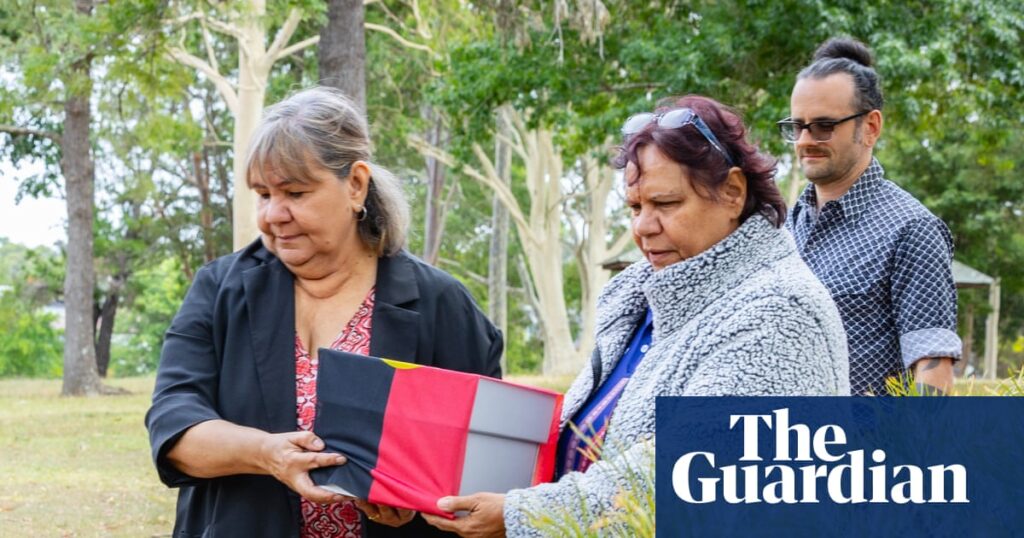
Elizabeth Dempsey felt an undeniable connection when she held the remains of her ancestors. “I just felt this full feeling inside,” she says. “We all felt it, and we knew they were ours.” Dempsey, along with her siblings, traveled from the gulf country of north Queensland to Sydney for a poignant reunion, marking the return of their Waluwarra ancestors’ remains after a century-long separation.
The remains were discovered in three institutions, including a university in Cologne, Germany. This discovery highlights the unfinished business of Australia’s colonial past, where the remains of thousands of Aboriginal and Torres Strait Islander people were collected, sold, and traded across the globe. These remains are held in museums, universities, and private collections both in Australia and internationally.
The Complex Task of Repatriation
Staff at eight Australian museums face the challenging task of returning these remains to their ancestral lands. However, the number of repatriations is consistently outpaced by new discoveries. Remains are frequently unearthed at construction sites, eroded from national parks, or found in forgotten boxes on old properties.
About three months ago, Dempsey and her sister, Sylvia Price, were informed by the federal arts department about the discovery of their ancestors’ remains at the University of Cologne. These remains originated from a cattle station on Waluwarra country outside Mount Isa.
The news brought mixed emotions for Price. “I questioned, ‘how could our Australian government allow that to happen, for our ancestor’s remains to be removed out of Australia?’” she reflects. “I came to the realisation that this has happened in the past. We can’t change it, but we need to move on.”
Piecing Together the Past
Further investigations revealed two more ancestors on home soil: one at the Australian Museum in Sydney and another at the Queensland Museum in Brisbane. Information about them emerged through morphological markers, archival records, and community knowledge.
“We’re still in the process of working with museum staff to get the whole picture,” says Price. “It’s sort of like a jigsaw puzzle – piece by piece, we’re just putting it together to find out what happened to them.”
Two of the ancestors were sold to the Australian Museum in 1905 by Walter Roth, then Queensland’s chief protector of Aborigines. Roth collected thousands of cultural artefacts from north Queensland before resigning under public pressure due to his controversial sales.
One of the Waluwarra ancestors was traded to a German university professor in 1936 in exchange for an Inca skull from Peru. The third ancestor was found by road workers near Mount Isa in 1973 and held in a forensic facility until 2016, when custody was transferred to the Queensland Museum.
Return and Reconciliation
This month, all three ancestors were reunited with their descendants in moving ceremonies held in Sydney and Brisbane. As the remains were presented at a smoking ceremony in Sydney, Dempsey’s thoughts turned to her grandfather. “He used to play these clapsticks,” she recalls. “If he couldn’t have his clapsticks, he’d be hitting the tin with his long fingernails, so I could hear those sounds in my head while we were there.”
Representatives from the Australian and Queensland museums apologized to the Waluwarra people. “We don’t want to hold any remorse against them, because we know that the staff have done all they can to help us return our ancestor, and that’s good enough for us,” Price says. “It feels like you’ve cried all your tears, you’ve grieved long enough – now it’s time for healing.”
Challenges in Repatriation Efforts
More than 1,790 Aboriginal and Torres Strait Islander ancestral remains have been repatriated from 11 countries over the past 35 years, yet an unknown number remain abroad. Australian museums have been engaged in repatriation efforts for decades, with institutions undergoing cultural reckonings and appointing Indigenous-led teams to lead these efforts.
Each of the eight major museums can apply for up to $100,000 a year in federal funding to support the return of ancestors and cultural objects.
Laura McBride, director of First Nations at the Australian Museum, emphasizes the importance of this work. “These people aren’t ancient human remains,” she notes. “The human remains that we hold are generally from post colonisation, so they’re our grandparents, our great-grandparents.”
The Queensland Museum faces similar challenges, holding about 840 Aboriginal and Torres Strait Islander ancestors. “Our returns to community are being outstripped by the numbers of ancestors that are being returned,” says Bianca Beetson, the museum’s executive director of First Nations.
The Path Forward
The repatriation process is complicated by insufficient records, native title disputes, community fears, and inadequate funding. However, Beetson stresses the importance of continuing this work. “We talk about it being the most important act of reconciliation,” she says. “Do we want these ancestors sitting in a museum for another two, three hundred years?”
The journey to return Aboriginal remains is not just about repatriation; it is a step towards healing and reconciliation. As more remains are discovered and returned, the hope is that these efforts will foster a deeper understanding and respect for the rich cultural heritage of Australia’s First Nations people.