




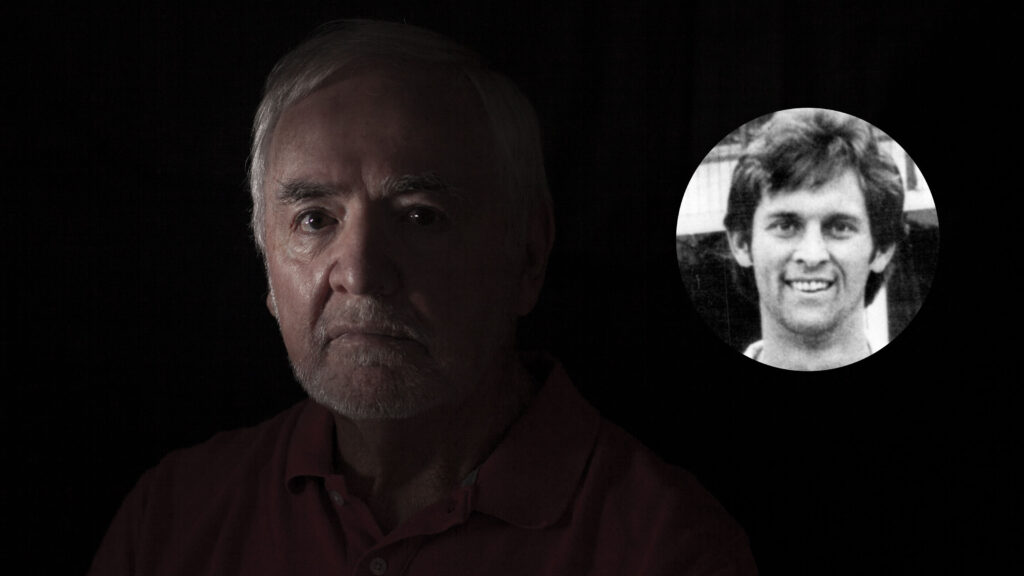
With his gaze steady but his body gently shaking, Terry O’Connell begins a story he hasn’t told in half a century. He is an old man now; white beard, pained eyes. And while, in private, the intense flashes of anger remain, his medication—and perhaps the intervening years—help him display a warm, gentle countenance. Outside, on a warm, cloudless winter’s day in Queensland, he eases onto a timber bench, and smiles into the sun.
Beside him is his former Sandgate-Redcliffe teammate Bob Joyce. Friend of more than five decades, Joyce has been the “block of concrete” O’Connell leaned on through times of desperate trouble. Yet even he isn’t privy to all that O’Connell wants to tell today. “I’m almost 76,” he says, “and I feel like my story should be heard.” And so Terrence John O’Connell reaches into his past, all the way back to December 13, 1975.
The Day That Changed Everything
It was hot and humid at Oxenham Park, home ground of Toombul District Cricket Club. A Saturday morning like most others through another endless Brisbane summer. O’Connell’s parents were down from the Queensland country town of Charleville, holidaying at nearby Redcliffe. Today, Mary would watch her pace-bowling son for the first time in Brisbane grade cricket.
O’Connell had driven to Toombul that morning from his home base of Toowoomba, and he had done so with a fire burning inside him. Truth is, that’s been the case most mornings since Vietnam; many years later, a psychiatry report would state that he “attempted to sublimate some of his feelings on a cricket pitch.” Added to that is the rivalry between his Sandgate-Redcliffe side and the boys from Toombul, which runs deep.
This summer, there were two new faces in Toombul’s top three. A pair of highly regarded Sydneysiders who arrived in the off-season. One is the Test-capped 22-year-old opener, Ian Davis. The other, not widely known in Brisbane grade circles, is a 23-year-old wicketkeeper-batter from Petersham-Marrickville named Martin Bedkober.
A Promising Talent
Martin Bedkober was a natural sportsman. In 1967, he was named ‘best forward’ in the 15s rugby union premiers for being a “tireless worker – excellent in defence and penetrating in attack.” Three years later, he received a School Blues sports award in cricket, was named captain of the Combined High Schools team, and was the senior school winner of the Johnson Memorial Award for Sport.
At the same time, he was showing himself to be an exceptional baseballer, being picked in the Combined High Schools team, making his state underage debut at 16, and also starring for the nearby Canterbury first grade side. In an obituary that appeared in the 1975-76 Petersham-Marrickville Cricket Club yearbook, it was written: “It is generally agreed that, had he decided to make baseball his chosen sport, he would almost certainly have played for NSW in the Interstate Claxton Shield series.”
Bedkober was also intelligent. In his School Certificate in 1968, he earned an ‘A’ for every subject bar English. He served as a prefect in his senior year, 1970, and in acknowledgement of his creative skills, one of his cartoon artworks was selected for the Fort Street yearbook.
The Incident
Shortly after play began at Oxenham Park, O’Connell had Davis edging through to wicketkeeper Ray Brewster. With Toombul one down, and the match just minutes old, the right-handed and whippet-thin Bedkober walked to the wicket. He was still a foreign face in his adopted city but today he had a special supporter in his corner: his fiancée, Virginia Johnston, who was visiting from Sydney for the weekend.
O’Connell was really fired up. “Martin came in, and Brian Grace, our captain, set the trap for him.” He needed no encouragement to pitch it short. The new ball was skidding through, and he gave Bedkober a brief working over. The batter scrambled a couple of runs. O’Connell ran in again. He couldn’t know it in the moment, but the next few seconds would change his life.
O’Connell’s right arm came over. His wrist snapped down, and his fingers released the ball. It wasn’t the fastest delivery he would ever bowl. Nor was it especially short. Bedkober moved to shoulder arms, but misjudged the trajectory as it jagged back towards him. The ball struck him in the chest, right on his heart.
“I was looking at him, right in the face,” Joyce says. “I was about to say, ‘I hope that hurt’.”
But at that moment, Bedkober fell. Almost immediately, Joyce sensed it wasn’t right. He moved quickly towards him, instinctively shifting from rival to rescuer. O’Connell, meanwhile, saw it all through a lens colored by war. It took him only a matter of seconds to reach the end point of this scene, well before it had played out for Short, or anyone else.
“I got down to him – and Bob got to him – and his eyes rolled back,” he says, very slowly now. “And my experience, being in Vietnam, I’ve seen people who had died – and I knew then that he was dead.”
The Aftermath
An ambulance drove onto the ground, parking only meters away. Even the paramedics were shocked by what they saw at this suburban cricket oval. One of them, Des Klaassen, applied an oxygen mask to Bedkober. Two more ambulances arrived to continue the supply of oxygen, firstly at the ground, and later en route to the nearby Royal Brisbane Hospital.
From beyond the boundary, the stricken onlookers included not only O’Connell’s parents, but Bedkober’s fiancée Virginia. Toombul players, led by Davis, attempted to shield her from what was unfolding.
“Then they put him in the ambulance, and they drove away,” O’Connell says. “I walked off the field and just yelled out: ‘He’s f—ing dead’.”
The news of Bedkober’s death spread quickly across Brisbane, courtesy of a front-page story in the Saturday evening Telegraph. O’Connell’s name was absent from the report, while Toombul Club executive Le Frantz was quoted: “Martin was a helluva nice fellow, dedicated to cricket and his job. In fact, we thought so much of Martin that we arranged to bring his fiancée, a schoolteacher, up from Sydney.”
Legacy and Reflection
In the years that followed, O’Connell was haunted by the incident. He showed signs of depression and regular agitation; telltale symptoms of the still-undiagnosed PTSD. He would wake from night terrors – sweating, kicking, yelling. As he and Bev tried to break it down, they found the dual traumas were merging into one.
“He was quite devastated by the sudden death of a batsman who had been hit in the chest by one of his (deliveries). He had quite intense feelings of guilt and anxiety which added significantly to the feelings he was already experiencing.”
O’Connell left Sandgate-Redcliffe ahead of the 1977-78 season for Toowoomba, where Bev would soon be teaching at Downlands College. He signed on with Western Districts and played three seasons, also enmeshing himself in the cricket community, chiefly as secretary of the Association.
Even as the anger bubbled away, occasionally revealing itself in smashed plates or holes in walls, O’Connell managed to give the best of himself in such capacities. He and Association president Kerry Shine (later to serve as Attorney-General of Queensland) worked to lift the standard of the Toowoomba competition, even bringing several Sheffield Shield pre-season fixtures to the region. Later, O’Connell reveled in a number of kids’ coaching roles, including his son’s soccer team.
For O’Connell, there exists a quiet sense of pride in these achievements, but invariably, his thoughts return to darker matters. They have taken him down some hard roads, including a suicide attempt that ended with him spending three weeks in Toowong Private Hospital.
“The thing that haunts me, is that … this was a trap that we set … I deliberately bowled the one short to hit him,” he says. “I meant to hit him, but I didn’t want to do that damage.”
As the 50-year anniversary of Bedkober’s death approaches, O’Connell continues to seek closure. The battle continues to rage inside him. O’Connell still gets depressed, moody, and “extremely angry”. This particular afternoon they will make their way south to Toowong to see his psychiatrist, who has been treating him for many years. The medication he is on, designed to give him “equilibrium” in his life, is an evolving cocktail; just last year he was briefly hospitalized while it was adjusted.
Before the month is out, the pair will again travel south, though this time they will take the train from Landsborough, as they often do, to see the kids, and the grandkids. O’Connell knows from experience exactly how one part of the journey will play out. He can see it already. As they wind through Brisbane, he will feel the train slow to a gentle roll at Nundah Station. There he will lift his gaze out the window, and he will take in the view of Oxenham Park. Just like that, his mind will flash back half a century.
“I’ll look over at Bev,” he says, “and she knows.”
Each season, Randwick-Petersham Cricket Club’s Player of the Year receives the Martin Bedkober Award, a testament to a promising career cut tragically short.