



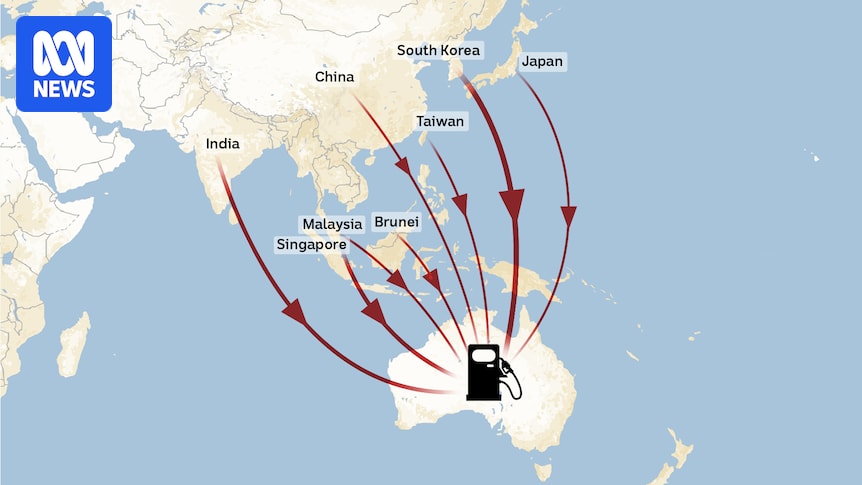
Australia is on the brink of experiencing significant fuel supply disruptions as the ongoing conflict involving the US, Israel, and Iran impacts global oil supply chains. While local fuel prices have already risen in line with global crude benchmarks, the country has yet to face direct shortages due to stockpiled reserves and a lag in the supply chain. However, this situation is expected to change soon, as Asia’s refineries, which supply over 80% of Australia’s petrol, diesel, and jet fuel, are now feeling the strain.
With only two domestic refineries still operational, Australia relies heavily on imports from Asian countries like South Korea, Singapore, Malaysia, and China. These nations, in turn, source a substantial portion of their crude oil from the Middle East, primarily through the now largely inaccessible Strait of Hormuz. According to Saul Kavonic, head of energy research at MST Marquee, the region is “approaching crunch time” as Australia’s position at the end of the fuel supply chain makes it particularly vulnerable.
Supply Chain Lag and Immediate Impacts
The delayed impact of the supply chain disruptions can be attributed to the time it takes for oil to traverse the world’s oceans. The last South Korea-bound oil tanker to pass through the Strait of Hormuz before its effective closure arrived only recently. The Eagle Vellore, which departed Iraq’s Al Basrah Port on February 26, carried approximately 2 million barrels of crude oil. As it approached the strait on February 28, the day US and Israel launched strikes, the vessel reportedly received warnings from the Islamic Revolutionary Guard Corps (IRGC) about the closure. Nevertheless, it managed to navigate through, significantly increasing the value of its cargo.
Meanwhile, Asian refiners are actively seeking alternative crude supplies. However, as Pauline Tang, an analyst at S&P Global Ratings, notes, “oils ain’t oils.” Refineries are optimized for specific crude characteristics, and Middle Eastern oil, known for its “heavy” and “sour” qualities, is particularly suited to Asian operations. Tang points out that while US, West African, and Russian oils are potential alternatives, they come with higher logistics costs and longer shipping times.
Responses and Adjustments in Asia
Amidst these challenges, some Asian refiners, like those in Singapore and Malaysia, have begun reducing output or shutting down units. “Refiners would be reluctant to shut down completely due to significant shutdown and restart costs,” Tang explains. However, some countries, including China, Vietnam, and Thailand, have already banned exports of refined products to protect domestic markets. South Korea, a major supplier of refined products to Australia, has imposed an export cap at 2025 levels, a move described by Neil Crosby of Sparta Commodities as “relatively optimistic.”
Energy markets expert Vandana Hari warns of an “escalating crunch” as countries exhaust their commercial crude and refined product inventories. “Running down existing reserves, banning exports, and seeking imports are among the limited options available,” she says. The price of airline fuel has seen the most significant increase, more than doubling, due to the difficulty in storing kerosene, the feedstock for jet fuel.
Global Market Dynamics and Australia’s Position
Australia’s energy security is further complicated by the global nature of the liquid energy market. Unusual trade flows have emerged, driven by the high prices in Asia. For instance, Exxon Mobil has reportedly chartered vessels to transport fuel from the Gulf of Mexico to Australia, marking the first such delivery since 2023. However, the potential for the US to enact an export ban poses additional risks, as it could limit Australia’s access to alternative fuel sources.
The Australian government asserts that fuel deliveries are secure until mid-April, but beyond that, the situation remains uncertain. Energy Minister Chris Bowen has noted the cancellation or deferral of several fuel shipments, although some have been replaced with alternative sources. Kavonic warns that if the global situation deteriorates, Australia may face shortages, as refiners prioritize domestic markets over exports.
Strategic Considerations and Future Outlook
In light of these challenges, experts suggest that Australia leverage its position as a major exporter of liquid natural gas (LNG) to secure its place in the priority list for imported fuel. Kavonic emphasizes the importance of diplomatic channels, stating, “What they should be doing is reminding our trading partners that they rely on Australian LNG for their energy security.”
As the situation unfolds, Australia must navigate the complexities of global energy markets and geopolitical tensions to ensure its energy security. The government continues to engage with key energy trade partners, but the path forward remains fraught with uncertainty. The coming weeks will be critical in determining the extent of the impact on Australia’s fuel supply and the measures needed to mitigate potential shortages.