


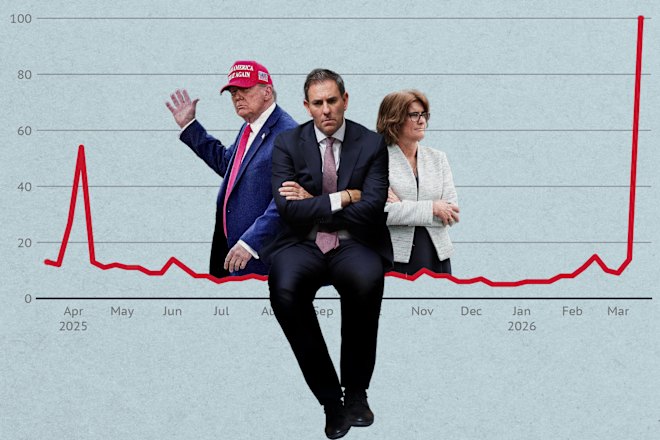
Australia’s economic landscape is facing renewed fears of a recession as the Reserve Bank of Australia (RBA) continues to hike interest rates amid soaring petrol prices and escalating global uncertainties. This development comes after Reserve Bank Governor Michele Bullock’s recent comments, which have intensified public concern about the nation’s economic future.
During a press conference on Tuesday, Bullock addressed the decision to raise official interest rates for the second consecutive month, acknowledging the potential risk of driving the country into a recession. “We don’t want to have a recession, but if it’s hard to get inflation down, then, you know, we’re going to have to deal with that possibility,” she stated. Her remarks have sparked a surge in online searches for “recession,” reflecting a growing anxiety among Australians.
Economic Context and Historical Parallels
Australia’s economy has been remarkably resilient, maintaining a record-breaking 29-year streak without a recession until the COVID-19 pandemic disrupted this trend. However, the brief recession in early 2020 was mitigated by substantial government financial support, leading many Australians to overlook its impact. The current economic climate, however, presents more complex challenges.
Consumer confidence has plummeted to its lowest level since March 2020, as indicated by the ANZ-Roy Morgan weekly measure. The combination of rising interest rates, inflationary pressures, and high petrol prices is creating a perfect storm for Treasurer Jim Chalmers and Finance Minister Katy Gallagher, who are preparing to release the government’s fifth budget in seven weeks.
Government Response and Economic Reform
The upcoming budget is under intense scrutiny, with Chalmers and Gallagher facing pressure to deliver significant economic reforms. The political landscape has shifted since Anthony Albanese’s decisive 2025 election victory, providing the government with a mandate to implement substantial fiscal changes.
Chalmers has been transparent about the economic challenges facing the nation, engaging in extensive discussions with economists and stakeholders. The May 12 budget is expected to introduce three major reform packages addressing spending cuts, productivity, and tax reforms. “I feel like the community, even though it’s under maximum pressure – cost-of-living pressure and other pressures – I feel like there is a level or a layer of understanding in the community that sometimes hard decisions are warranted,” Chalmers asserted.
Global Uncertainties and Economic Projections
Amidst domestic challenges, global uncertainties further complicate the economic outlook. The ongoing conflict in the Middle East, particularly the recent attack on the South Pars gasfield, has pushed oil prices towards $US120 per barrel. This volatility poses significant risks to Australia’s economic recovery and inflation control efforts.
Economist Chris Richardson describes the $US100-a-barrel scenario as the “Oh dear” one. The $US120 barrel is “Oh no”.
The RBA’s decision to raise interest rates was made on a narrow 5-4 vote, highlighting internal divisions over timing. Bullock emphasized the necessity of addressing inflationary pressures, particularly those stemming from high petrol prices. “If we don’t bring the excess demand down, then businesses are just going to build that into their costs. So it’s going to be even worse for everyone,” she explained.
Implications for the Future
As Australia grapples with these economic challenges, the path forward remains uncertain. The federal Treasury has modeled potential scenarios based on varying oil price levels, predicting significant impacts on inflation and economic growth. If oil prices remain elevated, the economy could face prolonged stagnation, with serious consequences for employment and financial stability.
The Reserve Bank’s recent financial system report underscores the potential risks posed by rising debt levels and market volatility. The report warns of a “disorderly repricing of assets” in response to adverse developments, which could destabilize the financial sector.
As Australians brace for potential economic turbulence, the government’s ability to navigate these challenges will be critical. The upcoming budget and RBA decisions will play pivotal roles in shaping the nation’s economic trajectory. Meanwhile, the public’s heightened awareness of recession risks underscores the need for clear communication and decisive action from policymakers.