


As an astrophysicist, my life is steeped in the wonders of space and the mysteries of the universe. This often makes me a discerning critic of science fiction books and films that delve into these topics. However, after attending a preview screening of the film adaptation of Andy Weir’s 2021 novel Project Hail Mary, I was moved to tears. The filmmakers not only honored the original story but also stayed true to the science at its core.
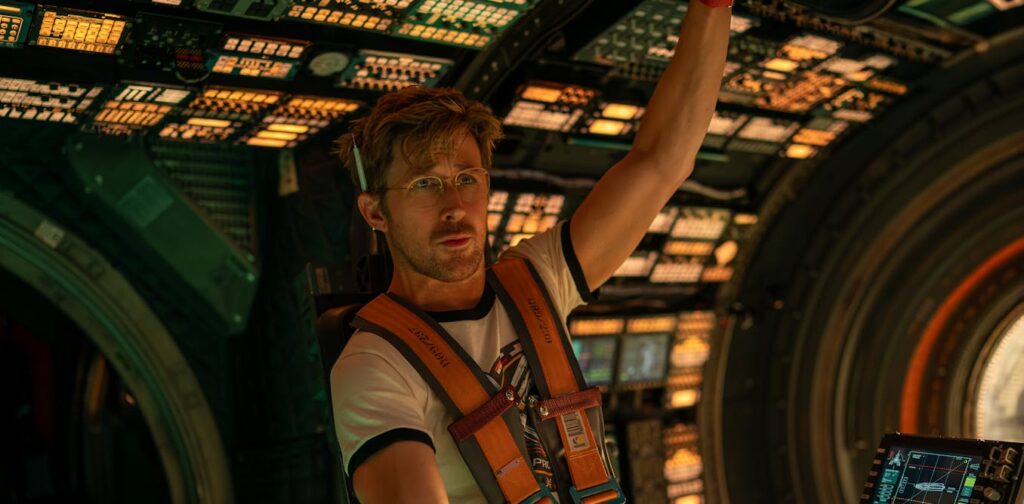
The narrative follows Ryland Grace, portrayed by Ryan Gosling, who awakens from a coma aboard a spaceship 11.9 light years from Earth, with no memory of his mission. As his memories gradually return, he realizes that the Sun is dying, and he is humanity’s last hope. The film, now showing in cinemas across Australia and New Zealand, blends hard science with fiction to create a compelling story.
The Science of a Dying Sun
In Project Hail Mary, the Sun’s demise is attributed to an alien organism spreading through our part of the Milky Way. This concept, while fictional, is grounded in the scientific theory of panspermia, which suggests that life can spread across solar systems. Although we lack concrete evidence, the theory is plausible. We’ve observed interstellar objects entering our Solar System, indicating that material can traverse vast distances.
If life forms could endure the harshness of space, they might spread in this manner, albeit as basic organisms. The movie’s alien organism, astrophage, remains firmly in the realm of science fiction, with its unique mechanics and behaviors.
Confronting the Vastness of Space
The idea of interstellar travel is daunting. Our galaxy contains over 400 billion stars, with only about 100 within 20 light years of Earth. Project Hail Mary focuses on Tau Ceti, located 11.9 light years away. Traveling there with our fastest spacecraft, the Apollo 10 module, would take 320,000 years.
To overcome this, the film employs the concept of special relativity, a theory developed by Albert Einstein in 1905. It posits that as objects approach the speed of light, time slows down in their reference frame. This phenomenon, known as a Lorentz transformation, is visually depicted in the film through Grace’s calculations on a whiteboard. His four-year coma is scientifically accurate due to time dilation experienced at such high speeds.
Encountering Extraterrestrial Life
During his mission, Grace encounters an alien named Rocky, who is also trying to save his world. The existence of aliens is a topic of scientific speculation, based on statistical probabilities rather than UFO sightings. With an estimated 100 billion planets in the Milky Way, the potential for life elsewhere is significant.
Amino acids, the building blocks of life, have been found in space, suggesting that the conditions for life may exist beyond Earth. This discovery fuels the belief that life could thrive in other solar systems.
Imagining Alien Worlds
The film invites viewers to imagine what alien planets might look like. Initially, scientific consensus supported the existence of planets around Tau Ceti and 40 Eridani A, Rocky’s home. However, recent data suggests these detections were false. Despite this, thousands of exoplanets have been confirmed, with 6,100 identified as of March 2026.
Grace and Rocky’s journey takes them to a theoretical planet orbiting Tau Ceti, depicted with vibrant colors and swirling gases reminiscent of Jupiter. These visuals highlight the potential diversity of alien worlds.
Project Hail Mary is more than a visually stunning adventure; it underscores the importance of our planet and the critical role of science in our survival. As we explore these fictional realms, we are reminded of the vast possibilities that science holds for understanding our universe.