
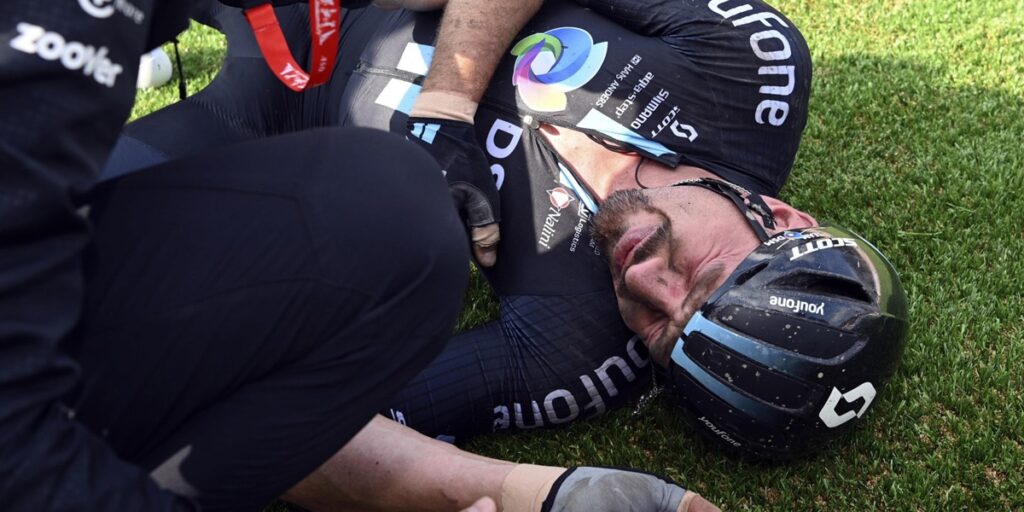
Roubaix - France - cycling - John Degenkolb (GER - Team DSM) pictured during 120th from Paris Roubaix (1.UWT) a one day race from Compiègne to Roubaix (256.6km) -photo POOL Franck Faugere/Cor Vos © 2023
Saying Relative Energy Deficiency in Sport (RED-S) doesn’t exist may sound like blasphemy to some and clickbait to others, but it’s a captivating title and the focus of a recent 2024 paper. If that question has you thinking, “Of course it exists — what the heck is this paper talking about?” Let’s hear the authors out.
The premise of the article, led by the well-respected exercise physiologist and nutritionist Asker Jeukendrup, is this: are we overfocused on energy, and are there other causes behind what many athletes experience under the umbrella of RED-S? My answer? Sometimes — and absolutely.
Understanding RED-S and Its Overlapping Conditions
RED-S, in its early conception, was framed as a gender-specific phenomenon known as the Female Athlete Triad — a syndrome of disordered eating, amenorrhea, and low bone mineral density. That changed in 2014 when the International Olympic Committee (IOC) broadened the concept into RED-S. The updated model was not gender-specific and included a wide range of additional signs and symptoms that healthcare practitioners and coaches were observing in the field.
In short, RED-S is a syndrome characterized by low energy availability — insufficient energy left over to support normal physiological function after accounting for exercise. The most recent update came in 2023.
Many of the signs and symptoms of RED-S are broad and can affect multiple systems of the body, including reduced metabolic rate, poor bone health, loss of menstruation, blood abnormalities, low libido, poor concentration, chronic fatigue, poor sleep, and constipation.
In this recent paper, the authors suggest that it is highly likely that the signs and symptoms experienced in RED-S are not solely a product of low energy availability, as the definition might imply, but rather that the causes are multifactorial. Considering the significant overlap in symptomology between RED-S and Overtraining Syndrome, that argument holds weight.
Stress, the HPA Axis, and System-Wide Effects
Stress on the body — whether from exercise load, competition, sleep disruption, travel, or life demands — affects the HPA axis in the brain. This is the body’s primary neuroendocrine system for managing stress. Because many of the body’s functions are automatic and governed by the nervous system, disturbances in the HPA axis can cast a broad array of effects across multiple systems. This helps explain why, in both overtraining and low-energy states, the symptoms can seem broad and “all over the place.”
A Shift in Framework: GAS and Allostatic Load
The authors state they are not attempting to reinvent the wheel or replace RED-S with a new model. Instead, they propose reframing the discussion using models that are more inclusive — specifically General Adaptation Syndrome (GAS) and the Allostatic Load model.
General Adaptation Syndrome (GAS)
The GAS model explains how the body responds to stress over time in three stages:
- Alarm – Detection of a stressor and activation of a short-term stress response.
- Resistance – Adaptation and coping. With proper recovery, this is where positive adaptation occurs.
- Exhaustion – If stress continues without adequate recovery, the body’s resources become depleted, leading to fatigue, illness, injury, or performance decline.
It’s also important to recognize that perception influences coping behaviors. Healthy recovery strategies versus restriction, overtraining, or avoidance are shaped by how we interpret stress. Stress is not purely physical — it is psychological as well.
The Allostatic Load Model
The allostatic load model expands on GAS. “Allostasis” means maintaining stability through change. When the body experiences a new or increasing stressor, hormones, the nervous system, immune function, and metabolism all adjust to help us cope.
One stressor increases load. Multiple stressors stack together. Over time, cumulative stress becomes an allostatic load.
If that load remains elevated for too long, it creates “wear and tear” on the body’s cardiovascular, hormonal, immune, metabolic, and reproductive systems. A prime example of the effect of stress stacking together: an athlete tries to maintain the same training workload while life stress increases — work deadlines, family demands, or financial pressure. As many coaches say, stress is stress. Perhaps that’s worth reiterating when investigating RED-S.
The Stress Bucket Analogy and the Bigger Picture
A helpful visualization tying overtraining, RED-S, allostasis, and GAS together is the stress bucket analogy. We all have a finite capacity for stress — our bucket. As stressors are added, the bucket fills. Without adequate recovery, the bucket overflows.
In athletes, this framework helps explain why performance decline or RED-S–related symptoms rarely come from a single cause. Instead, they often result from accumulated stress across multiple domains.
The authors cite eight domains that may contribute to symptoms seen in struggling athletes:
- Training Stress: Load, intensity, volume, monotony
- Life Stress: Work, family, competition, travel, social pressure
- Mental Health: Depression, anxiety, major life stress
- Disordered Eating: Restriction or unhealthy food behaviors
- Nutrition: Low energy, low carbohydrate/protein intake, micronutrient gaps
- Sleep: Poor quality or insufficient sleep
- Infection: Recurrent or lingering illness
- Medical Conditions: Thyroid, metabolic, cardiac, or other disease
When things start to fall apart — or when we’re investigating stagnation in health or performance — it’s critical to look at the complete picture. Taking a look at these 8 domains can provide a great starting point in this assessment. This self-assessment is hard to do alone and honestly. Which is yet another reason why having a team — dietitians, physicians, mentors, coaches, friends — matters.
In professional and collegiate sports, care teams monitor training load, discuss life challenges, and make coordinated adjustments to help athletes perform at their best in sport and life. For endurance athletes, where the solo rider or privateer often lacks that built-in team, the question becomes: can we increase awareness and help you build your own support system?
Because maybe the conversation isn’t “Does RED-S exist?” But rather, “When stress is accumulating, how do you best adjust — and who is in your corner to help you protect your health, longevity in sport, and performance?”