
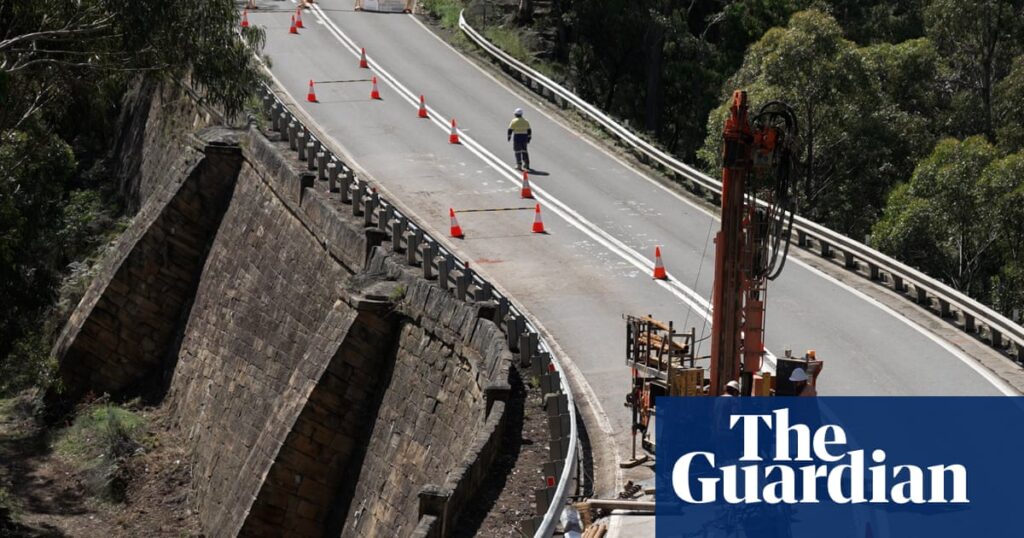
Almost two centuries ago, hundreds of convicts embarked on a monumental task in New South Wales’ Blue Mountains. They carved rock from the cliff face, constructed retaining walls, and built a road that would become known as Mitchells Causeway, or “Convict Bridge.” This vital link opened in 1832 and served the region for 194 years until its sudden closure last Sunday.
The closure of the Victoria Pass section of the Great Western Highway, a critical artery connecting Sydney to the central west, was prompted by the discovery of structural cracks. On Friday, NSW roads minister Jenny Aitchison announced that the road would remain closed for at least three months due to a “major geotechnical failure” that had significantly compromised the bridge’s integrity. Images of the site reveal snaking, longitudinal cracks that underscore the severity of the situation.
Approximately 12,000 vehicles traverse the bridge daily. The closure forces many to undertake lengthy detours, potentially adding up to two hours to their journey during peak times. While extra buses and trains have been deployed to mitigate the disruption, the situation has left locals frustrated and has reignited criticism over successive state governments’ failure to replace the bridge and address regional transport needs.
Community Outrage and Government Response
The announcement has sparked “red-hot anger” among residents. Former state and federal Coalition governments had initiated plans to widen a 34km stretch of road between Katoomba and Lithgow, including an 11km twin-tunnel from Blackheath to Little Hartley, beneath the existing Victoria Pass. However, the project was halted after the Perrottet government ceased funding in 2022, and the Minns government shelved it entirely in 2023 following the withdrawal of a $2bn federal commitment. Remaining funds were redirected to road maintenance in western Sydney and regional NSW.
Despite these setbacks, a $232m, 2.4km dual-lane “road to nowhere” was constructed at either end of the planned tunnel, bypassing Little Hartley but still connecting to the single-lane Victoria Pass. Minister Aitchison stated that at least two weeks of specialist testing and 3D imaging are required to fully assess the damage, with no traffic allowed during this period. “Under the most optimistic scenario,” she noted, repairs could take an additional two months.
“But there will be no shortcuts on safety – we will not risk lives,” Aitchison emphasized.
Lithgow Mayor Cassandra Coleman acknowledged the timeline and the provision of extra public transport, noting that businesses, particularly in Little Hartley, are “really hurting.” She cited one business that reported a 70% decline in revenue. Although Little Hartley remains accessible by car, it is excluded from a diverted route of the Great Western Highway between Mount Victoria and Lithgow.
Impact on Local Communities
Nationals state MP for Bathurst and former deputy premier, Paul Toole, whose electorate includes Victoria Pass, warned that exceeding the three-month timeline would exacerbate community anger. Since the closure, children in Hartley and Little Hartley have endured two-hour commutes home from school in Mount Victoria, a journey that previously took just 10 minutes.
Local resident Kylie Mackey expressed concern that the closure would limit her ability to visit her children in Sydney, anticipating a prolonged disruption: “It’ll be a hell of a lot longer than that.” The detour has redirected traffic onto Lithgow’s main street, causing damage from heavy vehicles. “It’s only been a week, and we’re already starting to see damage on our local roads,” Mackey reported.
Aitchison assured that additional resources would be allocated to reinforce roads bearing the extra load. The diversion adds 25 minutes to a journey, with longer delays expected during peak times and weekends. A local health district spokesperson acknowledged the impact on staff, patients, and visitors, advising them to “plan their journey, follow diversion signs, and allow extra time.” However, they confirmed that there are no disruptions to hospital services in Lithgow or the Blue Mountains.
Long-Term Solutions and Historical Context
While the state and federal governments have yet to commit to financial relief for affected businesses or residents, Minister Aitchison is working towards a “whole of government response.” She did not directly address whether the government would reconsider the shelved tunnel plan, stating that “nothing was off the table.” She rejected claims that the Minns government had underfunded regional roads, citing substantial maintenance investments.
Paul Toole criticized the lack of a long-term vision, contrasting it with federal plans for a $90bn fast rail from Sydney to Newcastle. “If it was in Sydney, Newcastle, or Wollongong, the project would go ahead, but it seems that regional communities are forgotten,” he argued. Mayor Coleman maintained that the Coalition’s original plans were “possible and feasible.”
For many, the closure was not unexpected. David Wilpour, a Lithgow resident, recalled a scare about the bridge collapsing in the late 1970s. “I’m quite amazed it’s lasted another 47-odd years,” he remarked. Behzad Fatahi, a civil engineering professor at the University of Technology Sydney, described the bridge’s longevity as “phenomenal,” noting its lack of modern structural elements. Engineers are investigating the cause of the cracks, which may be due to the movement of the northern retaining wall or the deterioration of the original crushed stone.
Fatahi suggested a medium-term solution: “injecting cement mixed with water into the empty space, shoring up the original structure.”
He also proposed designing and constructing tunnels as a long-term solution to bypass challenging areas. Meanwhile, residents are adapting to the longer, diverted route, compounded by fears of fuel shortages due to the Middle East conflict. Toole reported lines of trucks “burning additional diesel while fuel prices are skyrocketing.”
One resident, who wished to remain anonymous, described the diversion onto her Lithgow street as leaving her “extremely sleep deprived.” Her neighbors have dubbed their street the “New Great Western Highway.”
As the community grapples with the immediate impact, the broader implications for regional infrastructure and planning remain a pressing concern.