




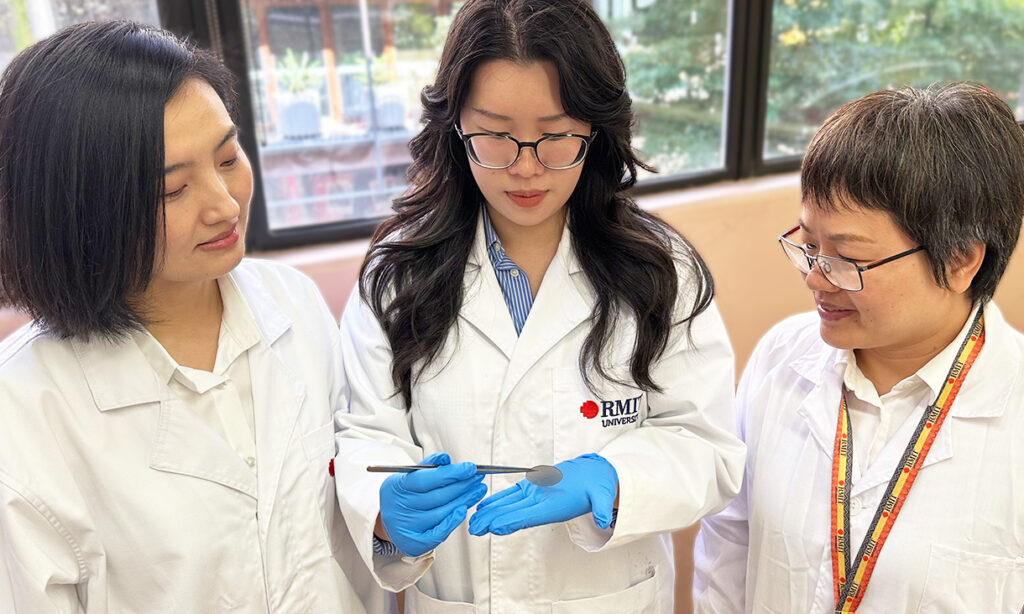
Chronic wounds pose a significant challenge to healthcare systems worldwide, necessitating complex and continuous care. In a groundbreaking development, researchers at RMIT University have unveiled a smart bandage that not only monitors infections but also administers therapeutic treatments, potentially transforming chronic wound management.
The innovative dressing integrates tiny, multifunctional nanomaterials, known as carbon dots, into a hydrogel matrix. These carbon-based nanoparticles serve dual functions: they can sense changes in the wound environment and act as therapeutic agents to combat inflammation. This dual capability marks a significant advancement in the field of smart wound dressings.
Breakthrough in Wound Monitoring and Treatment
Smart wound dressings have been explored for their potential to monitor infections or deliver healing agents. However, combining both functionalities into a single dressing has been a formidable challenge—until now. The RMIT team’s approach allows the smart bandage to change color in response to pH changes indicative of infection. This visual cue can be easily detected by portable smart devices, prompting the automatic release of therapeutic nanozymes to promote healing.
According to Nan Nan, a PhD candidate and the study’s first author, the smart patch’s dual nature facilitates timely and effective clinical interventions. “Being able to address potential infection at the earliest opportunity is critical to chronic wound management, making this real-time system a potential game-changer for healthcare,” she stated.
Scalability and Commercial Potential
The fabrication process developed by the researchers uses medically ready materials, such as hydrogels, to embed carbon dots. This process is not only straightforward but also scalable, offering strong potential for commercial translation. “Our approach integrates sensing and dual-mode therapeutic functions into a single dressing with a simple, streamlined design,” said Dr. Haiyan Li, a Senior Lecturer at RMIT’s School of Engineering. “This helps address some of the key challenges that have previously limited commercial translation.”
Dr. Li emphasized that many smart wound dressings developed in research settings struggle to become clinical products due to their complexity and cost. The RMIT team’s innovation offers a promising and adaptive platform that overcomes these barriers.
Next Steps and Future Implications
The initial studies were conducted at the laboratory scale, with further validation in vivo being a crucial next step. The research team is actively seeking industry partnerships to refine and scale up the technology for market readiness. Dr. Lei Bao, the study lead and Senior Lecturer at RMIT, highlighted the importance of further biological testing and design refinement for clinical use.
“Our next step is to evaluate how this technology performs in more advanced biological models and to work with industry partners to refine the design for real clinical use,” Dr. Bao explained. “Ultimately, our goal is to translate this research into practical smart wound dressings and integrate this smart platform into a digital health ecosystem.”
The team conducted their research at RMIT’s state-of-the-art Micro Nano Research Facility and Microscopy and Microanalysis Facility. Their findings, published in the journal Chemical Engineering Science, lay the groundwork for future advancements in smart wound care technology.
As the healthcare industry continues to seek innovative solutions for chronic wound management, the RMIT team’s smart bandage represents a significant leap forward. By providing real-time monitoring and treatment capabilities in a single, scalable product, this innovation holds the potential to improve patient outcomes and reduce the burden on healthcare systems globally.