




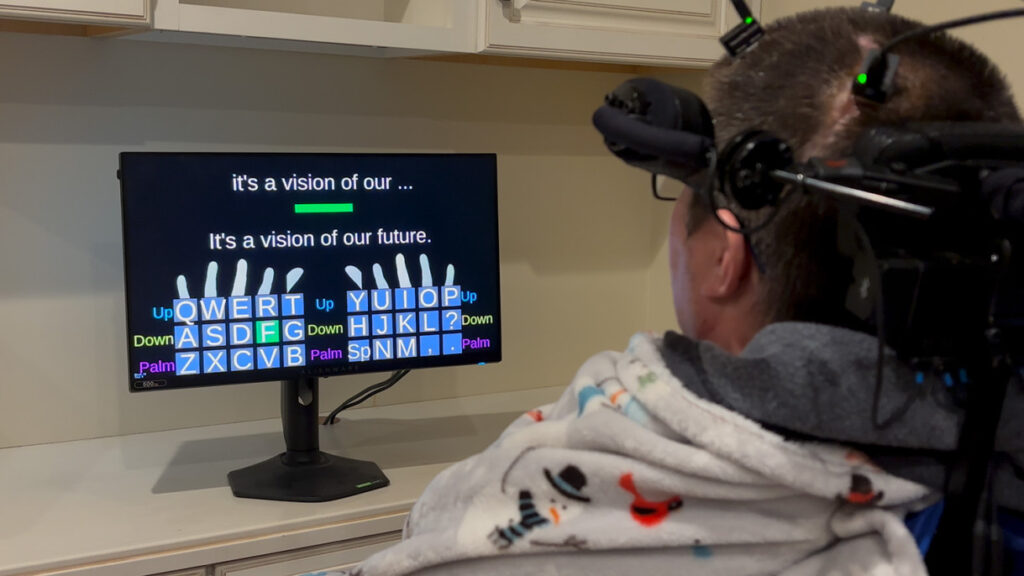
PROVIDENCE, R.I. — In a significant advancement for individuals with paralysis, researchers from Mass General Brigham Neuroscience Institute and Brown University have developed a brain-computer interface (iBCI) that significantly improves communication speed and accuracy. This innovative technology, detailed in a study published in Nature Neuroscience, offers new hope for those who have lost the ability to speak or use their hands.
The investigational implantable device was tested on two participants from the BrainGate clinical trial—one with amyotrophic lateral sclerosis (ALS) and another with a cervical spinal cord injury. The iBCI utilizes a QWERTY keyboard interface and attempted finger movements to facilitate communication, demonstrating remarkable performance in these trials.
Revolutionizing Communication for the Paralyzed
Dr. Daniel Rubin, a critical care neurologist at the Center for Neurotechnology and Neurorecovery, highlighted the challenges faced by people with severe speech and motor impairments. “For many people with paralysis, when losing use of both the hands and the muscles of speech, communication can become difficult or impossible,” Rubin explained. Current alternatives, such as eye-gaze technology, are often slow and frustrating for users. “BCIs are on track to become an important new alternative to what’s currently offered,” he added.
The BrainGate team, a consortium of experts from various fields, has been working since 2004 to enhance communication and mobility tools for individuals with neurological conditions. Dr. Leigh Hochberg, a professor of engineering and brain science at Brown, emphasized the collaborative effort behind the BrainGate project. “The BrainGate consortium demonstrates the strength of academic and university-based researchers working together,” he noted.
How the iBCI Typing Neuroprosthesis Works
The new iBCI typing neuroprosthesis begins with microelectrode sensors implanted in the motor cortex, the brain region responsible for movement control. A QWERTY keyboard is displayed to the participant, with each letter mapped to specific finger movements. As the participant attempts these movements, the electrodes detect the brain’s electrical activity, which is then translated into letters by a computer system. This output is refined through a predictive language model to ensure accurate communication.
“Two clinical trial participants, one with advanced ALS and the other with a spinal cord injury, used this new iBCI typing neuroprosthesis to communicate rapidly and accurately.”
One participant achieved a typing speed of 110 characters or 22 words per minute, with a word error rate of just 1.6%, comparable to able-bodied typing accuracy. Both participants successfully used the device in their homes, showcasing its potential for everyday use.
Future Prospects and Implications
Justin Jude, a postdoctoral researcher at Mass General Brigham and first author of the study, sees this development as a stepping stone towards restoring more complex motor functions. “Decoding these finger movements is also a big step toward being able to restore complex reach and grasp movements for people with upper extremity paralysis,” Jude stated.
There is potential for further improvements, such as incorporating stenography or personalized keyboards to enhance typing speed. “Our BCI is a great example of how modern neuroscience and artificial intelligence technology can combine to create something capable of restoring communication and independence for people with paralysis,” Jude added.
Research and Development Support
The study involved contributions from a diverse team, including Levi-Aharoni, Alexander J. Acosta, Shane B. Allcroft, Claire Nicolas, Bayardo E. Lacayo, Nicholas S. Card, Maitreyee Wairagkar, Alisa D. Levin, David M. Brandman, Sergey D. Stavisky, Francis R. Willett, Ziv M. Williams, and John D. Simeral. The research was supported by various institutions, including the Office of Research and Development, Department of Veterans Affairs, NIH, and others.
CAUTION: Investigational device. Limited by federal law to investigational use.
As the field of restorative neurotechnology continues to evolve, the BrainGate project represents a promising frontier in enhancing the quality of life for individuals with paralysis. The ongoing research and collaboration among scientists and medical professionals pave the way for future innovations that could further bridge the gap between current limitations and the needs of those affected by neurological impairments.