



A meteorite chip sat in a small container, bathed in liquid, while the International Space Station floated overhead. Inside, a fungus spread thin threads across the rock, and a bacterium built a slick biofilm. The question was simple to ask but harder to test: In microgravity, can microbes pull valuable metals out of asteroid-like material? A team from Cornell University and the University of Edinburgh says yes, at least in a proof-of-concept sense, with the fungus doing the heavy lifting for one of the most sought-after metals in the sample.
The experiment, known as BioAsteroid, was reported in the journal npj Microgravity. It compared a bacterium, Sphingomonas desiccabilis, a fungus, Penicillium simplicissimum, and a mixed “consortium” of both. Lead author Rosa Santomartino, an assistant professor of biological and environmental engineering at Cornell, collaborated with co-author Alessandro Stirpe, a research associate in microbiology. Charles Cockell, a professor of astrobiology at the University of Edinburgh, is the senior author.
A Space Test for Biomining
Biomining relies on microbes that help break down rock and release useful elements. On Earth, this approach can speed up extraction and reduce the need for toxic chemicals such as cyanides. The space angle is different; if humans aim to live and work far from Earth, they will need ways to utilize local materials instead of constantly resupplying.
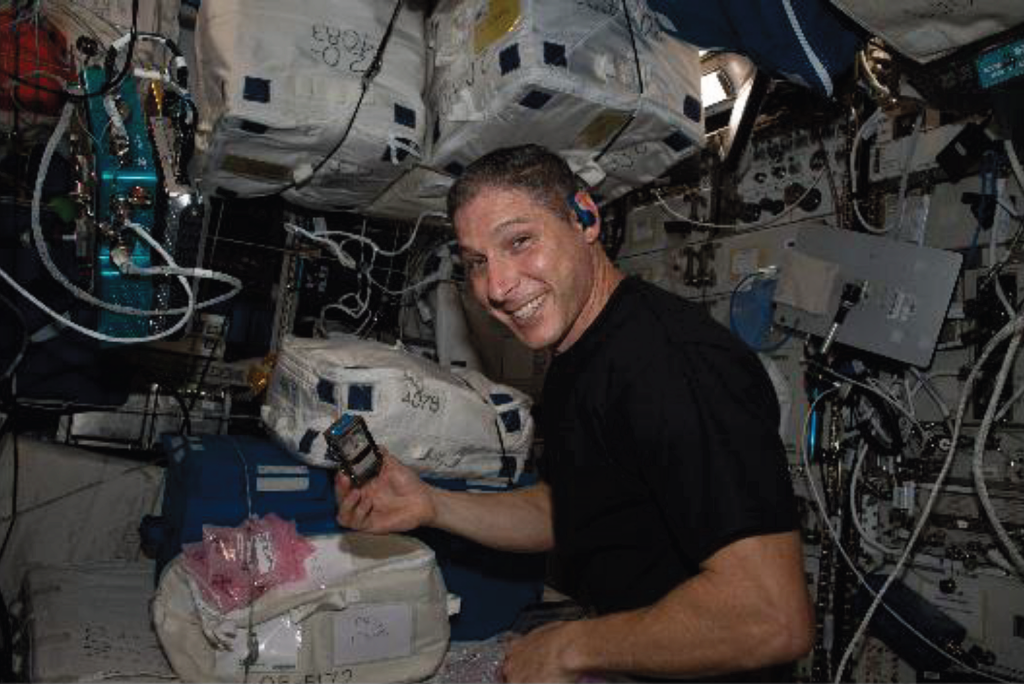
BioAsteroid put that idea into hardware and sent it to orbit. NASA astronaut Michael Scott Hopkins carried out the on-station work, installing the experiment containers into KUBIK incubators. Samples ran for 19 days, while the researchers conducted a parallel control experiment on Earth under normal gravity.
What the Microbes Did to the Rock
Microscopy showed that both organisms could colonize the meteorite fragments in orbit and on Earth. The bacterium formed a contiguous biofilm across many areas of the surface in both conditions. The fungus developed mycelia on the rock fragments in both conditions, and the authors did not report major qualitative changes in shape tied to gravity.
Cells often clustered around minerals bearing magnesium, oxygen, and silicon, which fits the meteorite’s silicate-rich makeup. They interacted less often with minerals bearing iron and sulfur.
Then came the leaching measurements. The team measured concentrations of 44 elements in the liquid around the rock, using ICP-MS. Statistical analysis flagged 22 elements as potentially relevant for deeper investigation, focusing first on three platinum group elements: ruthenium, palladium, and platinum.
Microgravity’s Impact on Metal Extraction
Under microgravity, the fungus stood out. Compared with non-biological controls in orbit, P. simplicissimum enhanced mean leaching for all three platinum group elements. In the ISS samples, mean extraction in the presence of the fungus reached 19.29% of the ruthenium in the rock, 11.91% of the palladium, and 0.29% of the platinum.
The “consortium” often looked similar to the fungus alone, but palladium was the exception. In microgravity, the consortium’s palladium extraction dropped to 3.74% of the palladium present in the meteorite, even while ruthenium and platinum tracked closer to the fungal-only condition.
On Earth, the pattern shifted. Enhanced leaching of ruthenium and platinum appeared with both organisms, alone or together, with reported increases spanning 142.2±19.9% to 218.9±67.5% of the non-biological control. Palladium, however, went the other direction under terrestrial gravity. Palladium leaching was reduced by the presence of the microbial species on Earth.
Implications for Space Resource Utilization
One of the more striking results had nothing to do with microbes. The team compared non-biological controls in microgravity versus on Earth to see how gravity affects “abiotic” leaching. Palladium behaved dramatically differently, with mean palladium extraction of 2.2±0.6% of the metal present in microgravity, versus 29.5±6.7% under terrestrial gravity, a 13.6-fold increase on Earth.
Platinum moved in the opposite direction, with 0.2±0.0% in microgravity versus 0.13±0.02% on Earth, a 1.8-fold increase in space. Ruthenium’s mean extraction was higher in microgravity too, 14.8±2.2% in space versus 6.6±2.1% on Earth.
Beyond the platinum group, the study reports that abiotic leaching in microgravity changed for 11 elements. Aluminium showed a 6.8-fold increase in microgravity, and iron showed a 4.3-fold increase. Sodium, in contrast, leached more under terrestrial gravity, with a 1.4-fold increase on Earth.
The Economic and Scientific Significance
The authors suggest altered fluid dynamics in microgravity, such as reduced convection, could change how quickly dissolved elements move away from a rock surface. However, this explanation does not neatly fit every element-specific pattern observed.
Using a palladium price of $36.39 per gram, the researchers estimate that palladium extracted under microgravity by the fungus, scaled to a 1000 m³ tank under their experimental conditions, would be about $10. They call that economically negligible, emphasizing resource self-sufficiency over short-term profit.
Research findings are available online in the journal npj Microgravity. The original story “Scientists use microbes on ISS to extract valuable metals from meteorites” is published in The Brighter Side of News.