




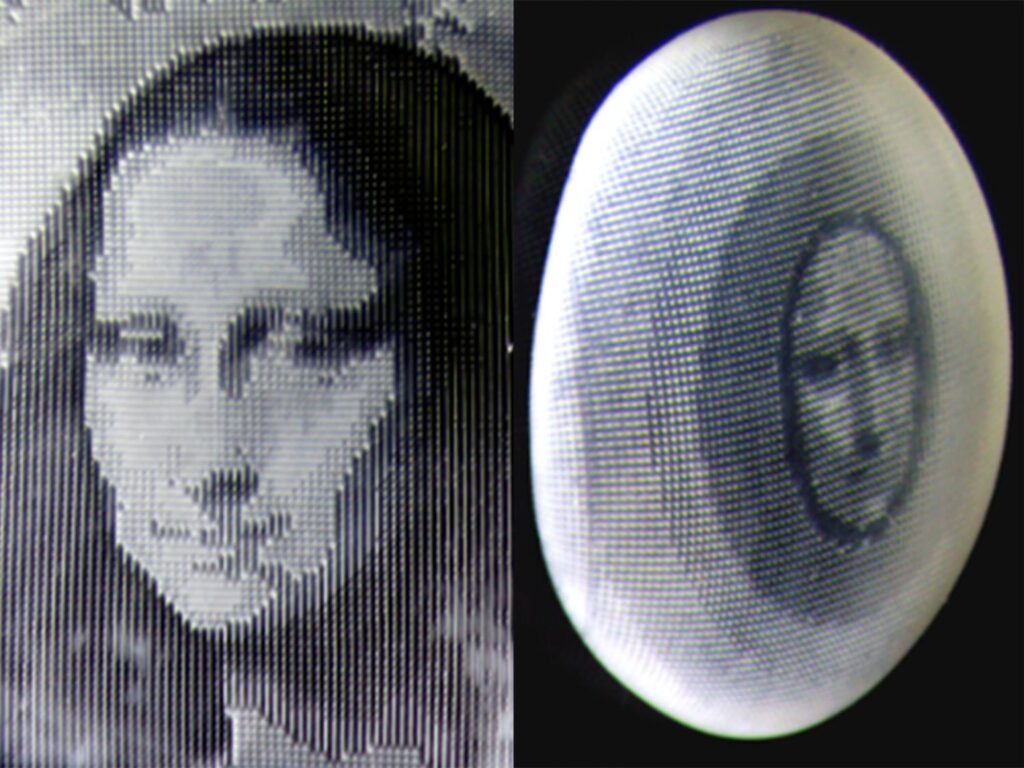
At first glance, it appears as a simple, slightly glossy sheet. However, with a quick immersion in water and a shift in temperature, a famous face emerges from obscurity. In a groundbreaking demonstration, a hydrogel film, a water-rich material akin to soft contact lens plastic, unveiled the Mona Lisa. This image was not printed with ink but encoded within the material itself, remaining invisible until specific conditions activated its reveal.
This innovative technology is part of a larger initiative at Penn State University to develop what researchers term a programmable “smart synthetic skin.” This thin, shape-shifting material can alter its appearance, texture, and mechanical behavior when exposed to external stimuli such as heat, solvents, or physical stress.
Inspired by Nature’s Masters of Disguise
Hongtao Sun, an assistant professor of industrial and manufacturing engineering at Penn State and the project’s principal investigator, cites cephalopods, including octopuses, as the inspiration behind this concept. These creatures can dynamically control their skin’s appearance and texture to blend into their surroundings or communicate with each other.
“Cephalopods use a complex system of muscles and nerves to exhibit dynamic control over the appearance and texture of their skin,” Sun explained. “Inspired by these soft organisms, we developed a 4D-printing system to capture that idea in a synthetic, soft material.”
The team’s research, detailed in a paper published in Nature Communications and featured in Editors’ Highlights, showcases the potential of this technology.
Printing Instructions into a Soft Sheet
Sun describes the process as 4D printing, where a three-dimensional object is created with properties that can change over time in response to environmental conditions. In this instance, the object is a hydrogel film, and the “fourth dimension” refers to its ability to morph or shift when stimulated.
The critical step involves what Sun calls halftone-encoded printing. This method builds images from dot patterns, similar to those used in newspapers and photographs. The team applied this logic to translate image or texture data onto a surface as binary information, encoding it into the material.
“In simple terms, we’re printing instructions into the material,” Sun explained. “Those instructions tell the skin how to react when something changes around it.”
These hidden instructions dictate how different regions of the hydrogel respond. When exposed to changing temperatures, liquids, or mechanical forces, some areas can deswell or soften more than others. With careful design, the entire sheet can exhibit programmed behaviors, from subtle surface texture changes to dramatic shape transformations.
The Mona Lisa That Disappears in Ethanol
Haoqing Yang, a doctoral candidate in industrial and manufacturing engineering at Penn State and the paper’s first author, highlighted the encryption and reveal effect as a striking demonstration. The team encoded an image of the Mona Lisa onto the smart skin. When the film was washed with ethanol, it appeared transparent, with no visible image. However, after immersion in ice water or gradual heating, the Mona Lisa became fully visible.
“This behavior could be used for camouflage, where a surface blends into its environment, or for information encryption, where messages are hidden and only revealed under specific conditions,” Yang said.
The researchers also demonstrated that information could be uncovered through touch and deformation, not just sight. By gently stretching the film and measuring its deformation using digital image correlation analysis, they revealed patterns that were otherwise hidden. This capability opens the door to new security applications, where a message might require specific mechanical manipulation and measurement methods to decode.
Beyond Images: Texture and Shape Changes
The hydrogel’s versatility extends beyond hiding and revealing images. Sun noted that the smart skin could transform from a flat sheet into bio-inspired shapes with complex textures. Unlike many shape-morphing materials that rely on multiple layers or material mixes, the Penn State approach achieves shape and texture control through digitally printed halftone patterns within a single sheet.
The team further demonstrated that the material could combine functions simultaneously. By co-designing halftone patterns, they encoded the Mona Lisa into flat films that later transformed into 3D shapes. As the flat sheets curved into dome-like structures, the hidden image gradually became visible.
“Similar to how cephalopods coordinate body shape and skin patterning, the synthetic smart skin can simultaneously control what it looks like and how it deforms, all within a single, soft material,” Sun said.
Engineering Toughness and Stretch
The research also delves into how patterned hydrogel films can be engineered for enhanced mechanical behavior. By using spatiotemporal control over photo-polymerization through dynamic light projection grayscale lithography in a digital light processing 3D printer, the team created hydrogel films with stiff, cellular-like pattern domains embedded in softer film regions. These patterns enable localized strain behavior in softer regions under stretching.
The team reports a more than threefold increase in ultimate strength and an 80 to 150 percent increase in material toughness compared to non-patterned films.
They utilized in-situ digital image correlation strain mapping to observe how deformation localized in different subregions and tracked deformation patterns using fast Fourier transform analysis of pattern domains.
Future Prospects and Practical Implications
Alongside Sun and Yang, other Penn State co-authors include Haotian Li and Juchen Zhang, doctoral candidates in industrial and manufacturing engineering, and Tengxiao Liu, a lecturer in biomedical engineering. The collaboration also involved H. Jerry Qi, a mechanical engineering professor at the Georgia Institute of Technology.
Sun expressed the team’s ambition to develop a general and scalable platform for precise digital encoding of multiple functions into a single adaptive smart material system.
“This interdisciplinary research at the intersection of advanced manufacturing, intelligent materials, and mechanics opens new opportunities with broad implications for stimulus-responsive systems, biomimetic engineering, advanced encryption technologies, biomedical devices, and more,” Sun said.
If the approach scales as anticipated, it suggests a future where soft surfaces can do more than merely hold shape. A film could conceal identifying markers that only appear under specific conditions, such as a solvent wash or temperature shift. Devices could alter surface texture or geometry without motors or layered materials. Furthermore, the ability to reveal information through deformation and measurement could support security schemes reliant on physical handling and sensing.
The research findings are available online in the journal Nature Communications.