




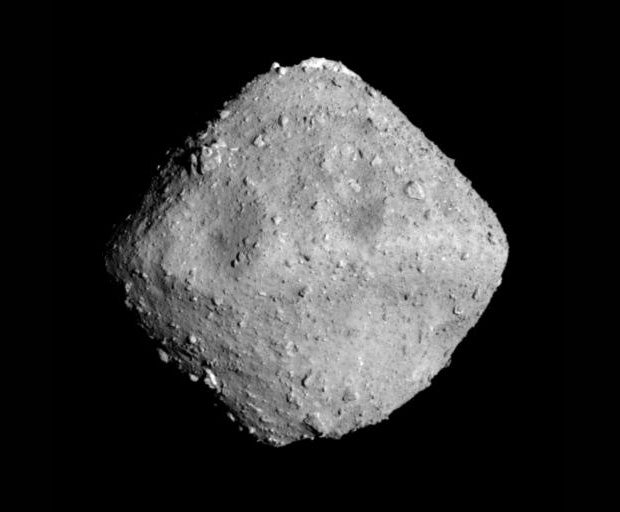
A 900-meter asteroid, Ryugu, is traversing our solar system, offering compelling evidence that life on Earth may have extraterrestrial origins. A Japanese research team has published groundbreaking findings in the journal Nature Astronomy, revealing that all five nucleobases—the essential molecular components of DNA and RNA—were found in samples from Ryugu.
This discovery is a significant advancement in understanding the origins of life. Over two years ago, the identification of uracil in Ryugu samples hinted at a broader picture. The confirmation of adenine, guanine, cytosine, thymine, and uracil in these samples, which traveled over 300 million kilometers to Earth, strengthens the hypothesis that life’s building blocks may have been delivered from space.
Sample Collection and Contamination Challenges
The samples were collected by Japan’s Hayabusa2 mission, which began in 2014. The spacecraft landed on Ryugu twice, collecting 5.4 grams of material and returning them to Earth in December 2020. These samples are particularly valuable as they have not been exposed to Earth’s atmosphere, preserving their pristine extraterrestrial state.
Previous studies on meteorites like the Murchison and Orgueil have shown the presence of nucleobases. However, contamination from Earth’s atmosphere and environment often complicates the determination of their extraterrestrial origin. In contrast, Ryugu’s samples provide a clearer picture, having traveled directly from space.
Patterns Across the Solar System
The analysis of Ryugu’s samples involved multiple detection methods, confirming the presence of nucleobases. These findings align with results from NASA’s OSIRIS-REx mission, which discovered similar compounds on the asteroid Bennu. The presence of all five canonical nucleobases in samples from two separate asteroids, collected by different space agencies, suggests a widespread distribution of these molecules across the solar system.
Each sample exhibited different nucleobase distributions, reflecting the unique chemical evolution of their parent bodies. The variations provide insights into the conditions, such as water flow and temperature, that influenced their formation.
Correlations and Chemical Pathways
The discovery of nucleobases on Ryugu does not confirm life on the asteroid but indicates that non-biological pathways for abiogenesis could exist throughout the solar system. The correlation between nucleobase ratios and ammonia concentrations, with an R² value of 0.89, suggests an unknown pathway for nucleobase formation in pre-solar materials.
Dr. Koga, a co-author from the University of Hawaii, emphasizes that while the findings do not suggest life originated in space, they provide crucial insights into the types of organic matter that can develop in non-biological conditions.
Independent Perspectives and Study Limits
Dr. Morgan Cable from Victoria University of Wellington describes the findings as “novel,” highlighting their significance in understanding biomolecule formation. However, the study authors and independent researchers caution against concluding that these nucleobases indicate past life on Ryugu. The asteroid’s cold, airless nature, lacking liquid water, supports abiotic chemistry rather than biological activity.
Dr. Cesar Menor-Salvan, an astrobiologist at the University of Alcala, notes that while the research provides insights, it does not support the theory of life’s origin in space. Instead, it highlights the potential for organic matter to develop in non-biological environments.
Requirements for Life and Chemical Delivery
Life requires more than nucleobases; it needs a defined molecular structure, including sugars and phosphates, and an environment that supports replication. Asteroids like Ryugu may have delivered these genetic materials and base chemicals to early planets through impacts.
The Ryugu samples contained more than nucleobases, including vitamin B3, amino acids, urea, and ethanolamine. These compounds, formed through non-biological pathways, suggest they existed before Ryugu formed, rather than resulting from contamination.
Long-Term Chemical Processes in Space
Ryugu’s samples also contained compounds likely formed under high-energy radiation conditions. Laboratory studies indicate these compounds can produce amino acids and sugars from simple nitrogen-containing molecules. Such chemical environments could have persisted for billions of years, facilitated by short-lived radioactive species in Ryugu’s parent body.
The findings from Ryugu support the hypothesis that prebiotic chemicals were delivered to Earth during a period of intense bombardment around 4 billion years ago. For this theory to be valid, these chemicals must form through non-biological processes and remain stable over time. Ryugu’s results support both conditions.
The relationship between nucleobase production and ammonia provides a new direction for laboratory experiments, potentially explaining how different environments produce genetic building blocks. Comparisons with samples from other asteroids, and eventually comets, will further this understanding.
For the general public, the key takeaway is that the molecules carrying genetic instructions for life on Earth have been preserved in asteroid material for much of the solar system’s history, awaiting discovery.
Research findings are available online in the journal Nature Astronomy.