



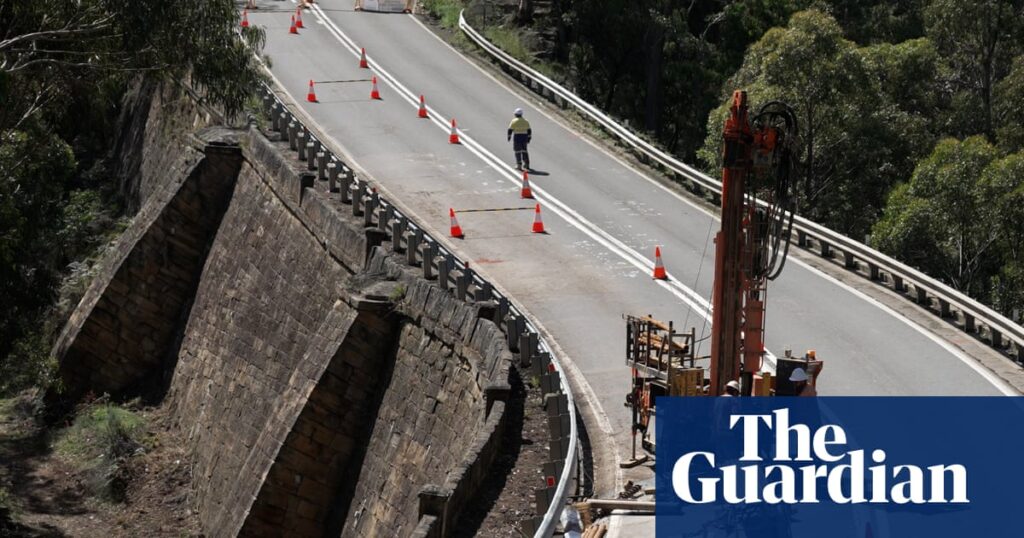
Almost two centuries ago, hundreds of convicts undertook a formidable task in New South Wales’ Blue Mountains. They carved rock from the cliff face, assembled sandstone, and constructed retaining walls to build a road. This road, known as Mitchells Causeway or “Convict Bridge,” opened in 1832 and served the region for nearly 200 years. However, last Sunday marked a significant change.
Transport for NSW closed the Victoria Pass section of the Great Western Highway, a vital link between Sydney and the central west, after discovering structural cracks. On Friday, NSW roads minister Jenny Aitchison announced that the road would remain closed for at least three months due to a “major geotechnical failure” that had caused the bridge to shift significantly. Images reveal snaking, longitudinal cracks on the road surface, indicating the underlying strain.
Impact on Local Communities and Transport
The closure affects approximately 12,000 vehicles that use the bridge daily, forcing many to take significant detours that can add up to two hours to their journeys during peak times. Despite additional buses and trains being provided, the situation has left locals concerned about the prolonged disruption and has sparked criticism over the lack of infrastructure investment in regional transport.
Former state and federal Coalition governments had initially funded a 34km road widening project between Katoomba and Lithgow, which included plans for an 11km twin-tunnel beneath the existing Victoria Pass. However, in 2022, the Perrottet government halted further funding, and the Minns government shelved the project in 2023 after the Albanese government withdrew a $2 billion federal commitment. Instead, funds were redirected to maintain roads across western Sydney and regional NSW.
“One business said today that they’ve literally lost 70% of their takings,” said Cassandra Coleman, Labor mayor of Lithgow.
Community Reactions and Government Response
The closure has incited “red-hot anger” among locals, as described by Nationals state MP for Bathurst, Paul Toole. He warned that any delay beyond the three-month timeline would exacerbate community frustration. Residents like Celine Watz and Kylie Mackey have expressed concerns about the impact on daily life, with children facing extended travel times to school and personal visits to Sydney becoming more challenging.
Aitchison stated that at least two weeks of specialist testing and 3D imaging are necessary to assess the full extent of the damage. “Under the most optimistic scenario,” she noted, the work to make the road safe would take at least a further two months. She acknowledged the disruption to families, businesses, and schools, emphasizing that safety would not be compromised.
“But there will be no shortcuts on safety – we will not risk lives,” Aitchison affirmed.
Long-term Solutions and Historical Context
The closure has reignited discussions about long-term solutions for the region’s transport infrastructure. Professor Behzad Fatahi, a civil engineering expert from the University of Technology Sydney, highlighted the bridge’s historical resilience. He suggested medium-term solutions like injecting cement into the structure and long-term options such as constructing tunnels to bypass challenging areas.
“I’m quite amazed it’s lasted another 47-odd years,” remarked local resident David Wilpour, referencing past concerns about the bridge’s stability.
Meanwhile, the diversion of traffic onto Lithgow’s main street has begun to strain local roads, with reports of damage from heavy vehicles. Aitchison has pledged additional resources to strengthen these roads, although the detour adds 25 minutes to journeys, with longer delays expected during peak times.
Future Implications and Government Accountability
The road closure’s broader implications extend beyond immediate travel disruptions. The lack of financial relief for affected businesses and residents has raised questions about government accountability. Aitchison mentioned working towards a “whole of government response” but did not confirm whether the tunnel project would be reconsidered.
Toole criticized the lack of a long-term vision, contrasting it with federal discussions about a $90 billion fast rail project from Sydney to Newcastle. He emphasized the disparity in attention given to regional communities compared to metropolitan areas.
As residents adjust to the new travel realities, concerns about fuel shortages due to the Middle East conflict add another layer of complexity. Reports of trucks idling in traffic, consuming additional fuel, highlight the ongoing challenges faced by the community.
“The neighbours have called our street the ‘New Great Western Highway’,” lamented a resident affected by the increased traffic on her street.
As the situation unfolds, the community remains vigilant, hoping for a timely resolution and a renewed focus on sustainable infrastructure development in the region.