




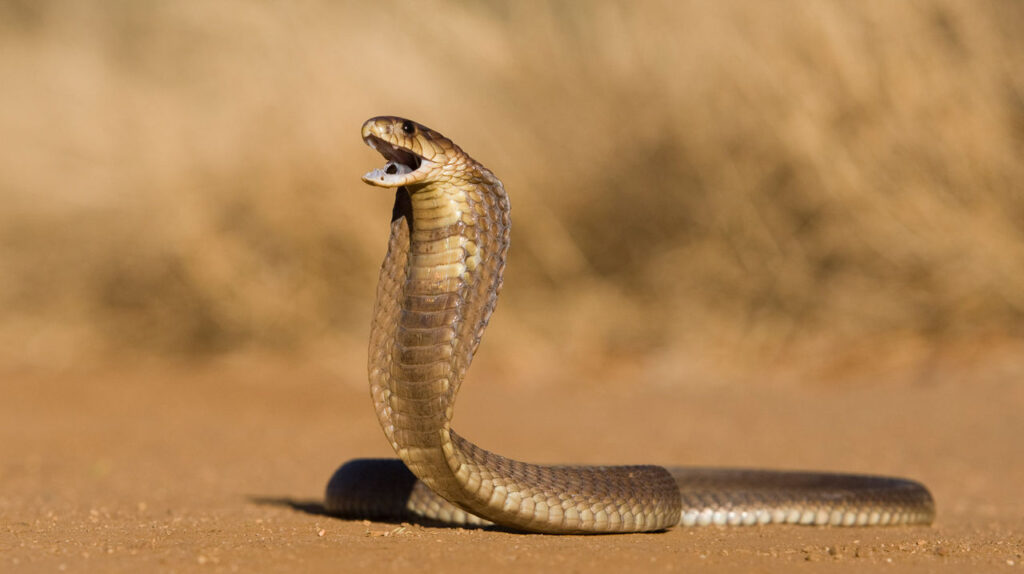
A snouted cobra (Naja annulifera) with hood up and mouth open in a warning posture
In a groundbreaking study, researchers have unveiled the mystery behind how snakes manage to stand upright without the aid of limbs. This revelation, highlighted by science outlets such as Earth.com and Discover magazine, is the result of a collaborative effort between University of Cincinnati Professor Bruce Jayne and engineering researchers from Harvard University. The study, published in the prestigious Journal of The Royal Society Interface, delves into the physics that enable snakes to perform this remarkable feat.
Professor Jayne, a renowned biologist at UC’s College of Arts and Sciences, has long been fascinated by snake locomotion. His work, in partnership with Harvard’s engineering team, combines biology, mathematics, and mechanical modeling to dissect the intricate balancing act that allows snakes to stand upright. The research reveals that snakes do not need to stiffen their entire bodies to span gaps or reach upwards. Instead, they rely on muscle rigidity near the base of their bodies, where their weight is predominantly supported.
The Mechanics of Snake Balance
The study’s findings underscore the importance of balance and strength in a snake’s ability to stretch upward or outward. According to the researchers, the key lies in the snake’s ability to maintain equilibrium while extending its body. This discovery not only sheds light on the physical capabilities of snakes but also opens new avenues for understanding the mechanics of limbless locomotion.
Professor Jayne’s previous research has explored various ways snakes navigate complex terrains, including tunnels, sand dunes, and branches. In 2021, he identified a unique climbing method used by snakes such as the brown tree snake, which he termed “lasso locomotion.” This technique allows snakes to scale wide-barreled objects like tree trunks or light poles with remarkable agility.
Historical Context and Evolutionary Insights
The ability of snakes to stand upright is not just a modern curiosity but a testament to their evolutionary adaptability. Snakes have been honing their locomotion skills for millions of years, evolving from legged ancestors to the limbless creatures we see today. This evolutionary journey has equipped them with the muscular and skeletal adaptations necessary to thrive in diverse environments.
According to evolutionary biologists, the transition from limbs to limblessness was driven by the need to navigate narrow burrows and dense vegetation. Over time, snakes developed specialized muscles and vertebrae that allow for incredible flexibility and strength, enabling them to perform feats such as climbing, swimming, and standing upright.
Implications for Robotics and Engineering
The insights gained from this study have far-reaching implications beyond the realm of biology. Engineers and roboticists are particularly interested in the mechanics of snake locomotion as they seek to develop advanced robotics systems capable of navigating complex environments. The principles of balance and muscle rigidity observed in snakes could inform the design of robots that need to operate in confined or uneven spaces.
As Professor Jayne and his colleagues continue to explore the intricacies of snake movement, their findings promise to inspire innovations in technology and deepen our understanding of animal biomechanics.
Looking Ahead: Future Research Directions
The research team plans to further investigate the nuances of snake locomotion, including the potential applications of their findings in fields such as biomimetics and robotics. By studying the unique adaptations of snakes, scientists hope to unlock new strategies for designing machines that mimic the agility and adaptability of these remarkable reptiles.
As the study of snake locomotion progresses, it not only enhances our appreciation for these enigmatic creatures but also paves the way for technological advancements that could revolutionize the way we approach engineering challenges.
For more insights into this fascinating research, readers can explore the full story on Earth.com.