

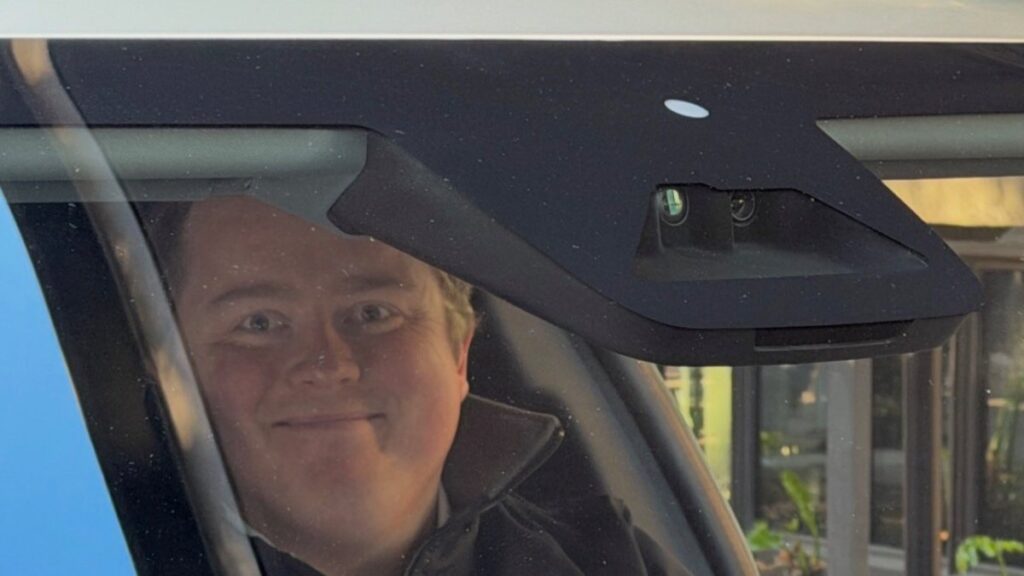
Tesla is on the brink of launching its autonomous ride-hailing fleet, and recent sightings of the Cybercab have revealed significant hardware upgrades. Spotted in Austin, the latest production units feature larger front-facing cameras and ambient lighting, sparking excitement and speculation within the community.
Images shared by @DavidMoss on X highlight a robust camera housing behind the windshield, suggesting Tesla might be testing a new Full Self-Driving (FSD) hardware package. This could potentially be a precursor to the anticipated AI5 (Hardware 5), although mass production of this next-generation computer isn’t expected until mid-2027. The larger lenses indicate an upgrade in optical sensors, crucial for a vehicle designed to operate without a steering wheel or pedals.
New Hardware and Interior Refinements
Beyond the enhanced front cameras, the Cybercab’s hardware evolution includes several other notable changes. A unit displayed at the USDOT Headquarters in Washington, D.C., showcased a massive cabin camera and, for the first time, an interior trunk camera. This rear-facing sensor aims to ensure passengers don’t leave belongings behind after their ride.
The Cybercab’s interior has been refined for durability, with the original carpeted storage trunk replaced by a rugged, non-carpeted material. Window control switches and USB-C ports have been relocated under the 21-inch central touchscreen, a shift from their previous position near the cupholders. The cabin remains minimalist, featuring only an emergency stop button with Braille above the screen.
Ambient Lighting and Wheel Design
Adding a touch of luxury, Tesla has introduced thin strips of ambient lighting in the doorframes, emitting a soft blue glow. This not only enhances the aesthetic but also provides functional illumination for passengers at night, a critical feature for a 24/7 ride-hailing service.
The Cybercab also sports a staggered wheel setup, with larger and wider rear tires to manage the torque of its electric drivetrain. The front features 215/60R/18 tires, while the rear boasts 225/60R/21 tires, all wrapped in Continental aContact rubber with aerodynamic hubcaps.
Built for a Driverless Future
Designed as a two-seat electric vehicle, the Cybercab is set to be the backbone of Tesla’s Robotaxi network. Equipped with a high-pressure washer system for each external camera, the vehicle ensures clear visibility for its FSD hardware, even in adverse weather conditions.
While early units were seen without traditional controls, Tesla has indicated that some models might initially ship with steering wheels to comply with regional regulations. However, the ultimate vision remains a completely wireless, steering wheel-less experience. Tesla’s recent FCC approval for Ultra Wideband (UWB) technology will support the vehicle’s planned wireless induction charging system.
Production Timeline and Future Implications
Tesla is rapidly transitioning from a traditional automaker to an AI powerhouse. The first production Cybercab unit has rolled off the line at Giga Texas, with mass production slated to begin in April. These hardware tweaks underscore Tesla’s commitment to the reliability of its “unsupervised” vision, marking a significant step toward a driverless future.
As the production target approaches, Tesla’s advancements in autonomous technology are poised to redefine urban mobility. The company’s focus on high-fidelity sensors and durable design elements highlights its readiness to lead the transition to a driverless society.
With assembly lines set to start moving in just a few weeks, Tesla’s Cybercab is not just a glimpse into the future of transportation—it’s a tangible step toward making that future a reality.