



On November 8, 2000, a significant encounter took place in London that would revisit one of history’s most enigmatic chapters. The occasion was a dinner hosted by philosopher Tony Quinton at Brooks’s, a prestigious club in St James’s. The guest of honor was historian Hugh Trevor-Roper, known as Lord Dacre of Glanton, who was eager to discuss the enduring relevance of his seminal work, The Last Days of Hitler.
As fate would have it, I had recently returned from a research trip to Moscow, delving into the archives on the Nazi downfall in Berlin. This fortuitous timing allowed me to engage with Trevor-Roper on the very subject he had meticulously documented decades earlier. His book, a cornerstone of historical literature, was born from an unusual directive given to him in 1945 while attached to British counter-intelligence in Berlin.
The Origins of Trevor-Roper’s Investigation
The genesis of Trevor-Roper’s investigation into Hitler’s death was a directive from Brigadier Dick White in September 1945. At the time, Soviet propaganda, under Stalin’s orders, claimed that Hitler had escaped Berlin and was hiding in Bavaria. With no documents available from the Red Army, Trevor-Roper relied on interviews with captured German officers who had been in the Führerbunker during Hitler’s final days.
Among his sources was Major Bernd Freytag Freiherr von Loringhoven, whose testimony proved invaluable. Despite the challenges, Trevor-Roper’s work debunked wild theories circulating at the time, which claimed Hitler had escaped by air or submarine. In reality, Stalin was well aware of Hitler’s fate.
Secret Soviet Operations and the Discovery of Hitler’s Remains
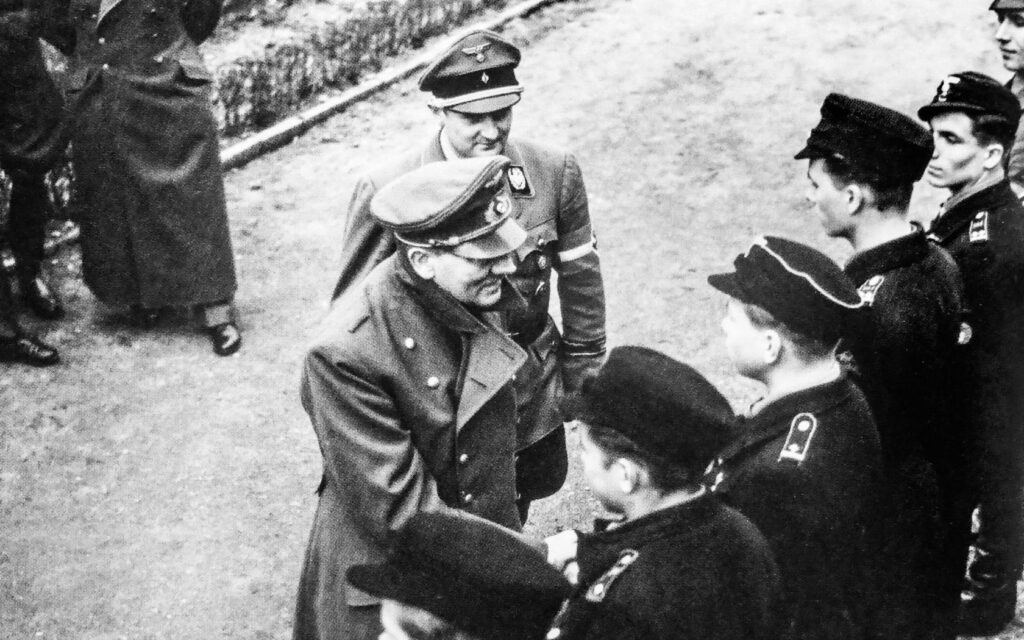
On April 29, 1945, while Hitler was still alive, a clandestine operation was orchestrated by Lavrenti Beria and Viktor Abakumov to deceive even Marshal Zhukov, the Soviet commander-in-chief. SMERSh, the Soviet counter-intelligence agency, was dispatched to the Reich Chancellery, securing the site before other Soviet forces could enter. The discovery of two charred corpses, identified as Joseph Goebbels and his wife Magda, marked the beginning of a grim revelation.
It wasn’t until May 5 that Hitler’s body, alongside Eva Braun’s, was found in a shell-hole. The bodies were smuggled out for examination, with Hitler’s jaw removed for dental verification. The secrecy surrounding these events was intense, with even Marshal Zhukov kept in the dark until two decades later.
Trevor-Roper’s Insights and the Russian Narrative
Trevor-Roper’s investigation was marked by skepticism towards the Soviet narrative. He suspected the Russians were hiding something, as they used Hitler’s supposed escape to criticize the Western Allies. Stalin’s obsession with understanding Hitler’s psychological grip on Germany fueled this secrecy. Albert Speer, Hitler’s architect, noted,
“The nation was spellbound by him, as a people has rarely been in the whole of history.”
Trevor-Roper’s portrayal of the final days in Berlin went beyond mere documentation. He vividly described the chaotic atmosphere and the personalities within Hitler’s circle. His analysis of Hitler’s decision to commit suicide was particularly astute, linking it to the betrayal by Heinrich Himmler.
Legacy and New Revelations
Despite some minor inaccuracies, such as the date of Hitler’s body’s exhumation, Trevor-Roper’s work remains a critical historical resource. The brief period of openness in the 1990s allowed researchers to access Russian archives, shedding new light on the events of 1945. Recent analyses, including a study of Hitler’s blood, suggest he may have suffered from Kallmann syndrome, potentially influencing his psychological profile.
These revelations prompt a broader question about the nature of evil and accountability. As historians continue to explore the past, they grapple with complex moral questions about the interplay between genetic predispositions and historical actions. Perhaps these are questions best addressed by philosophers like Tony Quinton, as we navigate the evolving landscape of historical understanding.