




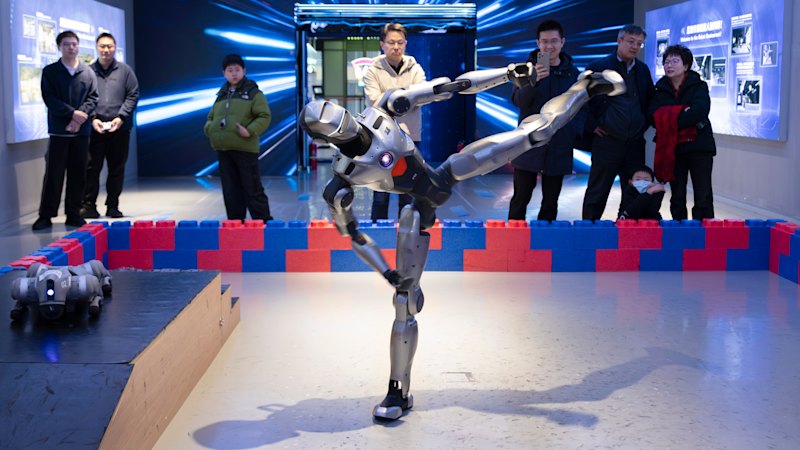
Beijing, March 14, 2026 — In the bustling tech district of Beijing, a new era of innovation is unfolding. Humanoid robots are not just a vision of the future; they are a reality, performing tasks from playing soccer to brewing coffee. This remarkable display takes place at the “Robot Mall,” a pioneering store that opened last year, marking a significant milestone in China’s journey to become a leader in artificial intelligence and advanced manufacturing.
The Robot Mall is more than just a novelty; it embodies China’s strategic ambitions to close the gap between gimmickry and genuine technological advancement. As the nation races to outpace the United States in AI development, the store serves as a tangible representation of this high-stakes competition.
Robots in Everyday Life
Among the many attractions at the Robot Mall is the Xbox Coffee Robot, a state-of-the-art machine that can brew a latte with your face etched in the foam. Priced at 359,000 yuan ($73,500), it symbolizes the premium cost of embracing futuristic technology. Another standout is an interactive lady bot designed by UBTech, intended for roles as diverse as AI receptionists and companions for the elderly, despite occasional technical hitches.
While these innovations come with hefty price tags, the long-term vision is clear: replacing humans in mundane and complex tasks could lead to significant payroll savings and efficiency gains for companies. However, this technological leap raises questions about the social implications of job displacement in an already fragile employment market.
China’s AI Ambitions
President Xi Jinping has framed the pursuit of AI supremacy as a national mission, integral to a new economic growth model. The latest five-year economic plan, recently approved by China’s ceremonial parliament, underscores this commitment by mentioning AI over 50 times. The plan includes an “AI plus” action strategy aiming for tech integration across 70% of key sectors by 2027.
The Chinese government is investing heavily in robotics, with a 1 trillion yuan fund dedicated to supporting high-tech start-ups over the next two decades. According to the International Federation of Robotics, China already has around 2 million robots in operation, installing more annually than the rest of the world combined.
The Challenges Ahead
Despite these advancements, the commercial viability of humanoid robots remains uncertain. Their current limitations in sophistication and dexterity mean they are not yet practical for household chores like laundry or dishwashing. Moreover, the robotics industry could face the same over-competition issues that have plagued sectors like electric vehicles, potentially leading to unsustainable “zombie” start-ups.
“Humanoid robotics could absolutely follow a similar trajectory,” says Lizzi C. Lee, a fellow on the Chinese economy at the Asia Society Policy Institute. “Many companies are betting that these machines will eventually play roles in logistics, elder care, manufacturing, and service industries – but the timelines and economics are still very speculative.”
In November, China’s top economic body cautioned against a potential bubble in the humanoid robotics sector, which already boasts over 150 start-ups.
The Future of Robotics
Back at the Robot Mall, innovation leans heavily towards entertainment, with robots like Xiao Bai, a red robotic dog that can perform tricks and interact with children. However, the potential for these technologies to be repurposed for military or surveillance applications is a growing concern. In 2024, China’s military demonstrated a robot dog equipped with an automatic weapon, highlighting the dual-use nature of such technologies.
As Beijing navigates these complex challenges, the city remains at the forefront of a technological revolution that could redefine the global landscape. The implications of this shift are profound, with potential impacts on everything from economic growth to societal norms.
Looking ahead, the key question for China will be how to balance the rapid advancement of AI and robotics with the social and economic realities of its population. As the world watches, Beijing’s experiment with the future continues to unfold, offering both opportunities and challenges in equal measure.