




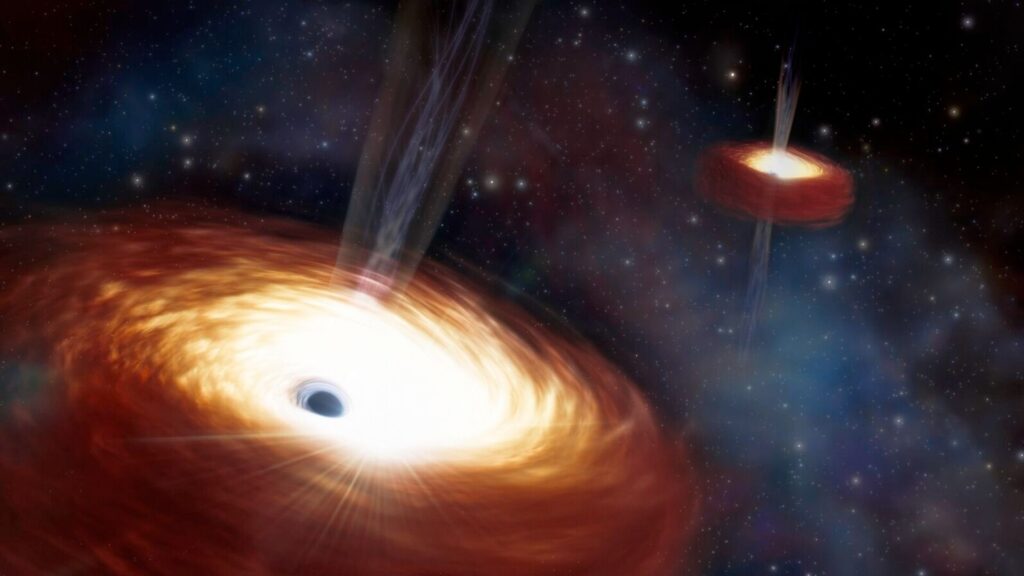
A groundbreaking study published in Nature Astronomy has revealed that the dense environments surrounding supermassive black hole binaries contain approximately a million solar masses within each cubic parsec. This discovery was made possible through the use of gravitational-wave data collected by pulsar timing arrays, offering a new glimpse into galactic centers that have been impossible to observe directly until now.
Pulsar timing arrays (PTAs) employ precise measurements of timing residuals from millisecond pulsars to detect gravitational waves at nanohertz frequencies. These arrays have uncovered a stochastic gravitational-wave background, an incoherent hum produced by countless supermassive black hole binaries spiraling together across the universe. However, the signal comes with a peculiar twist: at the lowest frequencies, the spectrum deviates from predictions for binaries evolving purely under gravitational-wave emission. This suggests that environmental factors or highly eccentric orbits are influencing how these massive binaries lose energy and tighten over time.
Gravitational Wave Background and Cosmic Clocks
The gravitational-wave background is a faint, persistent signal created by the superposition of gravitational waves from numerous sources across the cosmos. This background, detected by PTAs, originates from a population of supermassive black hole binaries, which are pairs of black holes with masses millions to billions of times that of the sun, formed when galaxies merge. As these binaries spiral inward over millions of years, they emit gravitational waves that accumulate into a detectable signal across the universe.
PTAs utilize networks of rapidly rotating neutron stars, known as millisecond pulsars, which emit radio pulses with extraordinary regularity, acting as cosmic clocks spread across the galaxy. By monitoring deviations in the arrival times of these pulses, researchers can detect the stretching and squeezing of spacetime caused by passing gravitational waves. Unlike ground-based detectors like LIGO, which observe stellar-mass black holes merging in fractions of a second, pulsar timing arrays are sensitive to much lower frequencies.
“For ground-based detectors like LIGO, this is difficult because they observe black holes at very late stages, where gravitational waves completely dominate the evolution,” explained Dr. Yifan Chen, associate professor at Shanghai Jiao Tong University. “In contrast, PTAs observe supermassive black hole binaries at much earlier stages, when environmental effects in galactic centers can still play an important role.”
Three-Body Slingshots and the Spectral Bend
The team behind the study modeled the prime suspect for the observed spectral bend: gravitational three-body slingshots. This process involves stars or dark matter particles surrounding a black hole binary getting ejected through repeated gravitational encounters, extracting orbital energy in the process. Dr. Chen provided an accessible explanation of the physics:
“A helpful way to understand this is to start with a simpler situation. Imagine a single black hole moving through a cloud of much lighter particles, such as gas, stars, or dark matter. In the black hole’s frame of reference, these particles tend to flow past it in the opposite direction to its motion. Through gravity, the black hole can fling these particles away slightly faster, and in doing so, it loses a bit of its own energy and slows down.”
When two black holes orbit each other, the process becomes far more efficient. A particle can bounce between both black holes multiple times before being ejected, extracting significantly more energy from the binary’s orbit than ordinary two-body dynamical friction. In realistic galactic centers, matter builds up around each supermassive black hole before the binary forms. Once the black holes get close enough, these three-body slingshot interactions efficiently eject this surrounding material outward, causing the black holes to spiral together faster and gradually smoothing out the dense material near the center.
Probing Galactic Cores
By comparing their model predictions to the NANOGrav 15-year dataset, the team constrained the parsec-scale density in galactic centers. The analysis favors a density of around 106 solar masses per cubic parsec, with a preference for relatively flat, “core-like” density profiles rather than steep concentrations.
“The density range favored by our analysis is broadly consistent with what we already know from electromagnetic observations of the two closest galactic centers we can study in detail: the Milky Way and the nearby galaxy M87,” Chen said. “This agreement is encouraging because it suggests that the environmental effects inferred from gravitational waves are realistic rather than exotic.”
Specifically, the stellar distributions in the Milky Way’s nuclear cluster and M87’s stellar core fall naturally within the best-fitting region. Interestingly, steep dark matter “spikes”—hypothetical concentrations formed by black holes growing within pre-existing dark matter halos—are disfavored by the data. The analysis does reveal some degeneracy between initial orbital eccentricity and environmental density.
“We find that eccentricity can partly mimic the effect of a dense environment, creating a degeneracy between these two factors in the gravitational wave signal,” Chen explained. “However, to explain the observed low-frequency feature using eccentricity alone would require extremely high initial eccentricities, which are unlikely for most systems.”
Future Work and Implications
Looking ahead, Dr. Chen emphasized the importance of more sensitive observations. “The priority is to confirm and better measure the low-frequency feature in the gravitational-wave background using more sensitive data. This will become possible as pulsar timing array observations continue to accumulate longer datasets, especially with new contributions from powerful radio telescopes such as China’s FAST after more than a decade of observations.”
Future facilities like the Square Kilometer Array and next-generation astrometry missions promise sharper spectral measurements to break the eccentricity-density degeneracy. Combined with electromagnetic observations of individual binaries, gravitational waves could distinguish stars from dark matter dominance and test exotic models like wave-like or self-interacting dark matter.
This technique shows that the cosmic hum from merging supermassive black holes carries information not just about the mergers, but about the hidden galactic environments shaping them. As research continues, these findings could significantly enhance our understanding of the universe’s most enigmatic regions.