




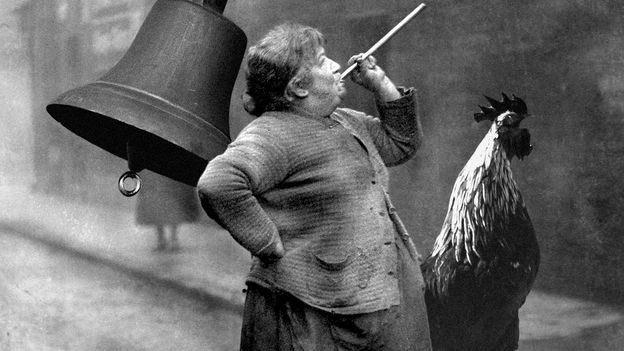
From candles that dropped metal pins every hour to the knocker uppers of industrial Britain, people throughout history devised numerous ingenious methods to ensure a timely wake-up. During Britain’s industrial revolution, the burgeoning factories necessitated strict timekeeping, with precise start times for workers becoming essential.
A worker arriving even five minutes late could halt an entire assembly line, impacting profits significantly. This urgency for punctuality was particularly pressing during the darker winter months. Although early alarm clocks existed, they were prohibitively expensive for the average worker. Factories experimented with whistles and bells to rouse workers, but these often proved unreliable. Consequently, a unique profession emerged: the knocker uppers.
The Rise of Knocker Uppers
These human alarm clocks traversed streets and neighborhoods, knocking or tapping on windows, or even shooting peas at them. Arunima Datta, an associate professor of history at the University of North Texas, explains, “They would stand there until they got a response from their clients, they wouldn’t move.” This profession wasn’t exclusive to Britain; similar roles existed in various societies, particularly in Muslim communities during Ramadan, when early wake-ups for prayer and meals were necessary.
Throughout history, people have employed inventive wake-up methods, from keeping roosters to using clever candle clocks that dropped needles into metal trays hourly. Understanding these historical practices might even offer insights into improving our sleep and wake-up routines today.
Natural Cues and Technological Innovations
Before personal alarm clocks became commonplace, people often relied on natural cues and daily routines. Fatima Yaqoot, a professor of sleep health at the University of the Sunshine Coast in Australia, notes, “Daylight was one of the main signals. In many pre-industrial societies, daily life followed the rhythm of sunrise and sunset, which naturally shaped circadian rhythms.”
Circadian rhythms, along with sleep pressure, dictate our sleep and waking patterns. Sasha Handley, a professor of history at the University of Manchester, cautions against assuming pre-industrial societies solely followed natural light patterns. “People’s labor extended well into the night, sometimes into the early hours, depending on tasks that needed completion at specific times of the year,” she explains.
“I would steer away from the typical story that everyone in the pre-industrial world just went by the patterns of light and darkness.” – Sasha Handley
Religious and Social Motivations
Religious motivations also played a significant role in timekeeping. People kept devices near their beds to wake up for prayers or church services, often competing to be the earliest riser. The preindustrial biphasic sleep pattern of two nightly sleeps is a popular concept, though its evidence is debated. Many cultures still practice polyphasic sleep cycles today.
Roosters and the dawn chorus served as early auditory alarms. Handley notes that rooster crowing aligns with their circadian rhythm, not just light. Bells were another widespread waking signal, particularly in medieval and early modern Europe, where church bells organized daily life.
Early Alarm Clocks and Technological Progress
Ancient alarm clocks existed, albeit in different forms. Handley describes water or flame-triggered devices that awakened individuals. Candle clocks date back to Ancient China, where nails would fall into trays hourly. Incense was also used in China for timekeeping, with metal balls acting as gongs.
Water clocks, or clepsydra, were common in Ancient Greece, with Plato credited for adapting one into an alarm. Mechanical clocks arrived in the 13th and 14th centuries, with domestic wall clocks featuring alarms by the 15th century.
“From very early they sometimes played tunes before the ringing of bells.” – Matthew Champion
The Industrial Revolution’s Impact
Clockmaking advanced in the 17th century, with evidence of people creating portable alarm clocks for travel. The first mechanical alarm clock was invented in 1787, but widespread production only began after a patent in 1876. However, these clocks were unreliable and costly for most people.
During the industrial revolution, sleep requirements changed, and knocker uppers became prevalent in industrial towns. They often began waking people at 3 a.m., sometimes discovering fires or other emergencies during their rounds.
The Decline of Knocker Uppers and Modern Implications
By the 1920s, the knocker upper profession faded as alarm clocks became affordable and commonplace. Yaqoot notes, “Personal alarm clocks became widely used in the late 19th and early 20th centuries, closely following industrialization and artificial light adoption.”
Handley highlights the historical emphasis on regular sleep patterns, a principle rooted in ancient medical literature. Modern research supports the health benefits of consistent sleep schedules and good sleep hygiene practices, such as creating a conducive bedroom environment and avoiding stimulants before bed.
“These are just the daily habits that have been really closely connected to sleep patterns for centuries and centuries that we seem to have forgotten a bit about in recent times.” – Sasha Handley
For trusted insights on health and wellbeing, sign up for the Health Fix newsletter by senior health correspondent Melissa Hogenboom, who also writes the Live Well For Longer and Six Steps to Calm courses.
For more science, technology, environment, and health stories, follow us on Facebook and Instagram.