


March 9, 2026 — 5:00am
One of the most photographed sights in Italy’s Tuscan city of Livorno is its striking 1920s promenade, Terrazza Mascagni, where more than 30,000 pavers stretch along the seafront in chequerboard style. The tiles may be black and white but, politically, Livorno is red. It is, I learn upon my arrival, the birthplace of the country’s communist party. And, although most travellers skip through Livorno en route to Pisa or Florence, Livorno, I discover, is an unexpected delight best explored on foot.
I disembark the cruise ship, Norwegian Viva, near the imposing Old Fortress of Livorno built by Tuscany’s ruling Medici family. The family was also responsible for my first stop: the Medici Port that was constructed in the 16th century to promote the trade of fabrics, spices, and goods from around the world. Although only remnants of the original walls remain, it’s easy to conjure the port’s historic hustle and bustle.
The Historical Pulse of Livorno
Livorno’s flourishing trade was thanks to the Grand Duke of Tuscany, Ferdinando I de Medici, who designated this as a “free port” to attract merchants from any nation. Under “Livornine” laws they were granted religious freedom and tax breaks. Traders from across the globe swarmed in, including Greeks, Dutch-Germans, French, English, and Armenians, plus a large Jewish community. Today, as locals attest, this open attitude continues. As one of few foreigners in town, everybody I encounter is ready to chat or assist me.
Nowhere better displays the background to the city’s tolerance and its diverse communities than the City Museum of Livorno. Housed within the Bottini dell’Olio building, a former 18th-century oil depot, exhibits cover the history of Livorno from the 13th to the 19th century, as well as the Risorgimento, the era during which Italy unified as an independent nation. It was during this time, though, that Livorno lost its status as a free port.
A City of Canals and Cuisine
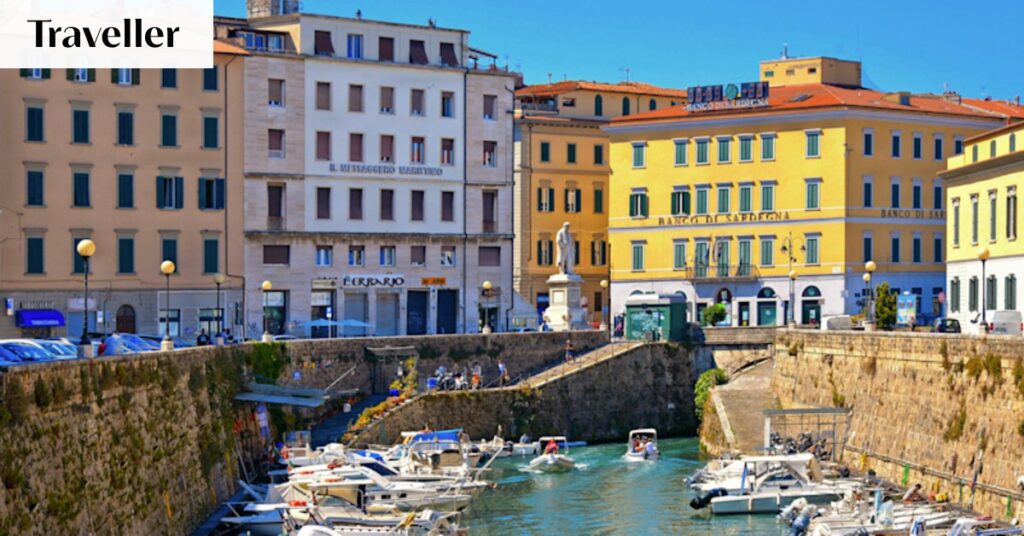
Nearby I discover a maze of canals, the Fossi Medicei, in the New Venice district. The waterways follow the original pentagonal shape of the defense moats that, from the late-16th century, surrounded the city’s new fort. These days, organized boat trips navigate the route though there’s no sign of them today as I’m here at the end of the season.
Locals say that the district comes alive in the evening when bars are open. And it’s here, at the waterside cafes, that you’ll find the local specialty cacciucco, a hearty seafood soup-cum-stew comprising five different fish (one for each “c”) plus tomato and garlicky bread.
Architectural Wonders and Local Delights
Tragically, much of Livorno was destroyed during World War II. For me, the most striking aspects of the city today are the patterned pavements and the architectural surprise that is the central market, Mercato delle Vettovaglie. Dating from 1894, topped by a steel-and-glass roof and trussed with floral metal, the market is one of few surviving art nouveau/neoclassical buildings. It’s a massive space filled with everything from olive sellers to local bakeries.
A mere three blocks south-west is the synagogue built in 1962 in a modernist style with hexagonal windows that was designed by architect Angelo di Castro. I admire the exterior before heading to the main cathedral, where there’s a small painting, Christ Crowned by Thorns, by Renaissance artist, Beato (Fra) Angelico.
But the prize for Livorno’s most quirky item goes to a local bite. At Gagarin, a small, casual spot on Via del Cardinale, customers rave about Livorno’s cinque e cinque (“five ’n five”). Essentially a sandwich, it comprises focaccia filled with a slice of an oven-baked chickpea “pancake” (torta di ceci) and eggplant, if desired. Its name stems from the fact that customers would request both bread and filling, each of which cost five centesimi (the subunits of the former Italian lira). It’s warm, unconventional, and surprisingly satisfying.
The Future of Livorno
Just like the city of Livorno itself, this dish represents a blend of tradition and innovation, a testament to the city’s enduring spirit and its ability to adapt and thrive. As Livorno continues to attract visitors with its unique charm, its history and culture remain at the heart of its identity.
The writer was a guest of Norwegian Cruise Line.