

BEIRUT/MIAMI/TEL AVIV/DUBAI — In a stark declaration aboard Air Force One, US President Donald Trump announced that he is not open to negotiating with Iran, suggesting that the ongoing conflict in the Middle East may only cease when Tehran’s military capabilities and leadership are completely dismantled. This statement comes amid escalating tensions and military actions that have already plunged the region into chaos and disrupted global oil markets.
Shortly after Trump’s remarks, Israel, a key US ally, launched new strikes across Iran early Sunday, intensifying a conflict that is now entering its second week. The strikes and the rhetoric underscore the fraught geopolitical landscape as both nations assert aggressive stances.
Allegations and Military Actions
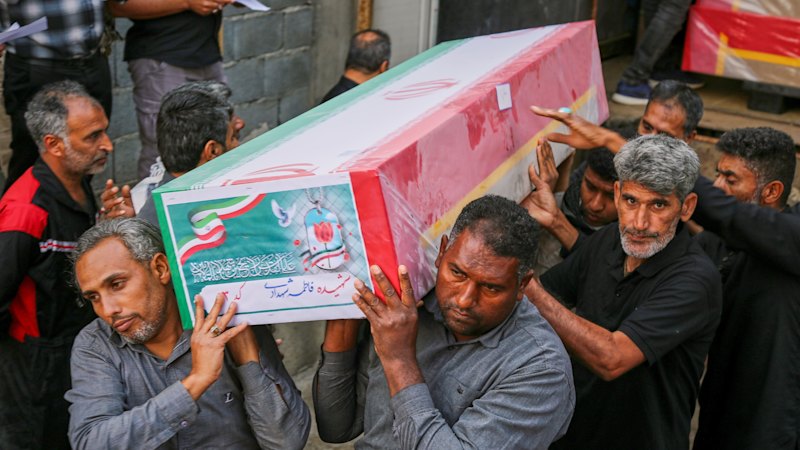
President Trump accused Tehran of being responsible for last week’s devastating airstrike on a girls’ school in Iran, which resulted in the deaths of over 165 people, predominantly children. However, this claim stands in contrast to satellite images and analyses from experts, as well as statements from US and Israeli military officials, which suggest that the explosion was likely caused by US airstrikes targeting a nearby Revolutionary Guard compound.
“No, in my opinion, based on what I’ve seen, that was done by Iran,” Trump told reporters, dismissing the evidence presented by independent sources.
Defense Secretary Pete Hegseth, who was present with Trump, noted that the incident was still under investigation. Yet, Trump interjected, asserting, “We think it was done by Iran because they’re very inaccurate, as you know, with their munitions.”
Strategic Considerations and Regional Reactions
The US-Israeli military operations have been justified by Trump as necessary to neutralize an imminent threat posed by Iran, which is allegedly nearing the capability to develop a nuclear weapon. Discussions between the US and Israel have included the potential deployment of special forces to secure Iran’s enriched uranium stockpiles as the conflict progresses, according to sources cited by Axios.
Meanwhile, the conflict’s ripple effects are being felt across the region. Saudi Arabia, Kuwait, the United Arab Emirates, and Bahrain have reported Iranian drone attacks, with significant damage occurring, such as a massive fire in a Kuwaiti government office block. Additionally, an explosion at the US embassy in Oslo, Norway, caused minor damage, though the cause remains unclear.
Saudi Arabia has warned Tehran that continued aggression could provoke a retaliatory response, insiders told Reuters.
Iran’s Political Landscape and International Dynamics
In an attempt to ease tensions, Iran’s president issued an apology to neighboring states for attacks on US facilities within their borders, while dismissing Trump’s demand for unconditional surrender as “a dream.” The president indicated that Iran’s temporary leadership council had agreed to halt attacks on nearby states unless provoked from their territories.
Iran’s internal political scene is also in flux, with the clerical body responsible for selecting a new supreme leader potentially convening soon to choose a successor to Ayatollah Ali Khamenei, who was killed in an attack last week. According to Iranian media, a consensus on the successor is nearing completion.
Casualties and Global Implications
The conflict has resulted in significant casualties, with Iran reporting over 1,332 civilian deaths and thousands injured due to US-Israeli attacks. Conversely, Iranian strikes have claimed 10 Israeli lives and six American service members, whose remains were recently repatriated to the US.
As the violence spreads, Israel has issued a stern warning to Lebanon regarding Hezbollah militants, threatening severe consequences if the group is not restrained. Israeli military actions in Lebanon have already resulted in approximately 300 deaths.
Trump criticized the UK’s delayed military response, stating, “We don’t need people that join Wars after we’ve already won!”
These developments highlight the complex and volatile nature of the Middle East conflict, with significant implications for international relations and global security. As the situation unfolds, the world watches closely, anticipating further escalations or potential diplomatic resolutions.