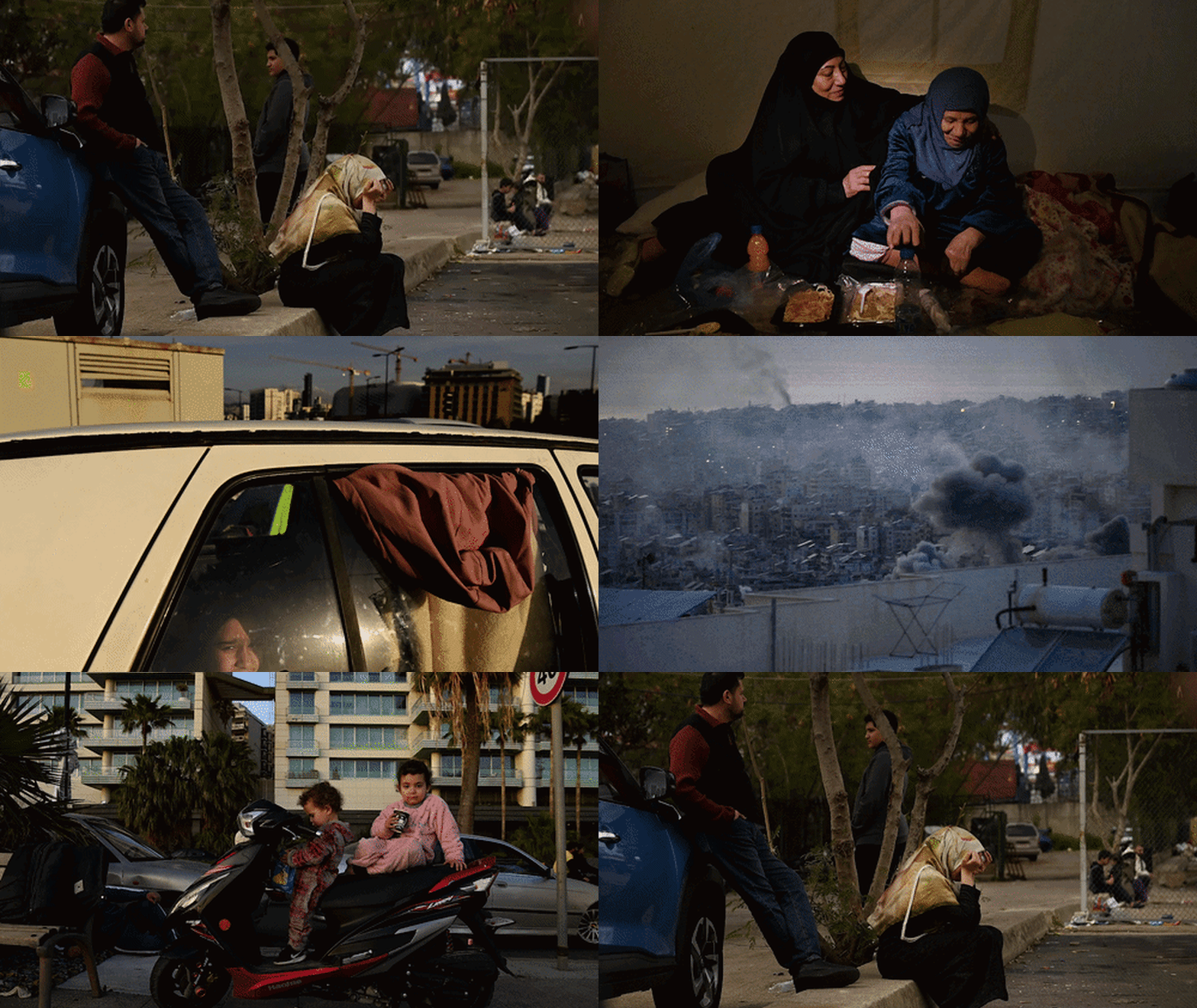
As the conflict between Hezbollah and Israel intensifies, families in Beirut find themselves caught in the crossfire, seeking refuge in makeshift shelters across the city. Displaced from their homes, many have taken to the streets, schools, and docks, highlighting the dire humanitarian situation unfolding in Lebanon.
Among those affected is Kamakian, a member of the Armenian community in Lebanon, who has witnessed the growing unrest firsthand. “They’ve left their homes. They had to drive around for hours on a road where it usually takes one or two hours to drive. They have nothing. They are uncomfortable. They have their kids to look after, and they have no work, nothing,” she explains. “This is not a world that they chose. And there is a high risk that they will never be able to return back home.”
Community Resilience Amid Sectarian Tensions
Kamakian, whose family has lived in Lebanon for generations, emphasizes the community’s unity beyond sectarian lines. “I don’t see the differences between the ethnic groups,” she says. “Most Lebanese don’t see the difference between Christian, Muslim, Shiite or whatever you want to call it – they’re just the political ways of manipulating people.”
However, for others, religious identity remains central to their response to the conflict. Hind al Harakeh, sheltering near the Beirut docks, states, “Death has been imposed on us. The enemy has destroyed our homes.” She believes in the right to resist, asserting, “Anyone who is under repression has the right to resist.”
Political and Military Standoff
The conflict has escalated following Israeli Prime Minister Benjamin Netanyahu’s vow to continue attacks on Hezbollah, demanding the Lebanese government disarm the group. “If you do not do this, Hezbollah’s aggression will have disastrous consequences for Lebanon,” Netanyahu warned in a broadcast.
Lebanon’s government is divided on the issue. Prime Minister Nawaf Salam has declared that Hezbollah must function solely as a political entity, banning its military activities. Meanwhile, Justice Minister Adel Nassar is reportedly considering legal action against Hezbollah’s leadership to enforce this ban.
“The conditions are set for a confrontation between the government and the militant group.”
Public Sentiment and International Implications
Public sentiment in Lebanon is mixed, with some blaming external forces for the conflict. Nada Izeddine, a mother at the Beirut docks shelter, criticizes international leaders, saying, “Trump is a crazy man, and he’s just taking advantage of his position – he doesn’t care about any of the people.” She defends Hezbollah’s actions as self-defense, questioning, “If someone came and attacked you, beat you, took your property, hurt your family or others, what would you do?”
The ongoing conflict has broader implications for the Middle East, with US and Israeli strikes on Tehran prompting Iranian retaliation across the region. In Lebanon, the risk of a humanitarian crisis looms large as the conflict widens.
Historical Context and Future Prospects
For some, like Ibrahim Al Haj Mohammad, the current conflict is reminiscent of past wars. Having lived through Lebanon’s civil war, he sees the latest violence as a continuation of unresolved issues. “It’s a series of wars, and it’s been running for years, and it’s not showing any results,” he reflects. “It is a shame, what is happening to the people of Lebanon, and even to those on the other side.”
Mohammad, a Palestinian born in Lebanon, believes that the solution lies in international diplomacy. “The solution is only in the hands of America,” he says. “Whatever they say – it applies.”
As the situation remains volatile, the future of Lebanon hangs in the balance. The international community watches closely, aware that the decisions made in the coming days could shape the region’s stability for years to come.