




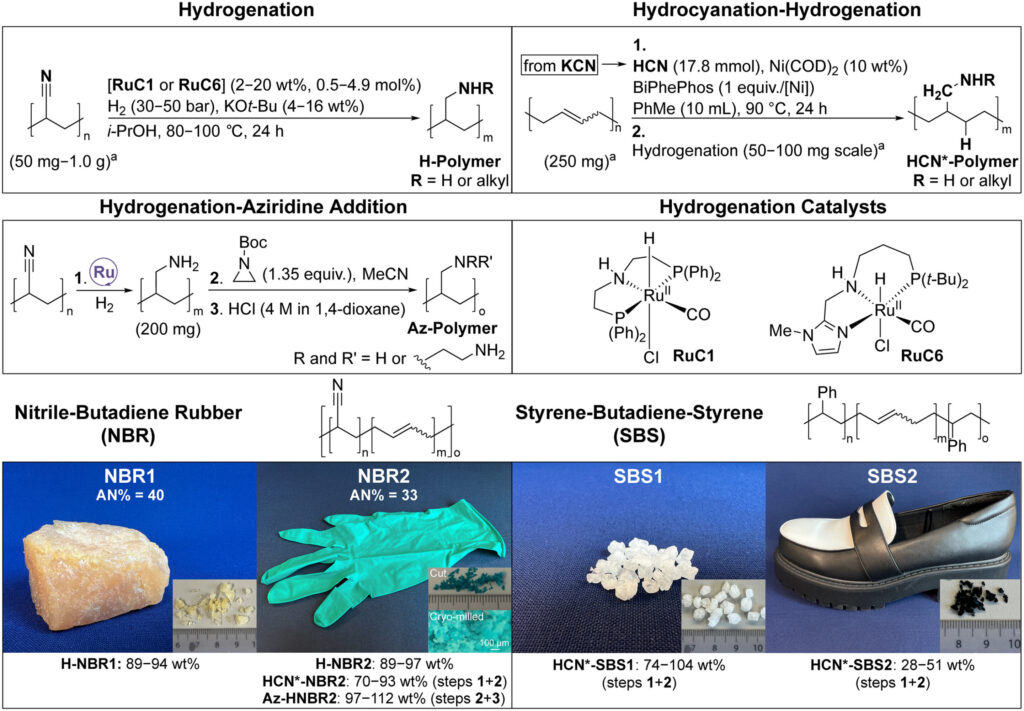
Every year, the global production of nitrile rubber gloves exceeds 100 billion units, predominantly used in the healthcare sector. These gloves, made from synthetic polymers derived from crude oil, are typically discarded after a single use, contributing significantly to material waste worldwide. However, a groundbreaking study led by Simon Kildahl, a postdoctoral researcher at Aarhus University, is paving the way for a novel recycling method. Published in the journal Chem, the research demonstrates how waste rubber can be converted into a CO2 adsorbent, offering a promising solution to a pressing environmental challenge.
“A plastic bottle can be recycled relatively easily, as we know from deposit-return systems. But other plastic materials are problematic because they cannot be reused in the same way. Therefore, they often end up being burned, which is currently the case for rubber gloves,” Kildahl explains. “In our experiments, we converted the glove so that it can capture CO2 instead of becoming a waste product that releases CO2 and other harmful gases during incineration.”
Revolutionizing Waste Management
Kildahl’s research is conducted under the auspices of the Skydstrup Group at the Novo Nordisk Foundation CO2 Research Center (CORC), a global collaboration focused on CO2 capture and conversion technologies. The center, headquartered at Aarhus University, has previously achieved success in recycling challenging materials such as polyurethane foam from mattresses and epoxy and glass fibers from wind turbine blades. The latest breakthrough with rubber gloves marks another milestone in their mission.
How Waste Gloves Become CO2 Traps
The innovative process involves shredding the rubber gloves into small pieces, which then react with a ruthenium-based catalyst and hydrogen gas, enabling them to capture CO2 from simulated flue gas. “In the real world, this could potentially take place at a power plant,” Kildahl notes. Once heated, the rubber product releases the captured CO2, which can then be stored underground or used in Power-to-X applications, while the material itself is refreshed for further CO2 capture.
This method is unique as it repurposes waste material that would otherwise contribute to pollution through incineration or landfill disposal. The approach aligns with the UN Intergovernmental Panel on Climate Change (IPCC) goal of removing 5–16 billion tons of CO2 from the atmosphere annually by 2050.
Climate Potential and Future Directions
To achieve these ambitious targets, CO2 must be captured from biomass incineration plants or directly from the air. Current methods, however, often require increased oil-based production, which diminishes their overall climate benefit. “That is why it is smart to utilize a waste material available in such large quantities, rather than extracting more oil from the ground,” Kildahl emphasizes. “With the rubber glove, we can create a CO2 capture material where almost every atom in the product comes from waste, except for a small amount of hydrogen, which can ideally be obtained from water via Power-to-X.”
Presently, the research is at the laboratory stage, with the goal of scaling up the process to make it economically viable. Kildahl is optimistic about the prospects, noting that the research is at a Technology Readiness Level (TRL) of 3 or 4, on a scale where 9 represents fully implemented commercial technology. “We are working on a gram scale right now, and reactions can look and behave differently when we scale up to kilograms. But our results look very promising,” he says.
Challenges and Economic Viability
One of the primary challenges facing the research is the cost of the catalyst used in the process. Making the method more affordable is crucial for its widespread adoption. Despite this, the potential environmental benefits and the innovative use of waste materials present a compelling case for continued investment and development.
The transformation of rubber gloves into carbon capturers represents a significant step forward in the quest for sustainable waste management and climate change mitigation. As research progresses, the implications for industries reliant on single-use plastics and the broader environmental impact could be profound, offering a glimpse into a future where waste becomes a valuable resource in the fight against climate change.