




Increasing fuel prices are placing significant pressure on Australia’s road transport industry, already grappling with financial challenges. Global oil prices surged over the past week, reaching approximately $US114 a barrel on Monday. This spike is attributed to rising geopolitical tensions in the Middle East, which have disrupted oil shipments through a crucial waterway.
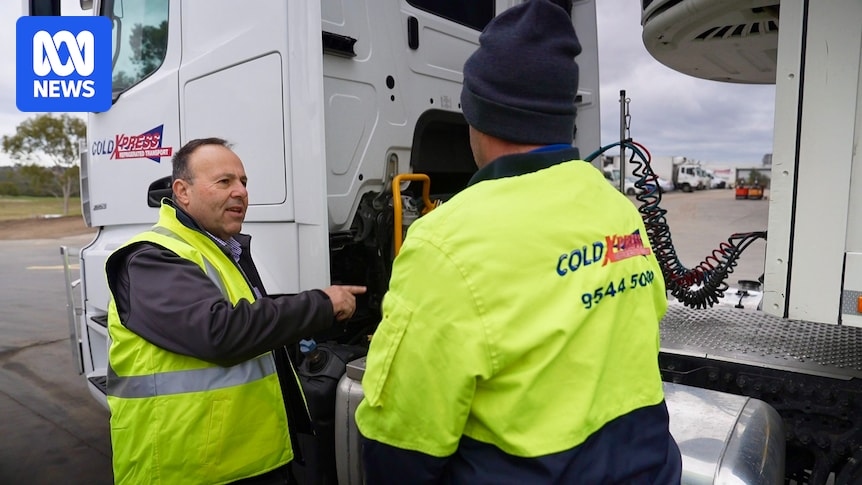
The escalation leaves trucking companies like Cold Xpress in a precarious position, forced to decide between absorbing the increased costs or passing them on to clients. “We can’t absorb the increase,” said John Di-Losa, CEO of Cold Xpress. “We are passing the cost on [to our clients] so it doesn’t impact us … for every 5 cents fuel goes up, we add 1.55 percent to an invoice,” he explained.
Industry Under Pressure
The chief executive of Australia’s Trucking Association, Mathew Munro, emphasized that the industry, already under immense pressure, cannot be expected to absorb these rising fuel costs. “Fuel is typically one of the top three costs for a trucking business. Any increase in fuel prices has a big impact,” he noted. Munro advised trucking businesses to review their costs and, if necessary, engage in open conversations with customers about adjusting fuel levies or rates.
Prior to the recent US-Israeli attacks on Iran, Di-Losa had already implemented multiple changes to ensure his company’s survival. Despite operating up to 180 trucks daily, he noted that profit margins were shrinking. “Every year we’re growing, but the bottom line seems to be shrinking,” he said. “We’re doing everything we can, we’re looking at synergies, we’re into the digital revolution, we use AI now to keep ourselves ahead of the game, but it’s still difficult.”
Financial Strain and Insolvencies
Data from CreditorWatch reveals that last year, one in twelve road transport operators shut down due to rising costs. “They’re under a lot of pressure at the moment,” said CreditorWatch CEO Patrick Coghlan. “We’ve seen a significant increase in the number of insolvencies [and] we’re seeing pressure on those remaining solvent businesses.”
For instance, Ron Couch Transport and Don Watson Transport, both long-standing industry players, went into administration at the end of 2025. Coghlan explained that such closures have widespread impacts. “All the input costs are generally going up, and then you combine that with a reduction in discretionary spend from the consumer,” he said. “So all of a sudden there’s a lot less that needs to actually be delivered.”
CreditorWatch reported a 100 percent increase in trading partners of road freight businesses lodging defaults for non-payment of invoices.
Challenges and Opportunities
Resilience is slim in the road transport industry, with profit margins often less than 3 percent. “Most operators have very limited capacity to absorb increasing costs, particularly when several costs are going up at the same time,” said Phil Bullock, director at NineSquared, a consultancy specializing in transport and freight.
Bullock highlighted systemic issues such as driver shortages and illegal contracting, which exacerbate financial pressures. “The industry is grappling with driver shortages and more recently, concerns around illegal contracting,” he said. “These pressures may drive unsustainable levels of price competition in an already competitive industry.”
The freight and logistics sector is crucial, contributing about 8 percent to Australia’s GDP and moving 90 percent of everyday goods across the country. Bullock warned that pressure on the trucking industry can affect supply chains, impacting prices and availability of goods for businesses and consumers.
Government Response
The federal government has acknowledged the challenges and is working on reforms to address them. A spokesperson stated that efforts are underway to eliminate “sham contracting.” “This includes our Closing Loopholes reforms, which commenced in 2024, making it harder for employers to get away with sham contracting,” they said.
These reforms empower the Fair Work Commission to set enforceable minimum standards for road transport contractors, targeting businesses that use contracting arrangements to undercut pay and conditions. “Under the reforms, employers must prove they reasonably believed a worker was correctly classified as an independent contractor,” the spokesperson added. “These changes help protect workers and ensure fair competition in the industry, and we have begun to see these reforms pay dividends.”
As the industry navigates these turbulent times, stakeholders continue to call for more robust support and strategic interventions to ensure its sustainability and growth.