



Global oil prices have surged past $100 a barrel for the first time since 2022, driven by the escalating conflict involving the United States, Israel, and Iran. The ongoing tensions have resulted in the removal of 20 million barrels of oil from the market daily, leading to fears of a sustained supply crunch.
The weekend saw a dramatic increase in violence in the Middle East, intensifying concerns over oil supply and causing prices to reach their highest level in four years. This surge has also triggered a significant sell-off in stock markets worldwide.
Impact of Middle East Conflict on Oil Supply
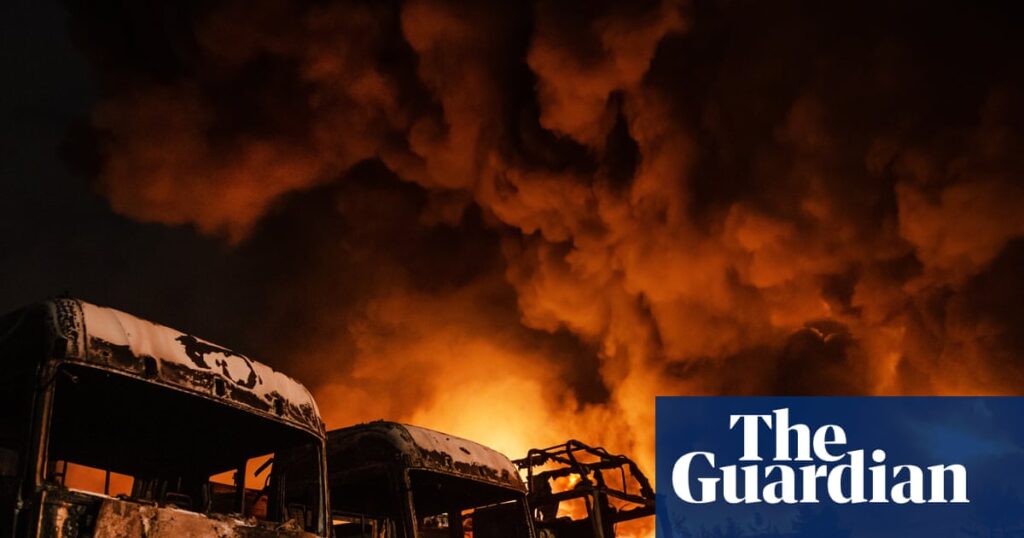
Amid the conflict, at least five energy sites in and around Tehran have been hit by strikes, with reports describing the scenes in the Iranian capital as “apocalyptic.” In response, Kuwait’s national oil company announced a precautionary production cut due to retaliatory attacks by Iran.
The Strait of Hormuz, a crucial trade route through which about a fifth of the world’s oil and seaborne gas tankers pass, has effectively been closed for a week. This closure has further exacerbated fears of a global oil shortage.
Market Reactions and Price Surge
Brent crude, the international benchmark, jumped 16.6% to $108.10 a barrel as trading began in the Asia Pacific markets. This marks the first time prices have surpassed this psychological threshold since Russia’s invasion of Ukraine. Similarly, the West Texas Intermediate (WTI) benchmark for US crude soared by 19.6% to $108.72 per barrel.
“The extraordinary spike in oil prices is a very small price to pay for U.S.A., and World, Safety and Peace,” Donald Trump stated on Sunday, describing it as a “short term” consequence of the US-Israel war on Iran.
The Iranian regime, however, warned that US-Israeli strikes could push prices even higher. A spokesperson for the Revolutionary Guards (IRGC) stated, “If you can tolerate oil at more than $200 per barrel, continue this game,” following the strikes on energy sites.
Global Market Turmoil and Economic Implications
Japan’s Nikkei 225 fell 6.3% in Tokyo during early trading on Monday, setting the stage for another turbulent week for global equity markets. South Korea’s Kospi dropped 5.9%, while Australia’s ASX 200 declined by 3.9% in Sydney. Pre-market trading data indicates Wall Street is also poised to open lower.
Oil prices have returned to triple digits following the highest weekly gains since the COVID-19 pandemic, including a $10 increase in US crude prices on Friday alone. According to Clayton Seigle, a senior fellow at the Center for Strategic and International Studies, “A deficit of 20m barrels per day is hitting global oil market balances with no sign of relief.”
“The grace period given by the market to the Trump administration expired at the end of last week,” Seigle noted. “While observers may have initially thought his disregard for painful oil prices was a bluff, it’s now clear that it isn’t.”
Future Prospects and Strategic Responses
Fears of a global oil shortfall were further compounded by Qatar’s energy minister, who predicted that if the conflict continues, all Gulf energy exporters could be forced to halt production within weeks, potentially driving oil prices to $150 a barrel.
Oil storage facilities in Saudi Arabia, the United Arab Emirates, and Kuwait are nearing capacity, which could necessitate the shutdown of major oilfields if crude cannot be exported through the Strait of Hormuz.
Hundreds of tankers have halted their transit through the strait after threats from Iran’s Revolutionary Guards to “set ablaze” any vessel using the route. This strait is crucial, carrying a fifth of the world’s oil and liquefied natural gas.
Seigle warned that exports from the Middle East would not resume “until shipowners, operators, and insurers feel sufficiently safe from the threat environment posed by Iranian warships and aircraft, missiles, drones, speedboats, and naval mines.”
Strategic Alternatives and Global Responses
The White House has proposed countermeasures such as rerouting Saudi crude via the Red Sea, utilizing emergency US crude reserves, or extending government-backed insurance to shipping companies. However, Seigle noted that these measures would not compensate for the loss of 20 million barrels of oil a day “or anywhere in that ballpark.”
As the situation continues to evolve, the global community remains on high alert, closely monitoring developments in the Middle East and their potential impact on the global oil market and broader economic stability.