



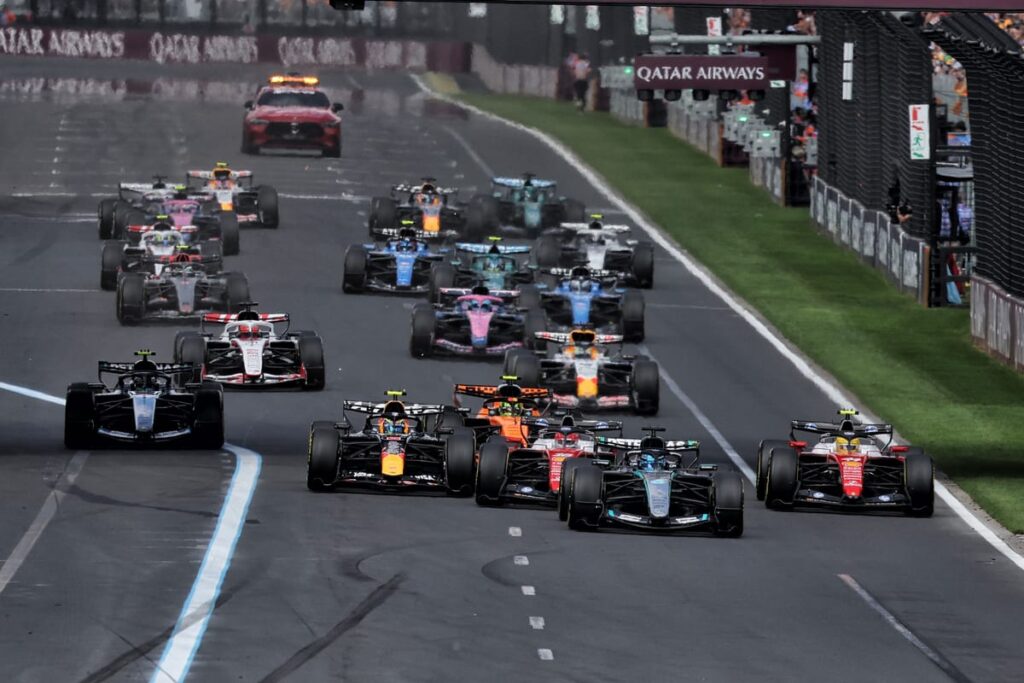
In the wake of the Australian Grand Prix, Formula 1 drivers have raised alarms over significant safety concerns, highlighted by a series of fortunate near-misses. The chaotic start of the race has brought attention to two pressing issues that demand immediate action.
Pre-season testing had already flagged potential discrepancies in race starts, with drivers expressing fears about incidents occurring on the first lap. The complexity stems from the engines’ turbochargers, which need to be spun up to avoid lag between throttle input and power delivery. This requires an extended period of revving just before the start, but the timing is unpredictable due to the new five-second pre-start procedure and the variable hold before the lights go out.
Challenges with Turbo Lag and Starting Lights
Ferrari, with its smaller turbo, has been less affected by these issues, as evidenced by their strong starts during testing and in Melbourne. Charles Leclerc, who launched impressively from fourth to take the lead at Turn 1, criticized the starting lights operator for a brief hold that caught many drivers off guard. “The starting lights operator was being quite cheeky,” Leclerc commented, noting the surprise among drivers.
Compounding the problem, several drivers reported unexpectedly low battery levels after the formation lap. George Russell and Max Verstappen were particularly puzzled by the absence of electric power, which only activates after reaching 50 km/h. This contributed to the varied launches and subsequent phases of the race start.
“At the start I almost had a massive shunt with Liam as he was stuck on the grid,” said Franco Colapinto, narrowly avoiding a catastrophic crash.
Speed Differentials and Safety Risks
Concerns extend beyond the start. Speed differentials on straights, between cars deploying energy and those depleted of it, pose significant risks. Lando Norris warned, “Depending on what people do, you can have a 30, 40, 50 km/h speed differential, and when someone hits someone at that speed, you’re going to fly.”
Such scenarios could lead to severe accidents, potentially involving cars breaching safety barriers. The specter of a “car in the crowd” incident is a grave concern for drivers and teams alike.
Controversial Aero Dynamics and FIA Decisions
Another issue emerged with the active aero settings through the kinked section of the track. Initially, the FIA removed the straight mode zone before FP3, only to reinstate it following backlash from teams. Carlos Sainz described it as “really dangerous,” particularly on the opening lap and during close racing.
Race winner George Russell echoed these concerns, suggesting changes to the straight mode to prevent aggressive reductions in front wing angle. He noted, “It was like my front wing wasn’t working,” advocating for adjustments to improve front grip.
Expert Opinions and Historical Context
The concerns raised are not new to the sport. Historically, F1 has grappled with balancing performance and safety, often revisiting regulations to address emerging issues. According to McLaren team principal Andrea Stella, “There were huge speed differentials on the grid. We can hope for the best or we can just do something further to make sure that we reduce this speed differential.”
“Keep attention on the start because at some stage that will become a problem,” Stella emphasized.
Looking Forward: The Path to Resolution
The incidents in Melbourne underscore the need for swift action. As F1 evolves towards its 2026 regulations, addressing these safety concerns will be paramount. Teams and the FIA must collaborate to refine technical regulations and ensure driver safety is prioritized.
Future discussions are likely to focus on refining turbo lag management, battery deployment strategies, and aerodynamic regulations. The goal is to maintain the sport’s competitive edge while safeguarding the well-being of drivers and spectators alike.
The Australian Grand Prix has served as a stark reminder of the inherent risks in motorsport, prompting a renewed commitment to safety innovations. As the season progresses, the spotlight will remain on how effectively F1 can address these challenges and prevent potential disasters.